Welcome!

Do you have APA formatting questions? Thesis statements got you down? Need to study grammar? Need some help with critical thinking? Having trouble with literary analysis or research? Want to take a look at some example essays? Well, I probably have a post here somewhere that can help you. Please use "Search This Blog," the "Labels," or my "Blog Archive" to help you find what you need. Have questions about what you find? Please feel free to comment or ask questions. I do moderate comments, and I try to respond to all topical questions and comments in a timely manner.

Tuesday, November 26, 2013

Paranormal Reality Television: A Lesson in Critical Thinking

This bit of light seems to be floating in the center of the room.  Is it a ghost?
Ghostly Orb? by spectrefloat
The nature of paranormal research reality television lends itself well to the discussion of critical thinking, and what we should, or should not, believe.


Since the early 2000’s, the number of paranormal reality television shows has skyrocketed. Just to name a few, there’s The Travel Channel’s Ghost Adventures, Biography’s Celebrity Ghost Stories, SyFy’s Ghost Hunters and Ghost Hunters International, A&E’s Paranormal State, and The Discovery Channel’s Ghost Lab. Many of these shows' teams, however, use pseudo-scientific methods to make conclusions, and the producers sometimes forego logic and reason to make for more exciting episodes. Whether or not we believe in ghosts, we can use these shows to our advantage when teaching students good critical thinking skills.


Ghost Hunting or Paranormal Television Assignment 

The format for all of these shows is generally similar, so showing any one of them can help us meet our learning objectives. A team of investigators attempt to gather scientific evidence that either proves or disproves paranormal occurrences, sometimes equivocating on the term “hauntings.” The teams conduct historical research, record audio, video, electric, electromagnetic, or atmospheric changes at a location, interview witnesses, and at times, rely on information given by mediums or psychics. The investigators, among others, claim there is truth behind every piece of evidence gathered while investigating. However, there are thousands of skeptics who make counter claims, daily, and post debunked pieces of evidence all across the Internet. Some teams are even made up of skeptics, or they do not believe in the methods or evidence of other teams.  Just like with all controversial topics, an overabundance of competing evidence can confuse viewers, who may choose, in the face of such uncertainty, passive acceptance over engaged thinking.

Goal of the Paranormal Television Assignment

The main goal of this assignment is to help students realize the power of persuasive techniques used in reality television, which requires a look at the nature of television in general. Paranormal television episodes work well in this context because they use terms directly related to reason, logic, and argumentation. Some of their evidence is extremely convincing, and some of the team members have years of experience as investigators and critical eyes when it comes to their own data. This assignment asks students to think critically while avoiding both dualistic and relativistic thinking; students should not dismiss evidence based on only faith-based value or reality assumptions. Students must study and evaluate the evidence as it has been presented by the team investigators, then choose and support a position on the issue, “Can I believe the conclusions made by this team of paranormal investigators?”

Sample Learning Objectives

Teachers can use this assignment to meet learning objectives from any level of Bloom's Revised Taxonomy.
  • Students will evaluate the authority and credentials of paranormal investigators.
  • Students will identify errors in inductive and deductive reasoning.
  • Students will summarize the role of television in our construction of positions on issues.


Follow-Up and Assessment

After watching an episode of one of the paranormal reality television shows, students should discuss the answers to the following questions in order to help them take a position on the issue, “Can I believe the conclusions made by this team of paranormal investigators?” Faculty can assess the students, during discussion or with written assignments, based on the following basic questions.
  1. Do these investigators have a profession that warrants the title of “expert” in paranormal research or investigation?
  2. Do these investigators have higher education in science or paranormal investigation?
  3. Do these investigators have adequate experience conducting paranormal investigations?
  4. Do these investigators have a vested interest in the results of their investigations? Do these investigators charge money to prove or disprove paranormal activity?
  5. Based on your previous four answers, do you think these investigators are “experts” in the field of paranormal investigation?
  6. What methodology do these investigators use to collect evidence when conducting a paranormal investigation? Do they use representative sampling, scientific experimentation, observation, research, or a combination of techniques?
  7. How does this team define “good evidence?” Do you agree with their definition of “good evidence?”
  8. Are there any errors in reasoning or logical fallacies demonstrated by the team throughout the course of this investigation?
  9. Do you find that the team’s premises support their conclusions?
  10. Do the researchers present inductive arguments as statements of probability, and do they present valid and sound deductive arguments as statements of certainty?
  11. What evidence or information, if any, would you like to have in order to make a better decision about what to believe and what not to believe?
  12. How does the nature of television affect your decision on which position to take on this issue?

Whether or not students are believers in ghosts, demons, or other paranormal phenomena, they need to think critically about the nature of reality television, the rules of true scientific investigation, and the definition of an “expert” when watching paranormal reality television. Thinking critically about television evidence and the nature of television can help viewers make better decisions when it comes to what to believe and what not to believe - no matter the topic.

Have You Tried This Critical Thinking Assignment?

Are you a teacher who has tried this assignment or a student who's completed this assignment?  I'd really love to know what you think.  Please leave a comment!


Copyright Amy Lynn Hess. Contact the author to obtain permission for republication.
Originally published Feb 10, 2012 by Amy Lynn Hess.


Monday, November 18, 2013

Teaching Cultural Diversity through Functional Pottery

Green Diamond Butter Dish by bohlsmargaret


The world over, one thing all people all have in common is the use of functional ware for cooking and serving their cultural cuisine.  The creativity and uniqueness found in such pottery is inspiring, and it is a perfect avenue by which to introduce student potters to a variety of cultures. 

By studying and imitating ware designs from around the world, students can get a muddy, hands-on lesson in cultural diversity.

Functional Pottery and Cultural Diversity


The world over, no matter the culture, one thing people all have in common is the use of functional ware for cooking and serving the food produced and available in that part of the world. The types of foods and recipes served dictate the uses and designs of the wares. Additionally, pottery from around the world is created using native clays, glazes, decorations, and techniques; all the more potential variety for students to research, practice, share, and study.

Learning Objectives in Butter Dishes


The study of butter and the butter dish might be a good starting point for students studying cultural diversity through the creation of functional pottery. Students can determine if butter is used in a culture, or why it may or may not be found on many tables. Students can study cultural design patterns and techniques for types of butter dishes, and they can design their own dishes based on whether or not people from the culture use melted butter, soft butter, hard butter, whipped butter, liquid butter, butter substitutes, large lumps of butter, or butter molded into particular shapes. Students can infer knowledge about the culture by studying the forms and functions of its pottery.

By combining cultural research and technique, teachers can meet any number of learning objectives or course goals from all levels of Bloom's Taxonomy.  For example, students can be asked to sequence the steps required to center a lump of clay on the wheel, summarize their current knowledge of butter dishes or particular cultures, safely use a slab roller in the creation of a butter dish, differentiate between types of butter dishes and their uses or places of origin, produce an imitation of a style of butter dish, and evaluate the functionality of their own finished products.


Pedagogical Requirements


In order to meet the stated learning objectives of the class or unit, teachers must determine the skill levels of their classes, the number of times the classes will meet, and any firing or equipment restrictions the students might encounter along the way. Some requirements for the assignment, however, should include research, planning, the creation of prototypes or test tiles for glazes, and the completion of a finished product per type of butter dish and cultures studied. Requirements that tie the project together can include student presentations, research papers, or a school-wide display of the artwork with statements by the students that include the cultural information, sketches of various designs, or any type of specialized display.

Regardless of where students may live, or where they might come from, the study of functional wares from all over the world can benefit their understanding of other cultures. With careful planning, teachers can use the study of functional pottery to meet cultural diversity learning objectives.

References


The Online Teacher Resource. (n.d.). Blooms Taxonomy Verbs. Retrieved from http://www.teach-nology.com/worksheets/time_savers/bloom/


Copyright Amy Lynn Hess. Contact the author to obtain permission for republication.
Originally published September 28, 2011. 

Wednesday, November 13, 2013

My Dahn Yoga Experience

Dahn Yoga was a type of yoga I hadn't ever heard of, so I decided to give it a chance. After my experience, however, I'll never go back.


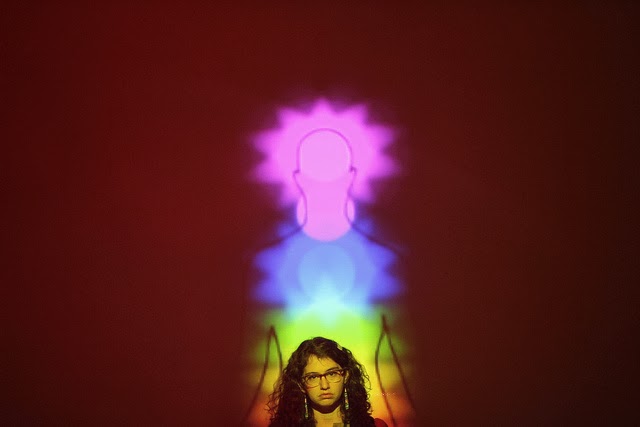
Chakra Displeasure by Claire L. Evans
There are mixed reviews when it comes to individuals' experiences with Dahn Yoga. Some claim the practice is the best thing to ever happen to them, many scoff at the claim it's even yoga at all, and others liken the program to a dangerous cult. The organization has even been sued for wrongful death and brainwashing by former members and their families (Falkenberg, 2009). However, I didn't read about these things until after my private session. Before attending my first and only class, I looked only at online reviews for the specific center I would be attending. What follows is an account of my personal experience.

Before my Dahn Yoga Appointment


While purchasing some shampoo recently, I noticed the store where I was shopping had flyers posted in the store advertising a free aura reading for later in the week. I hadn't ever had an aura reading before, so I thought it could at least be an interesting lunch-break diversion.

I arrived back to the store at my appointed time and was greeted with a hug by a very friendly Dahn Yoga instructor. He asked a few questions about my health and wellness, and he used a piece of electronic equipment to "read" my aura. When the results came up on his laptop screen, he was very complimentary about the uniqueness of my aura, pointing out that he could help me reach my potential by providing instruction that would "brighten" the areas of my aura that were literally darker in my results. He spoke to a great extent about chakra healing and meditation, both of which I believe can help a person lead a balanced life.

After five minutes or so, he presented the opportunity for me to have a private session at a Dahn Yoga center for the low introductory price of $20.00 (€ 15.0800). I took the opportunity with an open mind. I wanted to form my own opinion of the center and practice, and he seemed like a sincere, friendly person. The problem areas he had identified resonated with me. He told me he would call the day before my session to confirm.

Before the session I read reviews about the particular center I would be attending. Although most of the reviews were glowingly positive, there was one review that warned readers that Dahn Yoga is a cult and a scam. Thus warned, I promised myself I wouldn't sign up for any additional sessions until after I had mulled it over the week following the session.

Not having heard from the practitioner as promised, I did call to confirm my appointment before I left the office and headed to my appointment.

During the Session


I was slightly wary of what was happening throughout the session to the extent that when I looked at myself in the mirrored wall, I realized I was visibly uncomfortable. I was talking a lot, I could not relax, and even though I am normally able to clear my mind while meditating, my body and mind seemed to be on high alert.

I was noticing everything, both positive and negative.  I noticed the music was a bit loud and distracting, and the practitioner fiddled with the laptop that was playing the music a few times during the session.  Although he did ask for permission before touching me, I noticed that when it was time to breathe while he pressed or tapped on my body, I was feeling more ticklish than normal because my body was very tense. This, in turn, made me hold my breath. I noticed he seemed very knowledgeable about chakra healing and meridians.  I noticed that although I was too warm in my sweatshirt, I was not willing to take off my sweatshirt. I continued to think about that distractedly for the entire hour.  I noticed I felt no different when we were finished than when we began.

What I noticed the most, however, was the extremely obvious hard sell that followed the session.

When I explained I did not have a work schedule that would allow me to come during class times, the practitioner "reminded" me that this was a very important journey I was about to undertake and "suggested" $1200.00 worth of private sessions would solve my scheduling difficulties. When I explained my financial situation would not allow for that, he suggested a plan in the $900.00 range. Every time I said "no," he offered a plan $100.00 to $250.00 less than the previous suggestion until we got all the way down to a $93.00 plan with a 3% discount. Knowing I was probably his worst nightmare, I told him I would think about it. He gave me his number and told me to call no later than 9:00 p.m. so that the 3% discount could still be applied.

Following the Sales Pitch


Unlike positive experiences I've had at other yoga or meditation centers, this seemed very phony, from the tacky music to having to call to confirm my appointment when I had been told I would receive a call to the hard sell that followed the session.

As someone who strives to avoid the consumer-mindset in my daily life, I never respond well to a hard sell. The longer I thought about my session and attempted to keep my open mind about it and how it ended, the angrier I got. Just as I had promised myself, I thought about my session and whether or not I would subscribe to a plan. "No way," I thought, and that was before I researched the company and its various legal challenges.

I did not call the practitioner to subscribe to any plan, regardless of the very arbitrary 9:00 p.m. discount expiration. Instead, I realized what I should do more of is take advantage of the wonderful and easy-going yoga center located only a few miles from me where people can drop in for sessions at only $15.00 for an hour - with no sales pitch, only fresh fruit, to follow.

References


Falkenberg, K. (2009). Dahn yoga: Body, brain and wallet. Forbes Magazine. Retrieved from http://www.forbes.com/forbes/2009/0803/fraud-dahn-yoga-centers-body-brain-and-wallet.html


Copyright Amy Lynn Hess. Contact the author to obtain permission for republication.
Original publication May 1, 2012.


Monday, November 4, 2013

How to Make a Clay Whistle: A Beginner's Pottery Project

This is a picture and a drawing of a clay whistle for comparison.
A Clay Whistle Photograph and Design Plan
Walking into a pottery studio as a beginner can be a bit intimidating. There's a lot to learn, from basic handbuilding and throwing techniques to more advanced firing and glazing concepts. However, do not be discouraged!

A clay whistle project can be created in your first few days, even if you're just starting out.


The basic building techniques you should use and understand for this project are wiring off clay, wedging, pinching, paddling, and attaching pieces by scoring and applying slip.  Once you understand these basic techniques, you can master the art of making a working clay whistle!

Understanding How Whistles Make Sound


Before beginning, it's important to understand a few concepts about how whistles work so you can sketch and plan your project.

This whistle will work much like a flute. According to Mark Shepard on An Intro to Flute Acoustics, "Nearly all musical instruments are made up of two basic elements: a generator, which gets the vibration going, and a resonator, which amplifies the vibration and modifies it to create the sound of the instrument" (2001, para. 1).   For this project, the mouthpiece and "wedge" will be the generator, and the hollow form will be the resonator.

This is a diagram of the inside of a clay whistle.
The player will blow air that passes through a canal until it hits a wedge of clay that splits the air, causing the sound. The air will alternate between escaping out of the whistle and being forced into the whistle, which will cause vibrations in the form.


Make a clay whistle


Creating the Resonator of the Whistle; The Hollow Form

The basic idea in making the hollow form is to create enough space for the air to resonate.  The instructions here are for creating one pinch pot and sealing the end, then creating a flat surface for the generator.  Alternately, you can create a second pinch pot of the same size as the first and attach them together to form a hollow sphere.

  1. Wire off 1 - 2 pounds of clay.
  2. Wedge your clay and cut it into 1/2 pound cubes.
  3. Form balls of clay from the cubes.
  4. Wrap all but one of the balls in plastic (to keep them moist), and use the last one to create a pinch pot the size of your hand.
  5. Smooth and pinch the pot until the walls are 1/4 inch thick.
  6. Close your form by applying slip to scored edges. The closed edge is the bottom of the form.
  7. Lightly tap or paddle the top of the form in order to create a flat surface for the whistle's hole.


Creating the Whistle's Mouthpiece


The mouthpiece is the piece of the whistle the player will use for blowing air into the form.  Be sure it is smooth and has a straight slot on one side.  The air passing through to the wedge will need to be "shaped" as a rectangle in order to properly split between the form and the wedge.  It's a strange concept to think of "shaping" air, but by shaping the hole in the mouthpiece, the air can be "shaped."
The mouthpiece of a clay whistle is a cube or cylinder.


1. Use about one cubed inch of clay to create a smooth cube or solid cylinder.
2. Poke a thin, rectangular hole in the mouthpiece, like a shortened slit for a piggybank.
3. Set the mouthpiece aside.


Attaching the Mouthpiece to the Whistle

The mouthpiece must be aligned with the slit created in the hollow form, and it must be carefully attached to the form.  You don't want it to fall off or become out of alignment with the wedge while drying or while in the kiln!

  1. Insert a fettling knife (or popsicle stick) into the hollow form just under the top of the "lid."
  2. The top surface of the knife should touch the bottom surface of the hollow form's "lid."
  3. Remove the knife.
  4. Create a slot at the knife's opening that's the same size as the slot in the mouthpiece.
  5. Insert the knife into the mouthpiece, then into the slot in the hollow form.
  6. Push the knife through both slits so it just touches the lid of the hollow form, as before.
  7. The knife now sits where air will later pass through the whistle.
  8. Slip and score the mouthpiece to attach it.  Use extra coils of clay as needed to make a smooth connection.


Creating the Generator; The Whistle's Hole and Wedge


The hole and wedge are the pieces of the whistle that will allow sound to be generated.  Notice the shape of the hole and wedge in the following figure.


  1. Use a needle tool to cut out a small square of clay where the air hole meets the hollow inside of the form.
  2. Create 90 degree angles straight down into the form. You will be able to see the fettling knife's top surface.
  3. After the square is cleanly cut and you can see the surface of the fettling knife, create a 45 degree "slide" from the back edge of the square hole up towards the back of the hollow form. It's at this point the air will be split to make a sound. Use the top of the knife as a guide.
  4. Be sure to use the needle tool to clean any clay out from below the edge of the wedge that sits below the level of the air canal.
  5. Practice blowing softly into the mouthpiece and adjusting the angles until the wedge and air canal are aligned and the whistle makes the desired sound.
  6. Practice with all of the 1/2 pound balls of clay you've wedged. When the basic forms and whistles are complete and working (and you've cleaned the clay from around your mouth), let the clay become leather hard, then decorate your whistle before bisque firing.
  7. Remember to glaze carefully so as not to plug any of your whistle's holes with glaze.

Even if it's your first day in the pottery studio, once you understand basic handbuilding techniques, you can begin making your first clay whistle.

References


Shepard, M. (2001). An Intro to Flute Acoustics. Retrieved from http://www.markshep.com/flute/Acoustics.html


Copyright Amy Lynn Hess. Contact the author to obtain permission for republication.

Tuesday, October 29, 2013

What's a Thesis?

A thesis starts with an idea, your own idea.
A thesis starts with an idea, the writer's own idea.

Whether a writer is composing a speech or an essay, there is one thing that the writer should not forget to add, and that is the thesis statement.  But, what exactly is a thesis statement?


A thesis statement is a writer's claim or position on the narrowed topic at hand.  


Seems simple enough, right?


Let's break it down.

Who Writes a Thesis Statement?

A thesis statement must stem from the writer of the speech or essay, since a thesis statement is the writer's own claim or position on the narrowed topic at hand.  A paraphrase, summary, or quotation cannot be a thesis statement because none of those things would be the writer's claim or position on a topic.  A fact, statistic, or dictionary definition cannot be a thesis statement because those would not be the writer's own claim or position on the topic.

What Makes a Thesis a Thesis?

According to Osborn, Osborn and Osborn in  Public Speaking: Finding Your Voice, a thesis statement "summarizes in a single sentence the central idea of your speech" (117).  Jean Wyrick, in Steps to Writing Well, states "The thesis statement declares the main point or controlling idea of your entire essay" (pg. 31).   In other words, a thesis statement is the writer's own claim or position on the narrowed topic at hand.

When Does a Writer Compose a Thesis Statement?

A writer should compose a thesis statement after a sufficient amount of prewriting, including any required research.  Prewriting helps a writer narrow a topic to a manageable size: Remember, a thesis statement is a comment on the narrowed topic at hand.  Composing a thesis after a sufficient amount of research helps a writer answer a research question and make an educated claim about a topic or choose a position on a topic before drafting an essay.

A thesis statement should be well-thought out and clearly stated before the writer moves from the prewriting stage of the writing process to the outlining stage of the writing process.  At any time, a thesis can be edited or changed to reflect greater clarity or a change in the writer's position or claim.  However, starting with the clearest idea possible will greatly help the writer maintain unity, coherence, and clarity within the speech or essay.

Where Does a Thesis Go?

A thesis statement generally appears near the beginning of a speech or essay; it introduces the reader or audience to the writer's claim or position on a given topic.

In a basic five-paragraph essay or short speech, the thesis appears at the end of an introduction, following an "attention-getter" or "lead-in."  It may appear, again, in the conclusion.  In a narrative speech or essay, a thesis statement will often appear only in the conclusion, after the story has been told.

Why Do I Have to Have a Thesis?

The thesis statement helps a writer maintain unity in an essay or speech. Any idea that does not support the thesis should not appear in the essay or speech.

Furthermore, the thesis statement also has an effect on the audience.  The writer uses the thesis near the beginning of the speech or essay to offer the reader or listener a glimpse of what the essay or speech is going to prove.  The body of the speech or essay proves the claim or position of the thesis, and the conclusion reiterates the claim or position.   When a writer omits the thesis from the introduction, the audience might be confused about the point of the evidence offered in the body.  A reader or listener might begin to ask, "What's your point?"

How Do I Write a Thesis?

How a thesis statement is worded is very much related to the topic and purpose or the speech or essay.  For example, if the purpose of an essay is to inform, the thesis will indicate a position about the topic that is informative.  For a persuasive or argumentative speech, the thesis will indicate that the writer will be offering evidence in support of a claim.  A narrative thesis is generally a statement that sums up a life lesson or piece of wisdom or insight that was gleaned during the event depicted in the narrative.

 No matter the mode of an essay or speech, however, a writer should never forget the thesis statement, the writer's claim or position on the narrowed topic at hand.


Want to read more about writing essays?  Try
An Overview of the Writing Process
Avoid Unintentional Plagiarism
Myths about Writing Essays
Before Writing Your Blog


Try my complete online essay writing course on Udemy Writing for English Composition: College Essays.


References


  • Osborn, M., Osborn, S. & Osborn, R. (2012). Public speaking: Finding your voice (9th ed.). Boston, MA: Pearson.
  • Wyrick, J. (2011). Steps to writing well (11th ed.). Boston, MA: Wadsworth.


Thursday, October 17, 2013

An Overview of the Writing Process

Sometimes writing a paper can feel an awful lot like "Chutes and Ladders."

Writing is a process, but not necessarily a linear process.  


Instead of thinking about the writing process as a series of rungs in a ladder that lead to a final essay, think of the writing process as a successive set of cycles.

I don’t recommend trying to say “successive set of cycles” five times fast, but I do recommend reading this essay to get a better idea of what I mean by it.


Steps and Sub-Steps


The steps in the writing process include prewriting, outlining, drafting, and revising.  Each of these main steps includes several sub-steps.  For example, prewriting also includes choosing and narrowing a topic, creating a preliminary thesis statement, and defining a purpose and audience.  Outlining includes finding the best evidence, planning for order and flow, and logically dividing a preliminary thesis into preliminary topic sentences.  Some writers edit and draft concurrently, and others draft and research concurrently.  Revising may require additional editing for grammar, mechanics, and usage, but it is mainly a cycle of ensuring an essay has unity, coherence, and clarity. 

Clearly, the writing process is never as clear cut as the term “writing process” implies.  There are moments and situations where crossing back, across, and forward to additional “sets of cycles” might be necessary. 

  • Prewriting usually leads to outlining, but if a writer struggles with the outline, he or she may need to do more prewriting to clarify his or her own position on the topic or to better determine the purpose of the essay. 
  • Outlining leads to drafting, but a weak draft, a draft that includes too few details, may require more prewriting or a more detailed outline. 
  • A completed draft leads to revising, but after revising, a writer may need to redraft entire sections of the paper, which would call for additional prewriting, or outlining, or research.


Steps of the Writing Process in Action


Here is an example of the writing process in action.  The hypothetical writer, “Hannah,” has an expository essay assignment due in her composition class next week.  Where does Hannah begin? 

Prewriting

First, Hannah prewrites in order to generate ideas about a topic.  She uses the processes of freewriting and looping to help her decide to write an expository essay about how to make pine needle tea.  Her audience is her classmates, and after a brief conversation with many of them during a break from class, she learns that none of her classmates have ever heard of making pine needle tea. She knows she will be writing for people who will need to understand basic information in order to understand her how-to essay.

Armed with a knowledge of her purpose (to inform), a narrowed topic (how to make pine needle tea) and the level of knowledge of her audience (basic), she begins to compose a preliminary thesis statement.  She begins her thesis with her topic, and then she makes a statement about her topic, all within the same sentence.  “Making pine needle tea,” she writes, “is a simple process, and taking the time to learn to make this tea will yield a safe, delicious, and nutritious hot beverage.”

Outlining

Once Hannah has her preliminary thesis statement, she places it at the top of an outline and figures out how to divide the support for the thesis into logical topic sentences.  She decides to make her first body paragraph an explanation of the tea’s nutritional benefits, the second paragraph about gathering pine needles, and the third paragraph about preparing the needles and making the tea. Her first topic sentence is “Pine needle tea has many nutritional benefits.”  Her second topic sentence is “Gathering pine needles is easy, not to mention inexpensive.”  Her third topic sentence is “Preparing the pine needles for tea takes about thirty minutes, but is well worth any time spent.”

Hannah looks back at her thesis and realizes she has forgotten to include supporting details for her idea that making the tea is safe.  She rewrites the topic sentence for the second body paragraph as follows: “Pine needle tea is safe to drink as long as the preparer is knowledgeable about gathering the proper ingredients.”

Next, Hannah outlines how she will support each topic sentence.  She adds credible, expert information about the tea’s nutritional benefits to the outline for her first body paragraph.  She adds a step by step explanation  and description of pine needles as support for her second paragraph.  For her third paragraph, Hannah adds a step by step explanation of how to prepare the pine needles and brew the tea.

Drafting

Finally, Hannah drafts her essay, turning all of the support she jotted onto her outline into paragraphs.  She adds transitional words and phrases between paragraphs.  She adds attribution and citations for all of her expert testimony and credible, factual nutritional information.  Lastly, she adds a lead-in and a conclusion that summarizes her main points.

Revision

Hannah rereads her draft to look for opportunities for revision, and she realizes her second paragraph is weak.  When it comes to safety, she thinks, none of her classmates are going to believe the tea is safe right away.  She realizes she needs more ethos, or  expert testimony.  She then adds additional expert testimony about the safety of the tea to the outline for her second paragraph, and then she adds logical appeal, or logos, by adding the credible, factual information to her essay with proper attribution and a citation.  

While rereading her paper she also notices that the ending of her essay is abrupt and not very memorable.  She revises her introduction and conclusion to make them more interesting so that they capture and keep a reader’s attention. She incorporates pathos by using an introductory narrative that describes a harrowing wilderness adventure that ends in the explorers making pine needle tea for survival. 

Once Hannah is happy with her revised essay, she proofreads it one last time to look for grammatical and mechanical (punctuation and capitalization) errors.  She corrects the title of her paper for title case, corrects two sentence fragments, changes an instance of the second person “you” to the third person “people,” and changes the spelling of “they’re” to “their.”  She formats her essay according to the MLA style guide provided by her university, and she turns in her paper.


Summary

Following the steps in the writing process can help ensure a writer completes an essay that has unity, coherence, and clarity.  Each step, however, should not be thought of as a rung in a ladder that leads to a completed essay.  Each step is actually a set of cycles, a cycle of reading, thinking, revising, and rethinking, that gets a writer from idea to exceptional essay.


Want to learn more about writing essays?  


Try my online video course, Writing for English Composition: 

College Essays on Udemy.


Want to read more about the three qualities of writing? 


Clarity - Write with Clarity


Copyright Amy Lynn Hess. Please contact the author for permission to republish.

Friday, October 11, 2013

Avoid Unintentional Plagiarism

Plagiarism is theft, whether intentional or not.  Don't be a thief!
Don't be an intellectual thief: Cite your sources!

Plagiarism is intellectual theft, the act of taking someone else's words and ideas and passing them off as one's own.  Plagiarism can be either intentional or unintentional.  Unintentional plagiarism differs from intentional plagiarism in that the plagiarizer plagiarizes without knowing he or she has done it.


Whether a specific act of plagiarism is intentional or unintentional, however, is generally difficult to prove, and the punishment for academic dishonesty at a college or university will generally be severe. In the professional world, an employee or writer who plagiarizes could be fired or even sued.

So, how does a writer prevent unintentional plagiarism?  A writer avoids unintentional plagiarism by taking careful notes from sources, using attributed source content only where necessary to support a main idea, and by carefully adhering to the required documentation style guide.


Avoid Plagiarism by Taking Careful Notes from Sources


"Taking careful notes from sources" means writing a full source description even before writing down your first summary, paraphrase, or quotation from the source.  Jot down the author or authors, publication date, title, publication information, publisher information, editor information, page numbers, DOI number, call number, URL, and any other identifying information for that source.  In addition to reminding you to check your source for authority and timeliness, writing down the source description information guarantees you will be able to cite your source both in the text of your paper and at the end of your paper in your bibliographic entries.  If you need additional information, writing down a full description will allow you to find that source, again.

Furthermore, when you jot down supporting statements from a given source, be sure you can match that information with the source, not just the author, but the specific article and page or even the paragraph number.  That guarantees you will be able to ethically cite the source in the text of the paper and attribute the words or ideas to the original author.  Whether using a quotation, summarizing,  or even paraphrasing someone else's words, those words or ideas must be cited.  The rule is "If you can't remember where you found it, don't try to use it."  Therefore, you should always make sure you can remember where you found something so that you can use it.


Avoid Plagiarism by Using Attributed Source Content Only Where Necessary to Support a Main Idea


When writing, you should use source content only when that source content supports one of your own main ideas.  A paragraph in a literature paper, for example, that simply reports information about a poet seemingly has no purpose other than to fill space.  The entire paragraph would be source content, and every sentence would need attribution and in-text citations.

On the other hand, a writer who starts with his or her own idea has a much easier time getting to the point, and a much easier time avoiding plagiarism.  For example, a paragraph that begins with the original main idea that a poet lived a difficult life and therefore wrote difficult poetry might need only one or two pieces of source evidence that support the idea that the poet lived a difficult life.  In the rest of the paragraph, the writer could point out the similarities between the poet's life and her poetry.  Of course, if the entire idea came from someone else, passing this idea off as one's own would still constitute plagiarism.  The writer has to ask himself or herself, "Did I know this or think this before I read it someplace else?"

As stated above, words and ideas that belong to someone else must be pointed out to the the reader of a paper when and where they occur, not just at the end of the paper on a bibliographic page.  Let me say that, again: Within a paper, a writer must point out the specific words or ideas that came from someone else.   Quotation marks and transitional words like "According to" and "So and So states" become exceptionally important, as do parenthetical citations.  Those shortened citations will all match up to the longer bibliographic descriptions on the bibliographic page at the end of a paper.


Carefully Adhere to the Required Documentation Style Guide


Some common documentation styles include Turbian, American Psychological Association (APA), Modern Language Association (MLA), Chicago Style, and Associated Press (AP).  Whenever a writer, whether a professional or student, creates a document that includes research, the writer will adhere to the guidelines set forth by the appropriate or assigned style guide in order to effectively and consistently cite sources.  If you are unsure which documentation style to use, ask your professor or publisher.


An Example of How to Avoid Plagiarism


Take a look at the following process as an example of how to ethically cite your sources and avoid plagiarism:

1. Sarah decides to write a paper about the dangers of allowing pre-adolescent children to play "Grand Theft Auto V."

2. Sarah has seen the game and knows that it is violent.  She jots down a topic sentence on her outline that states, "Parents should not allow pre-adolescent children to play 'Grand Theft Auto V' because exposure to this violent video game can cause children to behave more violently."  In order to support her point she needs more scientific information about children's behavior after exposure to this type of content, so she does some research.

3. Sarah comes across a journal article that supports her hypothesis that when children play violent video games, they exhibit more violent behavior.  She write down all of the information she can about this article.

Title: Violent Video Game Effects on Aggression, Empathy, and Prosocial Behavior in Eastern and Western Countries: A Meta-Analytic Review

Authors: Craig A. Anderson, Nobuko Ihori, Brad J. Bushman, Hannah R. Rothstein, Akiko Shibuya,  Edward L. Swing, Akira Sakamoto, Muniba Saleem.

Date: 2010

Publisher: American Psychological Association, Published in Psychological Bulletin Vol. 136, No. 2, pgs. 151–173

DOI: 10.1037/a0018251

4. Sarah take a few notes from the article, and then she comes across the exact result she wants to use to support her topic sentence.  She writes it down exactly as it is stated in the article, and she makes sure to place quotation marks around it and record the page number where it was found:  "Regardless of research design or conservativeness of analysis, exposure to violent video games was significantly related to higher levels of aggressive behavior" (pg. 16).

5. She chooses to draft her paragraph as follows using the APA documention style because the paper is for her Introduction to Psychology class:

Parents should not allow pre-adolescent children to play "Grand Theft Auto V" because exposure to this violent video game can cause children to behave more aggressively.  That the game contains violent content is undeniable.  The game's rating makes it clear the game is only for mature players with its "M" for mature rating.  Unfortunately, not all parents understand that exposure to this violence within the game can affect their children's behaviors.  In a research study published in Psychological Bulletin in 2010, the researchers found that "Regardless of research design or  conservativeness of analysis, exposure to violent video games was significantly related to higher  levels of aggressive behavior" (Anderson et. al., p. 16).  The suggestion that parents not allow children to play "Grand Theft Auto V" is not merely an opinion, but rather, this study's results show that the game can change children's behaviors.

6. At the end of the paper, Sarah creates an APA references page and includes the following complete documentation details for her source.  The entry is formatted according to her school's APA style manual.  Notice that the name she uses in her in-text citation matches the first name listed for the article.

The  required elements for the references page includes the following: Authors (up to 6 & et. al.). (Date of publication). Title of article. Title of Journal, Vol(Issue), page number. doi:

Anderson, C. A., Ihori, N., Bushman, B. J., Rothstein, H. R., Shibuya, A.,  & Swing, E. L. et. al. 2010). Violent video game effects on aggression, empathy, and prosocial behavior in eastern and western countries: A meta-analytic review.  Psychological Bulletin 136 (2), 151-173. doi:10.1037/a0018251

The final references page entry looks like the following:


Sample APA References Entry for A Journal Article with Multiple Authors


Summary


No matter which style guide a student or professional writer uses, however, one thing remains the same: It is never ethical to take the words or ideas of another person and use them as though they were one's own.  Plagiarism, whether on purpose or on accident, is theft, and it will be dealt with as such.   Always be sure to take the proper precautions to be sure you aren't committing this dishonest act.


Copyright Amy Lynn Hess.  Please contact the writer for permission to reuse.

Wednesday, October 9, 2013

Using Anti-Plagiarism Software as an Assignment Requirement

When used properly, anti-plagiarism software can
be a useful tool for students and faculty.
When used properly, anti-plagiarism software can be an effective way to reinforce research and documentation skills.


The Higher Education Plagiarism Conundrum


In a 2011 article in The Chronicle of Higher Education entitled “Toward a Rational Response to Plagiarism,” associate professor Rob Jenkins explains the higher education composition class conundrum. He writes of students that in grade school they learn to copy, summarize, and paraphrase. "Perhaps in high school," he continues, "they're exposed to concepts of research and documentation. But many students, when they arrive on our campuses, have not yet mastered those concepts or come to understand fully the difference between what they did in middle school and what we're asking them to do” (para. 10 – 11). Teaching students to copy, summarize, and paraphrase without proper documentation is a trend we have to address as educators, and we have to address it in a way that doesn’t turn us into Jeremy Bentham-esque or Orwellian “plagiarism police.”

There isn’t a whole lot we can do about intentional plagiarism, but for those students willing to learn, we can certainly help them learn to avoid unintentional plagiarism.


Responsible Remediation


To remediate missing skill sets, educators can lecture on the topic or use research and documentation bridging exercises and in-class demonstrations. Students can be taught to take proper notes and create annotated bibliographies, for example.  Students can complete rough drafts and outlines in class. However, the best way to ensure educators responsibly remediate research and documentation skills outside the classroom is to put the onus of academic honesty on the students.

Just as Jenkins has stated, students rarely come into composition classrooms already fully aware of what constitutes plagiarism, let alone how to avoid it. Beyond lectures and explanations, students will need to look critically at their own writing in order to fully comprehend the breadth and scope of plagiarism and proper use of source content. Plagiarism isn’t just using quotations without citation, but how much source content is used, how it’s used, and how even ideas – not just words - that do not belong to the student writer must be cited both in the text of the paper and on a bibliographic page.


The Use of Anti-Plagiarism Software as an Assignment Requirement


Outside the classroom, students can continue to learn research and documentation skills by submitting their papers to anti-plagiarism software tools. This software, such as Turnitin, SafeAssign by Blackboard, or Grammarly, should be presented to the students for use as a tool to make their writing better, not a tool educators use to "catch them."

I, for one, am not willing to sit like The Elf on a Shelf in a plagiarism panopticon and watch in wait for my students to forget to include a citation. Furthermore, I do not want my students to feel as though the writing assignments I give them are traps I am using to ruin their academic careers.  


When the use of such software is required, it’s essential that the students submit the papers themselves. They can then review their own reports and look closely to be sure they have used an appropriate amount of source content and cited it both in-text and on a bibliographic page. When repeated throughout a term or a semester, it then becomes part of the writing process, a skill in and of itself. Checking a paper for unintentional plagiarism becomes second nature. Faculty need only see the source content report when they deem it essential or when a paper is suspiciously outside a student’s writing ability. Otherwise, students take full responsibility for any mistakes and revise to make the paper better, more ethically sound,  before anyone else reads the paper.

Anti-plagiarism software can be an extremely useful tool for both educators and students. They can help the teacher meet course goals and learning objectives for research and documentation. They can help students realize that checking papers carefully for plagiarism is part of the writing process. Most importantly, when presented properly, these tools remind the students that in the end, it is their responsibility to avoid plagiarism and to write their papers with academic honesty.


References


Jenkins, R. (2011). Toward a Rational Response to Plagiarism. The Chronicle of Higher Education. Retrieved from http://chronicle.com/article/Toward-a-Rational-Response-to/128611/?sid=wb&utm_source=wb&utm_medium=en


Copyright Amy Lynn Hess. Contact the author to obtain permission for republication.

Thursday, October 3, 2013

Part II: The Use of Narrative Assignments in Introductory Literature Courses

What do you do when no matter what else you have done, no one is doing what you want them to do? Well, the best thing to do is to try to do one more thing.  I did that, and I can vouch for doing it.

As I stated in Part I: The Use of Narrative Assignments in Introductory Literature Courses, using a narrative, or chronological format, as the main assignment requirement in the study of literature has "saved" my classes and my sanity.  As suggested by Sheridan Blau in his book The Literature Workshop: Teaching Texts and Their Readers, using the narrative essay assignment in lieu of the argumentative or expository essay assignment has given the students the chance to explore their own thinking and analytical processes, making the papers rich and exploratory.  But, how do we get students to do it?

An Experiment in Reading a Short Story


The first step is to slowly introduce to the students the idea that there are things they need to do, actions they need to complete, in order to understand a poem or story better.  Reading is a great start, but it isn't enough for deeper analysis.   I emphasize that lesson many times throughout the course, integrating analytical actions into class time leading up to the narrative paper assignment: They must engage with active reading.  The course becomes a lot less lecture and a lot more workshop.

For example, on the first day of class, I hand out a worksheet called "An Experiment in Reading a Short Story."  When we begin the poetry unit, I hand out a worksheet called "An Experiment in Reading a Poem."  The worksheets prompt the students to read a (very short) story or poem three times and complete different actions each time they read it.  They are then given permission to discuss the work with one another, ask questions, and even complete research, given time.


At the end of the  process, I ask the students for ideas about additional actions they could take to understand the story or poem better.  If we complete the workshop early, we complete the actions they think would be appropriate to understanding, or I introduce preplanned activities.

Narrative Paragraphs


The second step is allow students the chance to practice explaining their actions in writing, actions they have decided to complete on their own.  I set this up as a short writing assignment completed as homework so they can get the hang of reporting their step-by-step analytical reading processes.  Their narrative paragraphs generally follow the format of the "An Experiment in Reading" worksheet. They write about each of their consecutive readings, in order.  I ask them to write about what they did, what they learned by doing it, and how what they did and what they learned helped them understand something deeper about the story or poem.  For my students, non-majors, it's more important that they can tell me what they did to understand the story better than it is for them to understand the "expert" take on the story.  Many of the students, however, will use "complete literary research" as one of their actions, often including expert interpretation in their paragraphs without being asked to do so.

To help the students a bit, I also provide them with a list of action verbs based on actions we practice completing during workshop.


Narrative Essays


From narrative paragraphs we move on to the narrative essays.  Writing the essay, working through the reading and writing processes, is a big "step three," but students, if steps one and two have been successful, can tackle this paper effectively.

Students complete a paragraph or two per reading of a story or poem, then create a narrative frame to add context to the essay.    I ask them to weave a research question (based on a literary theory and prompted during the second read) into the introductory paragraph and answer the question in the conclusion of the paper.  In this way they cannot possibly complete the essay until they have completed enough analysis to have worked themselves into answers to their research questions.  The process requires them to think deductively and come to an interpretive conclusion by the end of the paper.  Again, each paragraph must cover three things: what the student did to understand the story better, what he or she learned by completing the action, and how the action and what was learned helped the student understand the deeper meaning of the story better.

So, what do you do when no matter what else you have done, no one is doing what you want them to do?  You focus on the doing, asking and answering again and again, "What did you do to understand the story or poem better."


Thursday, September 26, 2013

Myths about Writing Essays

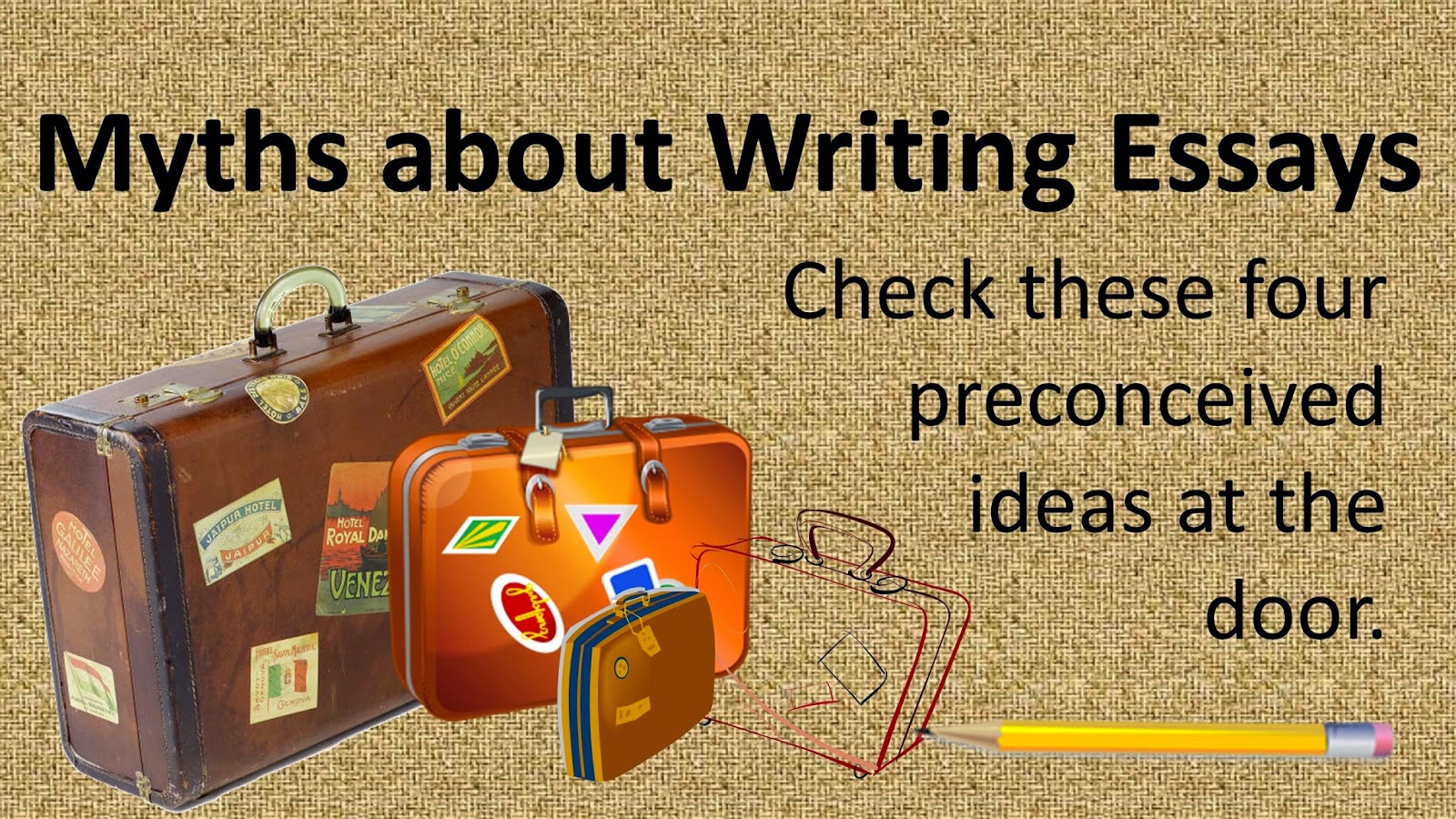
Four suitcases sit,  and the title "Myths about Writing Essays" appears above them.  The subtitle, "Check these preconceived ideas about writing at the door" appears to the right of the baggage.
Following certain old "rules" can actually cause more
serious writing errors.

There are a few "old friends" students bring into the college composition classroom with them year after year.  These memorized rules, these "old standby buddies" are called upon paper after paper, student after student, only to let their writers down in the end.


These seedy comrades, after all, are merely posing as pals, when in reality they are nothing more than mythical shadows leading their followers astray.

In other words, students come into my writing classes thinking that there are a certain number of sentences per paragraph, a certain number of words per sentence, a rule that states a sentence can't start with "because," and a rule that says a writer is not allowed to use "I" in an essay.

Rubbish.

Myth #1: There are 3 - 5 sentences in a paragraph.


Rubbish.

Reality: A paragraph is as long as necessary to support a topic sentence.  That means a paragraph requires two things: a topic sentence or a statement of a main idea and some sort of support or evidence that demonstrates the credibility of that main idea.  If a paragraph seems too short, it's missing its main idea or an element of support.  If the paragraph seems too long, it may contain more than one main idea or it may be "beating a dead horse" with its copious or trite evidence.

Believing the myth, students often commit more serious errors than paragraph length.  When students believe their paragraphs are too short, they add evidence that lacks credibility or they add meaningless sentences as filler, often even straying off topic or countering their thesis claims.  On the other hand, if they think a paragraph is too long, they cut sentences that help clarify their main ideas, leaving gaps in their arguments or reasoning.

Myth #2: There are no more than 25 words in a sentence.


Rubbish.

Reality: Sentences can be (and should be) long, short, and in-between.  A good essay will be composed of sentences of a variety of lengths and complexity.  As long as a sentence is well-written and well-punctuated, it can be as long as it needs to be in order to clearly establish the writer's claim or position on the topic under discussion.

When students adhere to the myth, they sometimes simplify their ideas at the expense of clarity or coherence.  For example, if writing an essay about a literary work, students will sometimes leave the title of the story, play, or poem out of their thesis statements in order to reduce the number of words, leaving a reader with a major question.  If including quoted evidence from an expert source, student writers will sometimes omit an introductory phrase or a statement of attribution before the quote, making the evidence seem arbitrary or pushing the edge of plagiarism.  Plagiarism is a much more serious error than sentence length.

Myth #3: Sentences cannot start with "because."


Rubbish.

Reality: A sentence should be complete.  Beginning a sentence with "because" does not necessarily mean a sentence will be incomplete; it simply means the writer must be certain the dependent "because" clause is followed by a comma and an independent clause.

Sentences should always begin with the most important words within the sentence.  Furthermore, reasons generally follow the word "because."  If a writer begins a sentence with "because," it could be because he or she wants to emphasize the reason within the sentence over the premise or conclusion.  Because some students are taught never to do such a thing, however, they never learn to add emphasis to the reason within a sentence.

Myth #4: Writers should never use "I" in an essay.


Rubbish.

Reality: An essay is a short discussion.  That short discussion can be molded into an expository essay, a descriptive essay, an argumentative or persuasive essay, or a narrative essay.  Depending on the type of essay a student is writing, "I" could be perfectly acceptable.

When students are trying to avoid "I," they sometimes commit a worse error; that is, they resort to using the second person, even when commenting on their own lives.  That error distracts readers and can even put a reader on the defensive.  For example, in a narrative essay about learning to drive, I once had a student writer state, "You need to drive more carefully so you aren't in any more accidents."  When I asked him why he was assuming I had been in a car accident, he stated that he was the one who had been in an accident.  When I asked him why he said it in his paper as though his reader had been in an accident, he told me it was because he had been taught never to use "I" in an essay.

In conclusion, although there are some hard and fast rules about writing writers should learn to trust like old friends, these are not those friends, those rules.  A paragraph should be as long as necessary to support a topic sentence.  A sentence should be as long or as short as necessary to clearly establish an idea.  Sentences can begin with "because," and "I" can sometimes mean the difference between offering a lesson or insight to a reader or offending or confusing a reader.  In the end, it remains a matter of unity, coherence within and between paragraphs, and a clearly stated and supported discussion of a claim or position.


Want to learn more about writing essays?  

Read 

Writing an Argumentative Essay: Basic Terminology
Identifying the Rhetorical Situation and Rhetorical Appeals

or

Take my online course on Udemy, Writing for College Composition: College Essays.


Copyright Amy Lynn Hess.  Please contact the writer for permission to reuse.

Thursday, September 19, 2013

Mina Loy's "Modern Poetry" and Its Relevance Today

An excerpt from an essay by Mina Loy: Poetry is prose bewitched, a music made of visual thoughts, the sound of an idea.
From Loy's "Modern Poetry" Image by Dave Bonta

Mina Loy's opinions about poetry are just as important today, if not more so, than in her own Modern Era.


One of the lesser-known poets of the Modern Era, Loy took seriously the tenets of Lowell and Pound's Imagism as stated in the "Imagist Manifesto," as well as Pound's challenge to make poetry new. She followed his example and joined the Modern literary conversation with an essay of her own called "Modern Poetry." What makes this essay relevant today is that what she praises as well-written poetry for the Modern Era remains true in our own time.


The Modern Era


The beginning of Modern poetry can be defined by the emergence of American avant-garde poets just before the start of World War I in 1914. Among the most famous of the Modern poets, and this list is certainly limited, are Ezra Pound, Gertrude Stein, T.S. Eliot, Marianne Moore, William Carlos Williams, Wallace Stevens, E.E. Cummings, and Hart Crane. These poets exhibit the sentiments of Pound, who challenged the poets of his time to “make it new.” Not only did they meet this challenge, but their influence has grown over the past poetic century as they have influenced new generations of poets.  How these poets made poetry "new" was defined not only by the most well known of the Era's poets, it was also explained by Mina Loy in her essay, "Modern Poetry."


Mina Loy's "Modern Poetry"


In Mina Loy's “Modern Poetry,” an essay first published in the non-literary magazine Charm in April of 1925 (Conover 217), Loy begins, “Poetry is prose bewitched, a music made of visual thoughts, the sound of an idea” (157). What follows that first sentence is a nine-point evaluation of Modern Era poetry. The majority of her essay focuses on using a natural rhythm for personal topics, and in the popular poetry of today, this acclaim for free verse, rhythm, and musicality is just as popular, if not more so than in 1925. As for the music of poetry, one only has to look at the popularity of rhythmic slam poetry, "music made of visual thoughts," to hear its spontaneity and see its effect on the popularity of poetry.


"Music Made of Visual Thoughts"


Several of Loy’s points in "Modern Poetry" praise the music of the then-new free-verse form. Almost with an air of knowing what was to come in the future of poetry, as over the years it has competed more and more with popular music as entertainment, she begins by saying music is more easily accessible to people than poetry because while music is “easy to get in touch with,” poetry requires “voluntary attention” (Conover 157). She continues to explain that poetry must be read as “pictured song” (157). Almost prophetically predicting the advent of slam or jam poetry, she explains that tempo and verse are used properly when found spontaneously, just as structured meter was at one time new and original, spontaneous thought. She extols Ezra Pound as the master at creating musical qualities in verse, and gives much credit to E.E. Cummings. Of Cummings she states his success lies in his “rich compassion” for “common things,” and his rhythms created by the combination of a free-verse form and “fresh rhymes.” Loy then gives examples of perfect poems, naming work by Hilda Doolittle, Marianne Moore, Lawrence Vail, and William Carlos Williams. Her last point again praises the “sublime” Williams. Loy cites his ability to create the new rhythm of poetry by his joining of bare fact with personal nature (161).

The poetry of the Modern Era has had a profound effect on the poetry we read and hear today - both as the written word and in popular song. Modern poets, famous and lesser-known alike, contributed to this evolution of rhythm, meter, image, and "the everyday" as acceptable poetic subjects. Most notably of the lesser-known poets is Mina Loy, whose opinions about poetry as explained in her essay, "Modern Poetry," are just as valid today as they were in 1925.


Want to read more about Mina Loy?  Try

Diagramming Mina Loy's "Letters of the Unliving" as a Method of Close Reading

Works Cited


  • Conover, R L. (ed.) (1996). The Lost Lunar Baedeker; Poems of Mina Loy. New York: Farrar, Straus and Giroux.


Works Consulted


Copyright Amy Lynn Hess. Contact the author to obtain permission for republication.

Using ChatGPT for Essays in English Composition Classes

The best essays are written by people for people. "Corona Typewriter" image courtesy of the author ChatGPT and other AI language g...