Welcome!

Do you have APA formatting questions? Thesis statements got you down? Need to study grammar? Need some help with critical thinking? Having trouble with literary analysis or research? Want to take a look at some example essays? Well, I probably have a post here somewhere that can help you. Please use "Search This Blog," the "Labels," or my "Blog Archive" to help you find what you need. Have questions about what you find? Please feel free to comment or ask questions. I do moderate comments, and I try to respond to all topical questions and comments in a timely manner.

Thursday, May 17, 2018

What if . . . ? A Brief Case for Learning Community Classroom Design


What if . . . we designed active learning spaces with collapsible walls?

Learning communities can take many forms. Some are based on grouping students by extracurricular activities and interests, some are based on course or disciplinary groupings, and some are based on the teaching philosophies and pedagogical methods of groups of faculty members.

No matter how a learning community is created, however, something that remains consistent is the need for those students in that community to learn together.  That need requires a space, and a space designed for learning communities will facilitate that sense of, well . . . community.
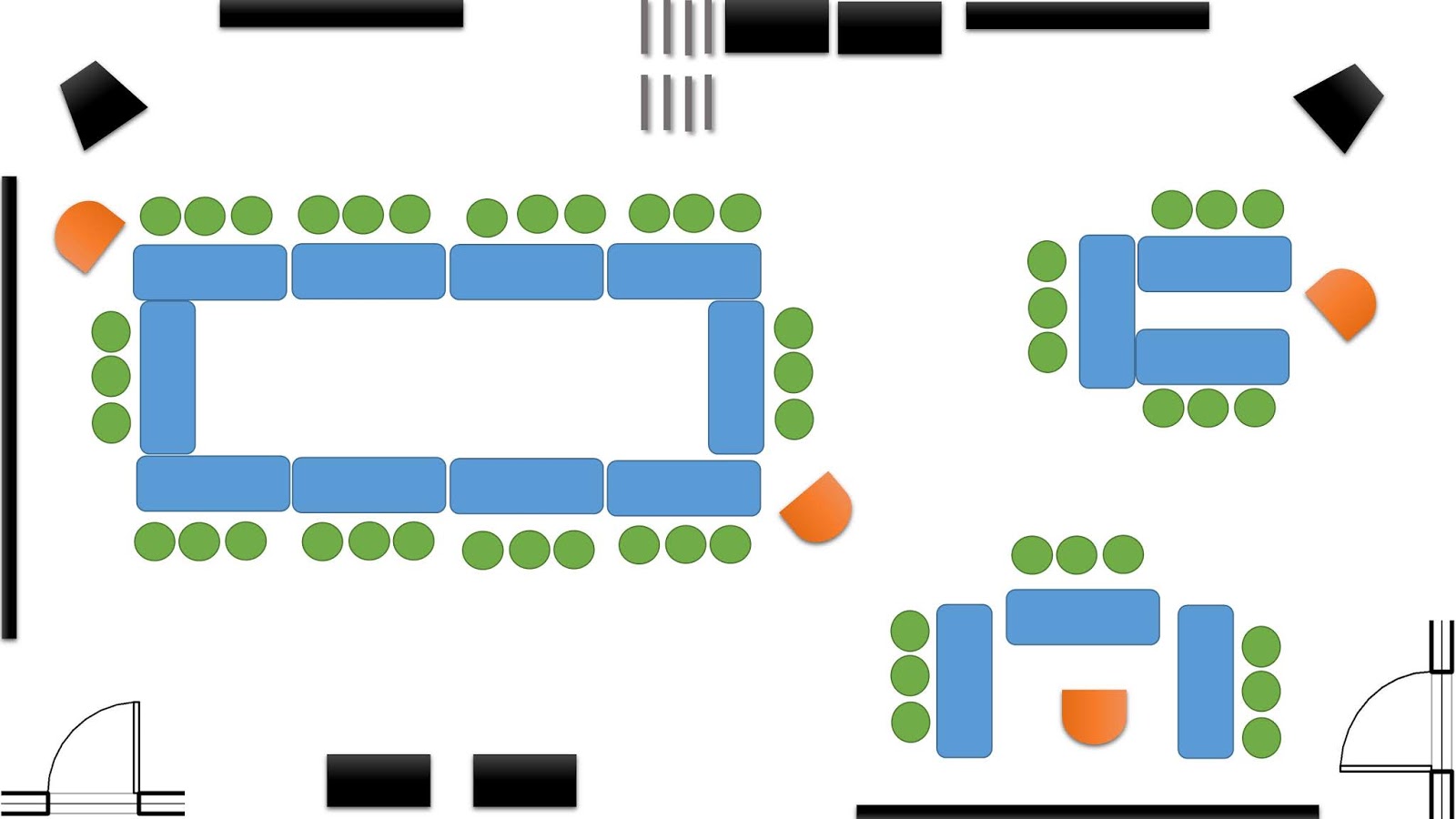


What if  . . . collapsible walls allowed for the expansion of learning communities, team teaching, and cooperative learning?

What if more institutions adopted the structure of learning communities, team teaching, and cooperative learning?  What would that look like?  One idea is to utilize one specific design element, the folding wall room divider, and one specific logistical consideration, block scheduling of students and faculty.


This solution requires each participating faculty member, in this case two, to teach two back-to-back sections of their class while their partner does the same. Classes happen concurrently. Students take one class, then the other, while their counterparts take the same classes in reverse order. As the semester progresses and the course materials begin to merge, the room divider can be opened, allowing for the faculty members to team teach for the day, both class blocks, perhaps offering lecture materials to the entire group, or perhaps allowing students to merge into large groups to brainstorm or collaborate on project-based learning assignments. The room can be arranged into areas that allow for faculty to mentor, meet, or otherwise assist individuals or groups of students. The room would allow for visitors, including community members and guest speakers, panel discussions, debates, and a whole host of collaborative learning activities.


What if . . . we opened our classrooms to community members as guest speakers?


The possibilities greatly expand, in this scenario, for facilitating the creation of working relationships among students, among faculty, and between students and faculty. These types of relationships increase engagement and student achievement, as faculty are able to become part of students' figurative and quite literal, circles.

What if . . . this is an option worth exploring? 


To read more about teaching and learning, try


Copyright Amy Lynn Hess. Please contact the author for permission to republish.

Tuesday, May 15, 2018

Active Learning Classroom Design and Pedagogy

Lithograph of Faraday delivering a Christmas lecture at the
Royal Institution. 
Maybe we've been doing things this way for too long? 

Active learning classrooms are spaces designed with student achievement in mind. As active learning is student-centered, so must the classroom reflect that orientation. The furniture is often mobile, designed with castors, making it possible to easily create tables for small groups of students to work together on projects, or to rearrange the set-up quickly for one-on-one meetings, speakers, or class discussions. Active learning classrooms are also equipped with all the technology necessary for faculty to seamlessly monitor student work, and for students to have at their disposal the tools and technology they might need to complete cooperative learning, experiential, service, project-based, or problem-based assignments. Active learning classrooms help shift the focus from the professor and the traditional lecture to the students and their peers.

To Assess by Sitting Down Beside

One key idea is to assess student learning and student progress from close up, as opposed to from "Faraday's stage," and as Dr. Ronald Purser reminds in his Problem Based Learning overview (n.d.), that requires sitting down with the students and observing them sitting down with one another. “To Assess,” he begins: “The Latin origin of this term, assidere, literally means to sit down beside. Another way of thinking of assessment is to use careful judgment based on the kind of close observation that comes from ‘sitting down beside.’” As opposed to outcomes-based assessment or assessment for the purposes of accreditation or program review, which too often ties faculty to sitting down with data instead of students, this real time assessment helps faculty keep students on track throughout a semester. This allows for real time improvement of the curriculum, and therefore greater engagement and student achievement.


The Learner-Centered Teaching Philosophy

Well known for her expertise in the field of active learning and active learning spaces, Diana Oblinger explains the importance of the pedagogy-design connection by simply stating that “Learning spaces convey an image of the institution’s philosophy about teaching and learning” (2005). These spaces are particularly important, then, for institutions looking to focus on learners and to engage underserved populations and minorities, as research made popular through the Yale Center for Teaching and Learning clearly shows. For example,


  • Active learning "has been empirically shown to decrease the achievement gap for underrepresented minorities and first generation college students, particularly in STEM fields; to reach 'a diversity of students'; and to build 'higher- order thinking skills' across engaged student populations" (Handelsman, et. al, 2007). 
  • "Active learning therefore can help improve class climate by promoting interconnections between students, which can enhance the sense of belonging and motivation for marginalized students and those with differing levels of academic preparation."
  • "Early quasi-experimental research revealed that teaching in an ALC can improve student attitudes, conceptual understanding, and passing rates, especially for female and minority students" (Baepler, et. al., 2016, Beichner 2007, Walker 2011).

Service and Experiential Learning

Benefits related specifically to service learning are reported by Yeh (2017) in Service-Learning and Persistence of Low-Income, First-GenerationCollege Students: An Exploratory Study. Her interviews with students gave “insight into the efficacy of service learning as a tool for improving college persistence,” which her framework equates with retention. Benefits related specifically to experiential learning are reported by Thacker, Berna, Torr, and Walsh in Experiential Learning: Benefits for Hispanic and First-Generation College Students (2017). They found that students in the studied experiential learning courses “report increased confidence, greater accessibility to and understanding of application of course concepts. And, perhaps of utmost importance, these pedagogical tools offer Hispanic, first generation students a lens through which they are able to view themselves as personally successful, intellectually empowered, and as productive community members.”

Summary

A shift from a  traditional lecture format to an active learning format of any type can often be challenging, but the benefits are innumerable. Active learning and active learning spaces often engage all students, including underserved populations, by offering them a chance to use soft skills and abilities that reflect the need for these same skills post graduation. Having spaces designed for this type of learning can make a great difference in bridging the gap between the two pedagogies, while at the same time proving an institution's commitment to student-centered learning.


Thursday, May 3, 2018

What's a Rhetorical Situation?


When writers write, they write to accomplish a goal related to an intended audience and a specific, narrowed topic. The way those three elements are mixed and matched is called the Rhetorical Situation. That means when writers write, they have to keep the Rhetorical Situation in mind from start to finish, or from prewriting to publication.

Three Parts of the Rhetorical Situation


Let's look at some examples of how changing the Rhetorical Situation changes how a writer writes, from the words the writer chooses to the citation style used to identify source content.


Example 1: Writing a Business Proposal


Intended Audience

When writing a business proposal, it's essential the writer understands the intended audience.  The person reading the document can make or break the business opportunity!  A banker will want to read about the financial acumen of the entrepreneur and will be interested in reading how the business will make enough money to pay back a loan. That information, therefore, will be essential, and it will need to be well researched in order to satisfy the level of knowledge of that banker, which is probably quite a high level of knowledge.  However, the banker will be less interested in reading an extensive list of sources on an MLA Works Cited page than perhaps a professor in an MBA program would be.

Narrowed Focus

That business proposal will need to have a narrowed focus, as well. A plan to open "some sort" of business will not impress the banker-reader. The banker-reader is going to want to know about a specific type of business, with a specific type of structure, located in a specific place.  The more details the writer provides, the more the banker-reader will be able to imagine the business operating on a day to day basis.  The writer will need to use concrete language and provide details about all facets of the business's model.  On the other hand, if the plan's purpose is to attract a business partner, perhaps the goal is to brainstorm ideas with that person.  That partner-reader will require a different type of proposal than that of a banker-reader. A change in either the purpose or the reader changes the entire document!

Purpose, Mode, and Strategy

The purpose of any business plan is to persuade, which means the mode for this proposal must be the persuasive or argumentative mode of writing. Within that mode there are a few strategies the writer can use to organize information. First and foremost, the writer must investigate whether or not the reader provides a template for proposals.  If so, the template should be followed as closely as possible. If not, there are other strategies for organization that can be used, like the problem-solution strategy. Every piece of information in this mode, to meet this persuasive purpose, must be aimed at convincing the reader to do or believe in the writer's plan. The writer wants the banker-reader to offer a loan or the partner-reader to join in the process of creating and opening a business.

Example 2: Planning to Write about Gardening or Earthworms


The following video explains the Rhetorical Situation and how it's used to plan a project during the prewriting stage of the writing process. Again, if any part of the Rhetorical Situation changes, the entire document must change.


Want to read more about quality writing?  Try

Adding Coherence to an Essay
Write a Unified Essay
Using Specific Language


Copyright Amy Lynn Hess. Please contact the author for permission to republish.

Wednesday, May 2, 2018

What to Eat While Fighting Lyme Disease - Detox Soup

Amy's "Detox Soup" Makes a Great Breakfast

One of the hardest parts of my Lyme fight has been eating, both finding things I can make myself eat and finding things that meet my dietary restrictions. I am currently eating only sugar-free, gluten-free and dairy-free in order to help reduce the amount of inflammation in my neck, knees, hips, and digestive system.  


One simple, tasty meal I've been eating for several months for breakfast is what I call my "Detox Soup." It combines several ingredients that seem to help keep inflammation at bay.  Whether or not you need as much help as a Lyme patient might need to stay healthy and keep at fighting weight, the key here is that it is tasty, and I happily eat it almost every day before leaving for work. I get three servings from the recipe. It reheats on the stove in a few minutes and tastes just as great the next day and the next.

Amy's Detox Soup Ingredients and Substitutions


  • 2-3 Cups Chicken Broth, Bone Broth, or Vegetable Broth (I like Swanson's or College Inn chicken broth)
  • 1 Cup Uncooked Royal Select Rice Blend (affiliate link) or Jasmine Rice
  • 1 or 2 Cloves Garlic
  • 1/4 Cup Fresh Cilantro or Fresh Basil Leaves
  • 1 Stalk Celery
  • 1/2 Lemon
  • 1 Tablespoon Coconut Oil or 1/2 Can Coconut Milk for a Creamy Soup

Making Amy's Detox Soup


  1. Add 1.5 cups water to a 4 quart stainless steel pot, bring to boil and add rice, or follow directions for cooking your choice of rice.  
  2. Add pressed or minced garlic and other fresh herbs while the rice is cooking.  
  3. Add sliced celery while the rice is cooking. 
  4. Add coconut oil or coconut milk, stir, and cover.  
  5. Lower heat and simmer for 10 minutes or until the rice has absorbed most of the water.
  6. Once the rice is cooked, add 2-3 cups broth and increase heat to medium or medium high.
  7. Add the juice of 1/2 lemon and zest to taste.
  8. Once the soup boils for 3 minutes, remove from heat and serve or store leftovers in a glass or ceramic bowl.

Nutrition Information

I used the nutritional tool on MyFitnessPal to calculate the approximate values for this soup with my ingredient preferences at 3 servings.


If you need a tasty soup made to meet an elimination diet or dietary restrictions because of  inflammation caused by any number of diseases or conditions, give this soup a try and let me know how it goes! Of course, be sure to speak to your healthcare provider to make sure the ingredients and nutritional values in this recipe meet your needs.  Be healthy and heal well!

Want more recipes?  Try

Mizeria: Dairy Free Cucumber Salad
Easy Cauliflower Soup
Cheesy Kale Salad with Almonds and Blueberries


Tuesday, May 1, 2018

Punch Needle Embroidery Supplies for Beginners

Embroidery punch needle and supplies
The Boye "I Taught Myself to Punch Needle" is a great value kit for getting started with needle punching!

Needle Punch Embroidery

Needle punch embroidery is a type of embroidery that mimics the look of a hooked or punched rug.  The main tool to use is a punch needle, a hollow needle that allows thread, floss, or fine yarn to pass through and leave a loop on the opposing side of the fabric, usually weaver's cloth (affiliate link) or a 14 or 18 count Aida.  As for a frame or hoop, it's essential for punch needle projects to use a locking or no-slip hoop (affiliate link) or frame - the fabric needs to remain drum tight as it's punched. Lastly, some people prefer to use a design or pattern that comes with the necessary fabric and floss. There are an overwhelming number of choices for supplies online, and the punch needles sold online range in price from about $3.00 to $20.00. Most come with the extra long threader needed to thread the needle.  It's hard to tell when shopping online, though, exactly which needle to buy, and putting together a beginner's kit can be a bit confusing.

Because I already crochet and have several balls of Aunt Lydia's #10 crochet cotton, I wanted to start with a needle and fabric that would accommodate the size of my crochet cotton. In order to really see the sizes of the needles and fabrics, I needed to go to a real store.  In my area there are three options for craft supplies: Michael's, Hobby Lobby, and Walmart.


Michael's Dimensions Punch Needle

The punch needle available at Michael's is the Dimensions needle, which is not adjustable, nor does it have interchangeable needles.  I did not purchase this needle, but if you'd like something simple and inexpensive, these Dimensions punch needles are also available on Amazon (affiliate link).  It is inexpensive, but it does not come with all the supplies needed to get started. A no-slip hoop, fabric, and floss, thread, or yarn, will still need to be purchased.

Hobby Lobby Artiste Punch Needle

The Artiste punch needle available at Hobby Lobby is adjustable and has interchangeable needles. At $16.00 (with tax), it is a few dollars less expensive than the Ultra punch needle, one of the best selling and most highly rated needle punches sold online. Like the Ultra, it comes with various sizes of needles, small, medium, and large, that can accommodate up to 6 strands of embroidery floss, fingering yarn, or crochet cotton.  Again, however, this needle does not come with the other supplies necessary to get started: It does not even come with instructions, so if you opt for this needle, be prepared to  find instructional videos and documents online.

Walmart's Boye Punch Needle Kit 

The Boye "I Taught Myself to Punch Needle Kit" (affiliate link) comes with not only the punch needle, but the locking hoop, patterns, and an instructional booklet with ideas for projects. I picked mine up for around $10.00, and picked up some embroidery floss and 14-count Aida fabric while I was there.  With the locking hoop that came in the kit, I was able to get stared on a project right away without the frustration of a loose project. Although this particular Boye kit comes with only one size needle (2 mm, the equivalent size to the large needle on the Artiste punch needle), I was able to easily use my crochet cotton and 6 strands of embroidery floss on the 14-count Aida. If I want to add to my needle sizes in the future, Boye also sells a needle kit that comes with three needle sizes.

Beginner's Punch Needle Shopping List

To review, in order to get started with needle punch, you will need a few special tools.

  • A punch needle
  • Weaver's cloth or 14 or 18-count Aida
  • A no-slip hoop
  • Thread, floss, or cotton, depending on your chosen needle size
  • A pattern kit or a healthy imagination


My recommendation is to start with the Boye "I Taught Myself to Punch Needle Kit," which will get you an inexpensive starter's kit that can easily be added to in the future.

Want to read more product reviews? Try

Needle Felted Alpaca Kit
Which Weaving Loom is Best for Beginners?
Are Adult Coloring Books Worth the Money?


Copyright Amy Lynn Hess. Please contact the author for permission to republish.


Using ChatGPT for Essays in English Composition Classes

The best essays are written by people for people. "Corona Typewriter" image courtesy of the author ChatGPT and other AI language g...