Welcome!

Do you have APA formatting questions? Thesis statements got you down? Need to study grammar? Need some help with critical thinking? Having trouble with literary analysis or research? Want to take a look at some example essays? Well, I probably have a post here somewhere that can help you. Please use "Search This Blog," the "Labels," or my "Blog Archive" to help you find what you need. Have questions about what you find? Please feel free to comment or ask questions. I do moderate comments, and I try to respond to all topical questions and comments in a timely manner.

Monday, September 29, 2014

iPhone 6, iSlave, and Made in the USA: A Rant

The Peace & Justice Center of Sonoma County offers ethical reasons
why consumers should not purchase Apple's iPhone 6.
I was recently doing something that no sane individual should ever do before a first cup of coffee: I was reading posts by online commentators.

Specifically, I was reading comments on an image posted on Facebook by US Uncut.   The image is a mash-up that includes children working in a mine, a woman working in a factory in China, and an image of the modified iconic iPhone dancers with the title, "iSlave." Under the images, the caption reads, "Apple's iPhone6: raw materials mined by Congolese child slaves, shipped to China for assembly by indentured workers who commit suicide jumping from factory windows, and sold by US retail employees getting poverty wages."  Although it was uncited, the original seems to have originated with The Peace & Justice Center of Sonoma County, who have also added the comment, "For a company that prides itself on innovation, Apple's supply chain resembles the 18th century triangle trade. *Also, let's not forget Apple dodges billions in taxes and illegally colluded to suppress the salaries of their engineers and programmers."

Setting that aside for now, I have to mention that even more specifically, I was drawn to a comment posted by Ryan Dailey, which, in its entirety (sans offensive swearwords marked with dashes) reads as follows:

 I honestly find it hard to believe that americans are ignorant to the fact that china is a communist country... They own three trillion in US debt and they can crush our economy at any time, nevermind that is the reason we are in such bad shape anyway. What happens when you give your neighbor all your money? Your house falls apart while your neighbor thrives. We buy everything from china, of course their "economy" is booming while ours crumbles, you can't just ship all your money out, you have to keep it in your economy... Nevermind all military is technology based and you won't find a factory in north america. If we do go to war with china does anyone honestly believe they will keep selling us the things we need to fight them. Haha, we dont even have the machines to make the machines to make the products anymore, we sent them all overseas. Tell me I'm wrong or crazy. Honestly I'm terrified. The time will come, we are outnumbered, our economy is trashed, we lack the resources to be self sustaining and our civil liberties would be the greatest factor in undoing us, remember communism people? Look it up again, now check the facts for yourself. Want to buy an american tv? a microwave? A cellphone? Toys for your kids? Well you won't find any outside 20 year old goodwill models. Buy china, replace often, don't get an option to buy anything made at home because we don't and can't and people are out of work. Detroit is what we really are. I'm not exaggerating or fear mongering. We need to so something. All we manufacture is entertainment and drugs. Who the - are we? How could we be so proud? I'm - terrified, will you be ever satisfied? 

Why was I drawn to Mr. Dailey's comment, you may be wondering? I was drawn to this comment for three reasons.  First, it was in the middle of my screen, and my eyes caught it. Second, at first I could not figure out how the comment related to the image, which made me curious.  Then I realized that the comment, in a roundabout way, expresses a wish to know what a person might buy instead of an Apple product. Lastly, I found Mr. Dailey's comment  lacking in research and sound logic, and I wanted to analyze it.  He backs up none of his claims.  For example, saying that "that is the reason we are in such bad shape anyway," is a bit off the mark, as there certainly is not just one reason "we are in such bad shape."  The "that" is certainly much more complicated than having our debt held by China, and the "that" is particularly vague, to boot.  Yet, although he doesn't offer any facts, he does challenge his readers to "check the facts for yourself," and he follows with a list of items that he claims are no longer made in the USA.  He mentions televisions, microwave ovens, cell phones, and toys.

As it may take me some time to intelligently respond to Mr. Dailey's entire comment, I can begin in this post to address his concerns about these four items, at least.

First, please be aware that Element Electronics makes televisions in the USA. Dacor makes microwaves.  David A. Mellis can show you how to make your own cell phone, and you can easily find handmade toys made by Americans on Etsy.

But have I digressed?

Isn't this supposed to be about Apple?  Well, in the words of Ryan Dailey, "check the facts for yourself."

Check out this infographic called "Apple Around the World" posted by Alex Hillsberg on the Finances Online Web site.  It may not address all of a consumer's concerns about buying Apple products, and it may even make a person feel worse about doing so, but it is certainly less biased and more comprehensive than "iSlave" iconography.

Check out this article called "If Apple Brought iPhone Manufacturing To The US It Would Cost Them $4.2 billion" by Tim Worstall on the Forbes Web site.

Check out this article called "CHART OF THE DAY: A Full Cost Breakdown Of Apple's New iPhones" by Dave Smith on the Business Insider Web site.

Check out everything you can find to check out about this issue and any other issue that is important to you believe unsubstantiated sound bytes delivered via Facebook and complicated by illogical and unsupported comments.  Seriously.  And if you want to bring manufacturing back to the USA, pick up a knitting machine and go sell bikinis on the beach instead of ranting on Facebook.

That is all.

Friday, September 26, 2014

Deductive Reasoning: Testing the Soundness of Arguments

A phonograph says "I've created a sound argument," while a man in a robe and a little robot stand to the side, saying, "That is not the 'sound' you're looking for."
An argument is "sound" when it is true and valid.
An Introduction to Argument

How is deductive reasoning different from inductive reasoning?


According to Moore and Parker in their text, Critical Thinking (2012), when we “set forth reasons for accepting a claim,” we are creating an argument (pg. 8). In other words, arguments must include reasons, also called premises, and a conclusion.  This includes arguments we make as well as arguments we choose to accept.

The two types of reasoning we use to propose or come to conclusions are deductive reasoning and inductive reasoning.  We use both of these types of reasoning skills to create, or decide whether or not to accept, arguments.

Inductive reasoning is a form of reasoning we use to come to probable conclusions.  We can use narratives, testimony, personal experience, and a whole host of types of evidence to create and argue for probable conclusions.  In the end, however, they are merely probable, not certain.

Deductive reasoning, on the other hand,  is a form of reasoning we use to prove certain conclusions.
Before we can propose or come to certain conclusions, however, we must first test the soundness of a deductive argument.

Deductive Reasoning: Testing the Soundness of Arguments

In deductive reasoning, the “thinker” has two tasks to perform before accepting the certain conclusion of an argument: the test of truth, and the test of validity.  When an argument passes both tests, the argument is said to be sound.  If an argument fails one or both tests, the argument is said to be unsound.

The Test of Truth

When we test the truth of premises for a given conclusion, we ask ourselves if each statement asserts a reality.  We have to find or provide evidence of that reality, check to be sure the evidence itself has been gathered or tested in an ethical and logical manner, and ensure the evidence is reliable, relevant, accurate, and timely.  The test of truth is a matter of fact and meaning.

When we test premises for truth, or an assertion of reality, we must carefully consider the language and the semantic meaning of each premise.  We must consider denotative and connotative meanings of words, the clarity and specificity of words and phrases, or vagueness and ambiguity caused by improper grammar, mechanics, and usage. If we cannot understand the premises, or separate one premise from the next, we cannot test the truthfulness of those premises.

For example, I could make the argument that

Major Premise: All apples are good for me.
Minor Premise: All apple juice is made from apples.
Conclusion: Therefore, all apple juice is good for me.

In order to test the truthfulness of these statements, I must find and evaluate source content from experts that prove the true or false nature of each of the two premises, the first being called the "major premise," and the second being called the "minor premise." There is a lot of evidence to support the first statement, and there is no reason not to believe that all apples are good for me.  However, there is conflicting evidence about the minor premise, about all apple juice being made from apples.  In fact, according to several studies, there are many other man-made ingredients and artificial sweeteners found in several brands of apple juice that make it deceivingly "not" good for me.

So, although the first premise is true, the second premise is false, which means this argument fails the test of soundness, and we cannot accept the conclusion.  Does that mean we toss our argument?  In some cases, perhaps. However, in this case I can add specificity and clarity to my minor premise to make it a true statement.  I can make the argument that my homemade apple juice is good for me.

Take a look at the change:

Major Premise: Apples are good for me.
Minor Premise: My homemade apple juice is made only from apples.
Conclusion: Therefore, my homemade apple juice is good for me.

I have now proposed my conclusion based on two true premises.  If I wanted to be even more specific, I could define "good for me," using clearer language; however, for this example I will accept the colloquial understanding of "good for me."

The Test of Validity

After testing whether or not each premise within an argument asserts a reality, I can label each premise as either false or true to reality.  True or false premises, labeled “T” or “F,” can be placed in a truth table to test the validity of the argument, or the semantic meaning can be determined by rewriting the argument in the form of a valid syllogism.  Testing the validity of a premise is a matter of form.

Because this argument is stated as a syllogism, with two premises and a conclusion, I will test the validity of this particular argument by comparing its form to known valid forms of syllogisms.

Syllogisms

In order to test the validity of a syllogism, a "thinker" must compare the form of an argument to known valid forms of syllogisms.  There are 24 valid forms of syllogisms, and in order to be valid, the argument must match one of those 24 valid forms.  Labeling each piece of an argument by letter allows for closer examination of its form.

The three parts of my example argument's premises are

A. Apples, the subject of the major premise.
B. good for me, the predicate adjective of the major premise.
C. homemade apple juice, the subject of the minor premise.

That makes the form of the given syllogism

A. All apples B. are good for me.
C. My homemade apple juice A. is made only from apples.
C. My homemade apple juice B. is good for me.

When I compare my argument to the known valid forms of syllogisms, I can see that this is a valid form of a categorical syllogism, and my argument passes the test of validity.

My argument has passed both the test of truth and the test of validity, and I can therefore call it "sound."

Conclusion: If A, then B.  A.  Therefore, B.

If an argument's premises are true and stated in the proper form, then the argument is sound.

My argument's premises are true and stated in the proper form.

Therefore, _____________ .


Can you fill in the blank?


In conclusion, before making or accepting the certain truth of a deductive argument, a critical thinker must test the argument for the truth of its premises, and a critical thinker must test the argument for the validity of its form.  Only after the argument passes both of these tests can it be considered a sound argument.


Want to read more about critical thinking and argument?  Try


Copyright Amy Lynn Hess.  Please contact the author for permission to republish.


Thursday, September 18, 2014

Monty PyTHon THursday: Diagramming Syllogisms

A newt, a log as a witch, a log, a duck, a witch, a carrot, and a fire extinguisher, all labeled, some incorrectly.
Sir Vladimir's deductions, when diagrammed, make little sense at all.

In Monty Python and The Holy Grail, Sir Vladimir "tests" the witchness of a peasant woman brought to him by her peasant neighbors.

The claim that she is a witch, though eloquently worked out by Sir Vladimir, is very much flawed.  How do we know it is flawed? Well,  we "test" the soundness of his argument by using the rules of deductive reasoning: We test the truth of each premise and the validity of the form in which the premises are stated.

However, even before we run his argument through those two tests of deductive reasoning, we can test his use of language.  We can look closely at the structure of Sir Vladimir's sentences by diagramming each of the pieces of his argument, called syllogisms.  When diagrammed, we can easily look at the essential elements of each sentence and weed out all of the flowery language that might be obstructing clarity.

Think you aren't up to the challenge of diagramming each syllogism?  Well, in the words of The Black Knight, "Come on, ya pansy."

First Syllogism


This syllogism is written in a valid form.  The form is as follows:
  • All A's are B's.
  • All C's are A's.
  • Therefore, all C’s are B’s.
The second premise, however, is false: There are things that burn that are not made of wood.  Therefore, although the syllogism is valid, it is unsound because it has not passed the test of truth.
  • First Premise: All witches are things that can burn.
  • Second Premise: All things that can burn are made of wood.
  • Conclusion: Therefore, all witches are made of wood.

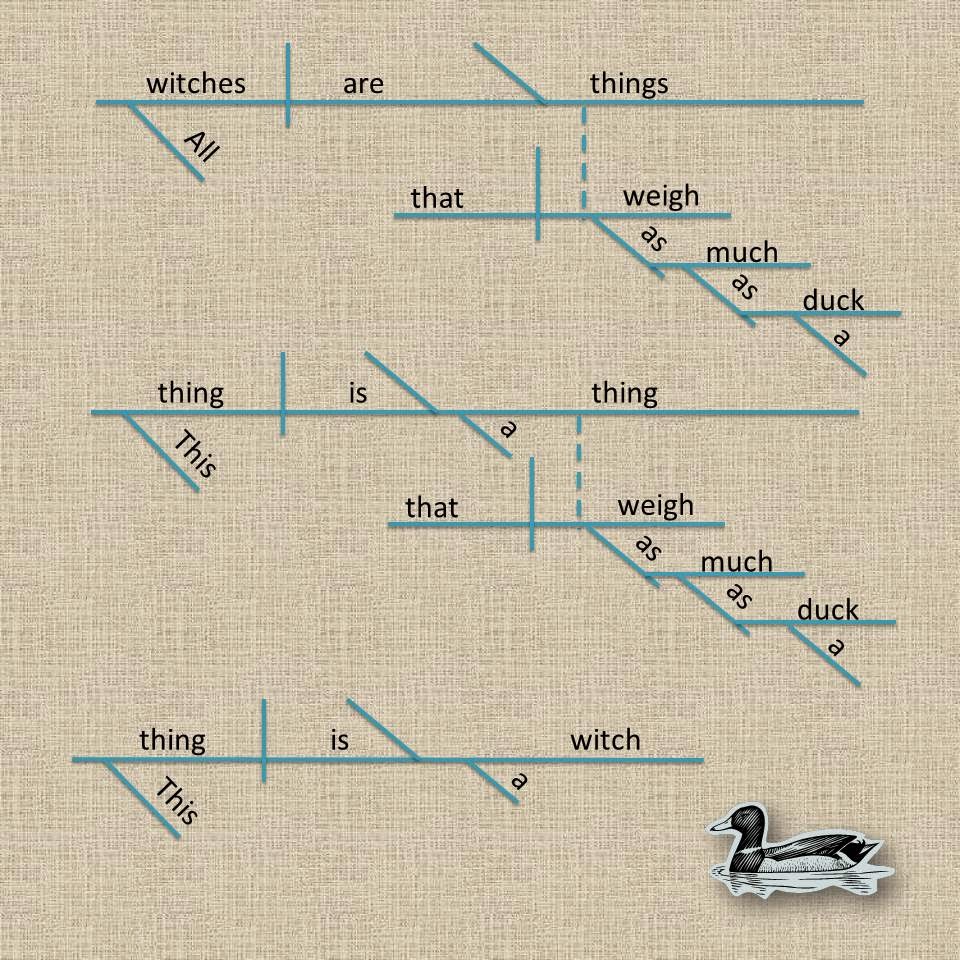
Does it really take an analysis of form and truth, though, to understand that this particular syllogism is not quite right?  Not really.  Before ever testing this argument for form or truth, we can diagram the sentences, the propositions, to help us narrow the sentences down to their essential elements.  Thus broken down, we can easily determine our A,B,C's and see that the language is vague and ill-stated - never a good sign of a sound argument.

The essential elements on the base lines of these propositions read "witches are things," "things are made," and "witches are made."  Someone should probably tell Sir Vladimir that "things" is never a great way to define the terms of our arguments.  "Things" is an example of vague language, and in the end, vague language ends up meaning practically nothing.

The Witch's Trial: The First Syllogism


Second Syllogism


The second syllogism is written in an invalid form.  The valid form is as follows:
  • All A's are B's.
  • All C's are A's.
  • Therefore, all C’s are B’s.
However, this invalid syllogism is written as follows:
  • All A's are B's.
  • All C's are B's.
  • Therefore, all C’s are A’s.
Do you see the difference?

Furthermore, it's again quite obvious that the premises are untrue, and even more obviously, the essential elements of these sentences are circular and nonsensical: All three read "Things are things."  

  • First Premise: All things that are made of wood are things that can float.
  • Second Premise: All things that weigh as much as a duck are things that can float.
  • Conclusion: So all things that weigh as much as a duck are things that are made of wood.


The Witch's Trial: The Second Syllogism


Third Syllogism


Just as with the second syllogism, this third syllogism is written in an invalid form.  The valid form, as above, is as follows:
  • All A's are B's.
  • All C's are A's.
  • Therefore, all C’s are B’s.
However, this syllogism is written as 
  • All A's are B's.
  • All C's are B's.
  • All A's are C's.
Even though slightly less vague than the previous sentences, the sentences in this third syllogism are still quite ridiculous: "witches are made," "things are things," and "witches are things."  We also know that the first and second premises are false, which makes this syllogism both untrue and invalid.

  • First Premise: All witches are made of wood.
  • Second Premise: All things that weigh as much as a duck are things that are made of wood.
  • Conclusion: Therefore, all witches are things that weigh as much as a duck.


The Witch's Trial: The Third Syllogism


Fourth Syllogism


Just as with the second and third syllogisms, this fourth syllogism is, once again, written in an invalid form.  The valid form, as above, is as follows:
  • All A's are B's.
  • All C's are A's.
  • Therefore, all C’s are B’s.
However, this syllogism is written as 
  • All A's are B's.
  • All C's are B's.
  • All C's are A's.
And, not to be confused with newts or women with carrots tied around their faces, according to Sir Vladimir, "witches are things," "thing is a thing," and "thing is a witch."  The first premise is also untrue, making each and every one of these syllogisms unsound arguments.

  • First Premise: All witches are things that weigh as much as a duck.
  • Second Premise: This thing is a thing that weighs as much as a duck.
  • Conclusion: Therefore, this thing is a witch.


The Witch's Trial: The Fourth Syllogism

How'd you do?  Were you able to do it, or did you head off to buy a shrubbery?  

Please use the comments box below to let me know if you have any questions, or if you just want to brag that you were able to tackle these syllogisms.  I will not say "Ni."


Want to learn more about diagramming sentences?  

Take my complete online course, "Sentence Diagramming: From Beginner to Expert in 12 Lessons" on Udemy, or purchase my text, Diagramming Sentences: A Playful Way to Analyze Everyday Language (affiliate link) on Amazon.


Friday, September 12, 2014

A Narrative Essay: Holding Hands

In about 45 minutes I will stop typing, eat some breakfast, take a shower, and pack my black suit.  I will be leaving for my 4th funeral in 2 years, and that number doesn't include the number of funerals I've not been able to attend.  I wonder if this is the real sign of being an adult; if that being an adult has nothing to do with grey hair, sore muscles, and numbers of years, and has everything to do with the numbers of funerals we attend for people we love?

When I was yet well away from being an adult, a little kid still a few feet from being as tall as my grandmother, we used to walk together.  We would, as is normal for a grandmother walking a young grandchild, hold hands.  She never just held my hand, though.  She would slightly squeeze it, three times, once for "I," once for "love," and once for "you."  

As a small child I thought, of course, that if I understood the squeeze, everyone must understand it.  I tested it on my grandfather, and he got it and squeezed back.  I tested it on my dad, and he got it and squeezed back!  My mom and my aunt got it, too!  I tested it on everyone I knew, and everyone I knew got it!  As I got older I would use this squeeze when I held hands with other people, and some would understand it, squeeze back.  Some would not get it, misunderstand, and either I'd let go or they'd let go.  As I got even older, I would use it as a test on unsuspecting dates.  Those that couldn't get it didn't last very long.  It was a good test.

My grandmother and I used the squeeze every chance we got to see each other, which wasn't enough for either one of us.  Over time, the squeeze developed into a conversation.

"Squeeze squeeze squeeze," for "I love you."
"Squeeze squeeze," for "How much?"
"Squeeeeeeeeeeeeeeeeeze," in response.

My grandmother and grandfather were both buried on the same day.  As people were standing graveside with their own thoughts, I had only 3 squeezes in my head.  As people were standing to explain to all of us what my grandparents meant to them, I had "squeeze, squeeze, squeeze" in my head.  During the luncheon? "Squeeze, squeeze, squeeze."  The flight home?  "Squeeeeeeeeeeeze."

Today I am going to my 4th funeral in 2 years.  I will go with my husband to honor his uncle.  I will make us some breakfast, we will take our showers, and we will pack our suits.  I will stand with him and hold his hand, and I will squeeze three times, and he will get it.  Today I will think of all the love we have for the amazing person we've lost, and it won't just be a sad day, although it will be a sad day.  I will make today another reminder to never take any opportunity to squeeze for granted, to squeeze with everyone I want to squeeze as often as I can.

Want to read more about narrative essays?  Try

Prewriting a Narrative Essay
Why Write a Narrative Essay
The Use of Narrative Assignments in Introductory Literature Courses


Copyright Amy Lynn Hess.  Please contact the author for permission to republish.


Friday, September 5, 2014

Diagramming Sentences: Folk Song Friday

A sentence diagram of "You Are My Sunshine."
"You Are My Sunshine" is a great song to use for diagramming and analysis!

Diagramming sentences is a playful way to analyze everyday language.  Part of our everyday language includes music and song. Why not practice our grammar and analysis skills by diagramming a song?


"You Are My Sunshine" was written by Oliver Hood and the Rice Brothers' Gang in 1933.  It makes a great song for analysis because of its complicated sentence structures and catchy, popular tune.  Furthermore, as we begin to diagram and analyze this song, we start to see that there is more to it, and this speaker, than just life with sunshine.


Do you know how it goes? One, two, three, four, one . . .


The Chorus


The lyrics to the chorus of "You Are My Sunshine."
"You Are My Sunshine" Chorus

The chorus of the song, the most well-known part of the song, contains an appositive, a complex sentence structure, a personal address, an imperative sentence that uses understood you, linking verbs followed by subject complements, and an interjection.  It also includes contractions and a noun clause.  Can you pick them out?  I'll give you a hint: Appositives and understood you will always be placed on a diagram in parenthesis.

Verse One


"You Are My Sunshine" Verse One

Just like the chorus, the first verse of the song contains a personal address, a linking verb, a noun clause, and a complex sentence structure.  In addition, this verse also includes a compound verb, a present participle, a prepositional phrase, and a compound-complex sentence structure.

As a matter of comparison to the chorus, we can easily see in this verse that there are a lot of I's as subjects. All six clauses have "I" to the left of the subject-verb divider line.  What do you think that might mean?  What might that imply about the speaker in the song?

Verse Two


"You Are My Sunshine" Verse Two

The second verse introduces an infinitive phrase, "to love another,"  and the object complement, "happy." There is also another good example of an appositive, the renaming of "it" for "all."

The double  inclusion of the word "if," a subordinating conjunction, tells us even more about the speaker than the many uses of the word "I" in the previous verse.  Think about the circumstances that people are in when they most often use the word "if." The circumstances are often uncertain, or a person may be examining his or her potential future paths.  This type of sentence is called a conditional sentence.

Verse Three


"You Are My Sunshine" Verse Three

The third verse offers an excellent example of an indirect object and an excellent test of our abilities to diagram a compound-complex sentence.  The compound-complex sentence in this verse contains four clauses.  Do you see all four?  Here is a hint: "You told," "you loved," "no one could come," and "you've left and love," are the four subject-verb pairs.

Because songs and music are such an integral part of our daily lives, taking the time to analyze them can truly help us understand them better.  Diagramming, though exceptionally helpful when learning about grammar and usage, can also help us find ways to analyze a song's meaning by helping us see patterns in the language. Those patterns prompt us to ask questions and dig deeper into the song's greater implications.  As we can see here, this particular song is about a lot more than just life with "sunshine."

Want to learn more about diagramming sentences?  

Take my complete online course, "Sentence Diagramming: From Beginner to Expert in 12 Lessons" on Udemy, or purchase my text, Diagramming Sentences: A Playful Way to Analyze Everyday Language (affiliate link) on Amazon.


Tuesday, August 26, 2014

More than a Calorie Counter: A Review of MyFitnessPal Products

A fork holds a pea, a salad, and a cookie.  Do you need help keeping track of the food you eat?
Do you need help counting calories or compiling
additional nutritional information?

MyFitnessPal's free calorie-counting products are user-friendly, educational and effective.


I have been ten to twenty-five pounds over my ideal weight, up and down, for about five years. Just exercising has not helped me lose those extra pounds I've been carrying, and I have known all along that the way I was eating was contributing to the problem. Two weeks ago, I decided to make a change. For my first step, I sat down with my phone to search for "an app for that." I found MyFitnessPal, a free mobile app with very high user ratings. I decided to give it a try. Two weeks later, I've lost four pounds, and I'm more knowledgeable than ever about how my lunchtime choices affect my health.

MyFitnessPal's Free Mobile App and Web Site are Quick and Easy to Use


MyFitnessPal can be used quickly and easily on either a user's iPhone mobile device, Android mobile device, Blackberry device, or on the Web site. In large green numbers, the homepages display the number of calories a user, based on his or her start-up goals and settings, has left to consume in a day. As the day progresses and entries are added, food calories are deducted from the total, and exercise calories are added to the total. Summary information is available as a graph, or as a "Fitness," "Nutrition," or "Progress" Report. It's very easy to check-in and keep track.

Although it may seem like an overwhelming task to keep track of calories, this product makes it quite simple. Every user has access to an extensive database of both calorie-per-food and calorie-per-exercise information. It's very easy to search for a food by brand, choose a serving size, and add the food to the diary for the day. Exercises can be searched by type, time spent, and level of activity. Foods and exercises that are used often, like a daily coffee, for example, can be clicked and reused in seconds without searching. Calories can also be quickly added or deducted without being linked to a food or exercise, and foods or exercises a user wants to add to the database can be added at any time.

The Site Provides Educational Nutrition and Calorie Information


As mentioned previously, each MyFitnessPal user has access to an extensive database of calorie and nutritional information. This type of information, at a person's fingertips, can be used to make decisions on a daily basis about what to eat - before it's purchased and eaten. Not only do the databases contain Calorie information, but fat, cholesterol, sodium, potassium, carbohydrates, fiber, sugars, protein, and vitamins A, C, calcium, and iron. This makes it possible for nutritional information to be used by people who may have additional health concerns in any way they may need to use it. For instance, a person with high blood pressure may be more interested in sodium or potassium than in calories.

In addition to the databases, this product offers access to recipes, personal recipe calorie calculations, weight-loss tickers, a Basal Metabolic Rate calculator, a Body Mass Index calculator, and a heart calculator. All of these are useful on their own, but when used together to promote an all-around healthy lifestyle, they are invaluable. The more educated a person is about his or her own health, the healthier he or she is likely to be.

A Free Online Product to Help You Eat Healthier 


According to the 2011 Food and Health Survey conducted by the International Food Information Council Foundation, when asked "Over the past six months, have you made any changes in an effort to improve the healthfulness of your diet?" 59% of American responders answered, "Yes." To me, this does not seem like enough. So perhaps with its extensive tools and databases, ease of use, and its social networking functions, MyFitnessPal will help more people meet this main objective, the objective of those Americans who responded "Yes," is to lose weight and lead healthier lives. One has only to look at the outpouring of support, positive messages, and success stories on the Message Boards to see that this product works. One only has to try it to feel that it works.

References


International Food Information Council Foundation (2011). 2011 Food and Health Survey. Retrieved from http://www.foodinsight.org/


Disclaimer: The information contained in this article is for educational purposes only and should not be used for diagnosis or to guide treatment without the opinion of a health professional. Any reader who is concerned about his or her health should contact a doctor for advice.


Copyright Amy Lynn Hess. Contact the author to obtain permission for republication. Originally published on Aug 11, 2011.

Monday, August 18, 2014

Bell Pepper Soup: An Adaptable Veggie Classic

Images of home made bell pepper soup with ground turkey.
An easy, inexpensive, gluten-free recipe!

This adaptable soup, made with three types of bell peppers, is flavorful, colorful, healthy, and fairly inexpensive.


This bell pepper soup is exceptionally adaptable. It's a great recipe to use whether I'm feeding a large group of big eaters or just cooking for myself. I freeze any leftovers in glass storage containers and pull them out of the freezer for single meals, making it easy to pack lunches or plan for a busy week. After it's reheated, there is no lost flavor.

I can also make this soup a few different ways depending on my budget—either my money budget or my calorie budget. Depending on my guest list, it can be gluten-free, sugar-free, low-sodium or high-fiber. My favorite way is to make this soup by choosing low-fat and low-calorie ingredients because the low-calorie and low-fat ingredients make up for eating it with homemade bread and butter and a big glass of milk!

I've marked here what I've found to be either required or optional ingredients.

Required Ingredients for Bell Pepper Soup

From the fresh produce department


3 fresh bell peppers (I like to use one green, one red or orange and one yellow.)
1 small bag of baby carrots
1 sweet onion


From the canned goods aisle


2 -3 cans/jars stewed or diced tomatoes
1 large can/box chicken broth


From the meat department


1 pound of ground turkey


"Soup it Up" with Optional Ingredients


Yellow bell peppers behind small piles of diced red and green bell peppers.
Make this soup using three kinds of bell peppers.

From the spice rack 


(I add all my spices to the turkey while it's browning.)
1 tablespoon ground cumin
1 teaspoon fresh garlic
1 tablespoon sea salt
1 tablespoon mixed, ground peppercorns
1 tablespoon chili powder (Surprisingly, adding this is best in the summer when it's hot.)

From the frozen foods aisle


1 cup frozen spinach
1 cup frozen beans

Homemade or dry ingredients


1-2 handfuls of Polish kluski or Hungarian rivilchas (I add these when it's cold outside, but when I add noodles, I have to use more chicken broth. This option is not the low-calorie option.)

Steps for Making Bell Pepper Soup


Carrots, bell peppers, tomatoes, and ground turkey in a chicken broth.
Even after cooking, the soup remains bright and colorful.
1. I use a teeny-tiny bit of olive oil in a 6-quart kettle to prevent my meat from sticking. I brown my turkey, spices and onion in the kettle.

2. As the meat browns, I dice the peppers and add them to the kettle, too. Because I use ground turkey, there is no need to drain the meat when it's cooked all the way through, and I can add the tomatoes, broth, beans, spinach and carrots right into the same kettle. This has to come to a boil, then I lower the heat to simmer for an hour. It takes that long for the baby carrots to get soft—and longer when I use big carrots.

3. During the last 10 minutes, I bring the soup back to a boil to add the kluski or rivilchas. Dry noodles and fresh noodles take the same amount of time to cook, but I've found that fresh noodles actually absorb more broth, so I have a little more broth on hand.

4. When the noodles are soft, I turn off the stove. Before I eat, I let the soup sit on the stove for 20 more minutes to cool—then I eat!


Copyright Amy Lynn Hess. Contact the author to obtain permission for republication.  First published Jul 1, 2011 by Amy Lynn Hess.

Thursday, August 14, 2014

How to Write Recipes

A cookbook lays open in a lovely kitchen and a lemon meringue pie sits finished.

Written recipes are a type of expository writing.  The goal of a recipe writer is to explain to a reader how to prepare a dish.


Minimally, a recipe includes ingredients and step-by-step  instructions.  Sometimes a recipe includes a list of required equipment or skills. In addition to those basics, however, there are many other ways to liven up a recipe.  Sometimes a recipe writer will add nutritional information, a brief history of the dish or ingredients, or add alternative methods or dietary requirement instructions.  As readers, we may take a recipe writer's writing skills for granted as we drool over beautiful photographs of the finished product.  We shouldn't.

In addition to the recipe's content, a recipe writer must also pay special attention to writing conventions.   The grammar and mechanics of writing a recipe are just as important, if not more so, than in any other piece of expository writing.


Measurements and Abbreviations

First, a recipe writer must adhere to a consistent set of measurements and abbreviations.  Can you imagine a new baker reading a recipe and trying to figure out how to combine 4g of baking powder with 1C of flour and 2 ounces of baking soda?  What about .5L of milk?  How about if it said 4 TBS or 4 TBLS or 4 TSPS?  Is 4 tsp the same as 4 TSPS?  And aren't ounces for liquids?  Some fortunate souls might be able to work it out, but others will not.  Therefore, it is essential that a recipe contain measurements and abbreviations consistent with the conventions accepted by the intended audience and consistent within the recipe - not changing willy nilly in the midst of the recipe.

Verb Tense and Order

Second, a recipe writer must use the proper verb tense and explain the cooking steps in such a way that they are easy to follow.  In other words, it's important to clearly tell the reader when tasks and steps should be completed by using a clearly defined step-by-step order.  A new cook might truly appreciate the instructions to preheat an oven while whisking eggs, or to add chopped nuts only moments before placing a bread into the oven. However, if the instruction to preheat the oven appears after the instruction to add chopped nuts, the instruction to add nuts moments before placing the bread into the preheated oven will be for naught.

A recipe will also read more smoothly if verbs are consistent with previous verbs.  It will read even more smoothly if the structure of each step emphasizes the verbs.  For example, each new step can begin with "chop," "dice," "saute," "steam," or "grate."

Vocabulary and Terminology

Third, when writing a recipe, the vocabulary of cooking must be used correctly.  "Saute" and "fry" may seem like the same thing to some cooks, but they really are not.  Likewise, to use the zest of lemon is not the same as using a lemon.  And can you imagine what might happen if you label a recipe gluten-free when it is not, or vegan when it is really vegetarian or pescatarian?  It is essential that the specific language of cooking, all the jargon and vocabulary associated with cooking, be used appropriately.

The main goal of a recipe writer is to help the reader recreate a favorite dish based on the written recipe.  That requires recipe writers pay very close attention to some very specific writing conventions in order to successfully meet that goal.


Copyright Amy Lynn Hess.  Please contact the author for permission to republish.

Wednesday, August 6, 2014

How to Paraphrase Source Content

An actor presents Act V Scene 1 from Hamlet, much to the confusion of the man on the left.
Comprehension is key to a successful paraphrase.
There are three ways to incorporate ideas from another writer into your own papers.  First, you might quote the original source.  Alternatively, you could summarize the main idea or ideas from a source.  Third, you could paraphrase the original by putting it into your own words while still expressing the context and tone of the original.

Of the three, I believe paraphrasing is the trickiest to master, as it requires complete comprehension of the original and a strong understanding of how to rephrase the original idea in context and in your own words.


A Paraphrase Requires Complete Comprehension of the Original Source Content 

First things, first:  In order to rephrase someone else's words, you must thoroughly understand the original.  For example, do you thoroughly understand the following sentence from a United States government memo written during World War II?

Such preparations shall be made as will completely obscure all Federal buildings and non-Federal buildings occupied by the Federal government during an air raid for any period of time from visibility by reason of internal or external illumination.

Franklin Roosevelt, the United States President at the time, found it difficult to understand.  However, once he worked out its meaning, he paraphrased it as "Tell them that in buildings where they have to keep the work going to put something across the windows."


A Paraphrase is a Rephrase the Original Source Content

In order to ethically paraphrase an original bit of text, the writer must put the idea into his or her own words, or use quotation marks to set apart any key words or phrases he or she doesn't change, and then attribute the original to the original writer.  Let's look at an example.

James Thurber once said "There is no good writing, only rewriting."  If I wanted to borrow that, I could learn it by heart and let others know I was quoting James Thurber, or I could try to paraphrase the idea - and still let others know the idea came from James Thurber.  I might say, "To paraphrase James Thurber, rewriting makes writing effective, not just writing." 

Always make sure the paraphrase is truly in your own words and not too close to the original.  Otherwise, you might be accused of plagiarism.


A Paraphrase Must Maintain the Original Content in Context

Mike Palmquist, writer of The Bedford Researcher, offers the following advice about paraphrasing in context:

"To provide a clear context for your source information, establish why the quotation, paraphrase, or summary is reliable by identifying the source's credential's.  In addition, indicate how it relates to your main idea and what it contributes to the point you're making." (pg. 252)

To paraphrase, you should always make sure a reader can tell the difference between your own writing and the paraphrased content of others.  Furthermore, you should make sure your readers know why you've included the paraphrased material by making sure you tell them how the content supports your own idea.  

For example, instead of stringing together a list of paraphrased facts . . .

While President Clinton was in office, private sector jobs grew more than at any other time in U.S. history.  While he was President, democrats held the majority in Congress.  President Obama's term in office has not seen such growth.  Republicans control Congress.

Make sure the reader knows where your information originated and what point you are trying to make by including it.  

Private sector job growth can be influenced by a number of factors.  One is the cooperation between the executive and legislative branches of government.  For example, while President Clinton was in office, private sector jobs grew more than at any other time in U.S. history (Jackson, 2006, para. 6).  Contributing to the successful jobs numbers was his ability to work seamlessly with the legislative branch: While he was President, and a democrat himself, democrats held the majority in Congress.  On the other hand, President Obama's term in office has not seen such growth (Smith, 2014, pg. 578).  As the republicans control Congress, they are seemingly unwilling to cooperate with President Obama, a democrat.


If you continue to practice diligently using and citing paraphrased source content, you will get more and more comfortable and adept at taking a bit of information, unraveling it, and rephrasing it in context.


Try my complete online essay writing course on Udemy Writing for English Composition: College Essays.

Thursday, July 31, 2014

How to Summarize Source Content

One way to increase the credibility of your ideas is to incorporate expert ideas into your own writing with summary material.


What's summary material?


A stack of books is bigger than a summary on a piece of paper.
Can you summarize your favorite novel or film?
Unlike a quotation, which is an exact replica of another writer's original words, sentence or sentences, a summary "is a concise statement, written in your own words, of information found in a source" (Palmquist, 2012, pg. 257). For example, you can't possible quote an entire chapter in a textbook, but you could summarize its main point.  You might also summarize the main point of an entire article or entire book, or even just one paragraph.  The important thing is that you make your summary original, concise, and use it in such a way that the reader knows you have borrowed the information.  In other words, always cite summary material, and add it to your paper using attribution words.


Can you show me an example of summary material?


When summarizing an entire article on poisonous spiders, for example, a writer might compose the following paragraph:

It's exceptionally important that people enjoying the outdoors be able to identify poisonous spiders indigenous to the area where they are spending their leisure time.  Misidentifying a poisonous spider might have traumatic results.  For example, Dr. Sam Wessel, in an article called "A Guide to Poisonous Spiders Across the World," tells how, in 1994, his brother misidentified a spider in the desert as being a benign spider from his hometown in Ohio, a forested area.  The misidentified desert spider was extremely poisonous, and as a result of the confusion, his brother lost his entire arm by the following year (2009).


What makes a summary a good summary?


The writer of the previous paragraph follows all of the rules for using summary material.

  1. The original article was several pages long, but the summary concisely reiterates just the main point that supports the topic sentence of the paragraph.  
  2. Furthermore, the writer was successful in letting readers know where they can find the original, like when I wrote "in Dr. Sam Wessel's article, "A Guide to Poisonous Spiders across the World," which was published in 2009. . ."  
  3. We can also easily tell which information from the paragraph belongs to the original writer, and which information came from Wessel.


To summarize using summary material, be sure the information you summarize is pertinent to your own, original point.  Make sure the reader can distinguish your own ideas from the ideas that came from a source.  Last, but not least, make sure you cite the summary material.


References


Palmquist., M. (2012). The Bedford Researcher (4th ed.). Boston, MA: Bedford's/St. Martin's.


Try my complete online essay writing course on Udemy Writing for English Composition: College Essays.

Wednesday, July 23, 2014

How to Crochet: American Single Crochet or British Double Crochet

A stocking cap shows the crochet symbol for a single crochet and reminds us that a single crochet stands 1 loop tall.
The American Single Crochet stitch is also known as the British Double Crochet.

The American single crochet stitch, also known as the British double crochet stitch, is an easy-to-learn basic stitch that any beginner can master.


The single crochet is a great stitch for making projects that require a fabric that isn't too "holey."

For example, the single crochet stitch can be used for washcloths, hot pads, slippers, tablecloths, jewelry, scarves, bags, purses, amigurumi, blankets, bowls, felted fabrics, ornaments, and clothing.  The texture of the fabric can be altered by using different size hooks with the appropriate weight of yarn.


Want to Learn the Single Crochet?


By watching a few videos and remembering the sing-song mantra "around, through, pull through one, pull through two," you, too, could soon be making your very own projects while reaping the many mental health rewards of this craft . . .

because . . .

if you didn't already know, just the act of crocheting, itself, has an added benefit:  Crocheting is good for your mental health!

  1. First, it's a very good form of stress relief and can be therapeutic for many people. 
  2. Second, it's a relatively inexpensive, creative outlet.
  3. Third, it's also a great way to connect with others, and 
  4. fourth, it also helps people give back to their communities.  
As a matter of fact, a psychologist friend of mine recently told me crochet is even sometimes used to treat PTSD or severe anxiety.  A skein of yarn and a hook cost under $10.00.  There are a multitude of online groups and local classes for learning to crochet, and, according to Wikipedia's Crochet entry, some ways people give back are to create clothes and blankets for soldiers, cancer patients, homeless shelters, newborn babies, and nursing homes (para. 43).


Are you ready to pick up a hook and learn how to crochet?


Try my complete online crochet course, "Crochet for Stress Relief" on Udemy.com.  

Using ChatGPT for Essays in English Composition Classes

The best essays are written by people for people. "Corona Typewriter" image courtesy of the author ChatGPT and other AI language g...