Welcome!

Do you have APA formatting questions? Thesis statements got you down? Need to study grammar? Need some help with critical thinking? Having trouble with literary analysis or research? Want to take a look at some example essays? Well, I probably have a post here somewhere that can help you. Please use "Search This Blog," the "Labels," or my "Blog Archive" to help you find what you need. Have questions about what you find? Please feel free to comment or ask questions. I do moderate comments, and I try to respond to all topical questions and comments in a timely manner.
Showing posts with label Poetry. Show all posts

Wednesday, December 12, 2018

A Comparison Essay: On Kaiseki and Haiku

Seasonal Kaiseki image by Nishimuraya Kinosaki used with
Creative Commons License 4.0.

Haute cuisine, much like poetry, has both internal and external form. In addition to how a dish looks, its ingredients and components, it's expected to be more than the sum of its parts: A fine dining experience of the highest caliber contains within it the chef's narrative and an essence of unity.  The same is true for poetry.


Japanese seasonal kaiseki is a lot like Japanese haiku, for example.

The Importance of Haiku's Internal Form: Kigo and Kireji

A haiku's external form is immediately recognizable.  Most readers of poetry can identify a haiku by its three lines of a set number of sounds per line: In Japanese, the lines are divided into 5-7-5 sounds, and in English some poets have adapted that structure into 5-7-5 syllables per line. However, the poem's internal form is much more intricate and contextual than its external form. A haiku's excellence and importance is judged by its use of seasonal words and cutting words, known as kigo and kireji, respectively.

A poet's seasonal words, or kigo, come from lists of words known to evoke particular seasons or even to draw upon the cultural context of famous poems that use the same seasonal words. These lists of kigo are called saijiki.

An excellent explanation of how to use cutting words, or kireji, comes from Michael Dylan Welch:

In Japanese, traditional haiku include words that function like a spoken sort of punctuation. More importantly, they cut the poem into two parts, creating a sort of juxtaposition, not only grammatically but also imagistically. The point is to carefully pair two images together in such a way that a shift or disjunction occurs between them. The art of haiku lies in creating the right amount of distance between the two parts, so the leap is neither too far (and thus obscure) or too close (and thus too obvious). By focusing on concrete images rather than judgment or analysis, the two juxtaposed parts of a haiku allow the reader to feel what the poet felt, without the poet telling the reader what to feel.

Just as the simplicity of haiku's external form tricks us and pleasantly surprises us as we dig into its images and meaning, a chef's internal form, narrative, or unity, can surprise and delight the palates of diners. An excellent haiku poet's use of kigo and kireji sets them apart as masters of the form just as a chef's knowledge of technique and ingredients creates renown.

Seasonal Kaiseki 

Lines of haiku are not the only inspiration that comes in threes. Appreciating a balance of three has been instilled in artists across all art forms, and cooking is included in that long list. According to an article by Elaine Yu and Amanda Sealy from 2006, kaiseki is an "evolving tradition," but initially, "a set consisted of meshi (steamed rice), shiru (soup) and mukozuke." In the traditional, diners started with rice and soup to "warm up the stomach," then would move on to sake and sashimi. Like haiku, the flavors and textures progress in an order determined by the maker, the poet, the chef. The meal is punctuated with a form of culinary kireji.

Traditional kaiseki has more in common with haiku than its Japanese origins, punctuated progression and lines of three, however. Kaiseki is based on seasonal ingredients. A hassun is a seasonal platter that sets the tone of the meal based on its ingredients, those available fresh in any given season. Just as the kigo sets the season of a haiku, the ingredients found fresh in a given season may become part of the hassun course. A yakimono is a course of grilled, seasonal fish. A ko no mono is a course of seasonal vegetables, prepared and pickled.  Being seasonal is part of the language of kaiseki, just as seasonal words are part of the language of haiku.

Culinary expression and poetic expression may seem miles apart as art forms and as experiences, yet haiku and kaiseki speak to one another and through one another. A haiku is a meal of seasonal words, punctuated and progressing toward a feeling of satisfaction in the images. Kaiseki is an edible poem, and those who appreciate it savor its available ingredients, its kigo, just as much as they savor the separation and pauses between courses.

Want to read more about poetry? Try

How to Identify a Sonnet
Denotative and Connotative Meaning in the Poetry of Denise Levertov
Diagramming Mina Loy's "Letters of the Unliving"
En Plein Air and Haiku


Works Cited


Welch, Michael Dylan. "Why 'No 5-7-5'?" NaHaiWriMo. http://www.nahaiwrimo.com/home/why-no-5-7-5

Yu, Elaine & Amanda Sealy. "A Beginners Guide to Kaiselki, the World's Finest Meal." CNN. Nov. 8, 2016, https://www.cnn.com/travel/article/guide-to-kaiseki-cuisine/index.html 

Copyright Amy Lynn Hess. Please contact the author for permission to republish.

Tuesday, October 11, 2016

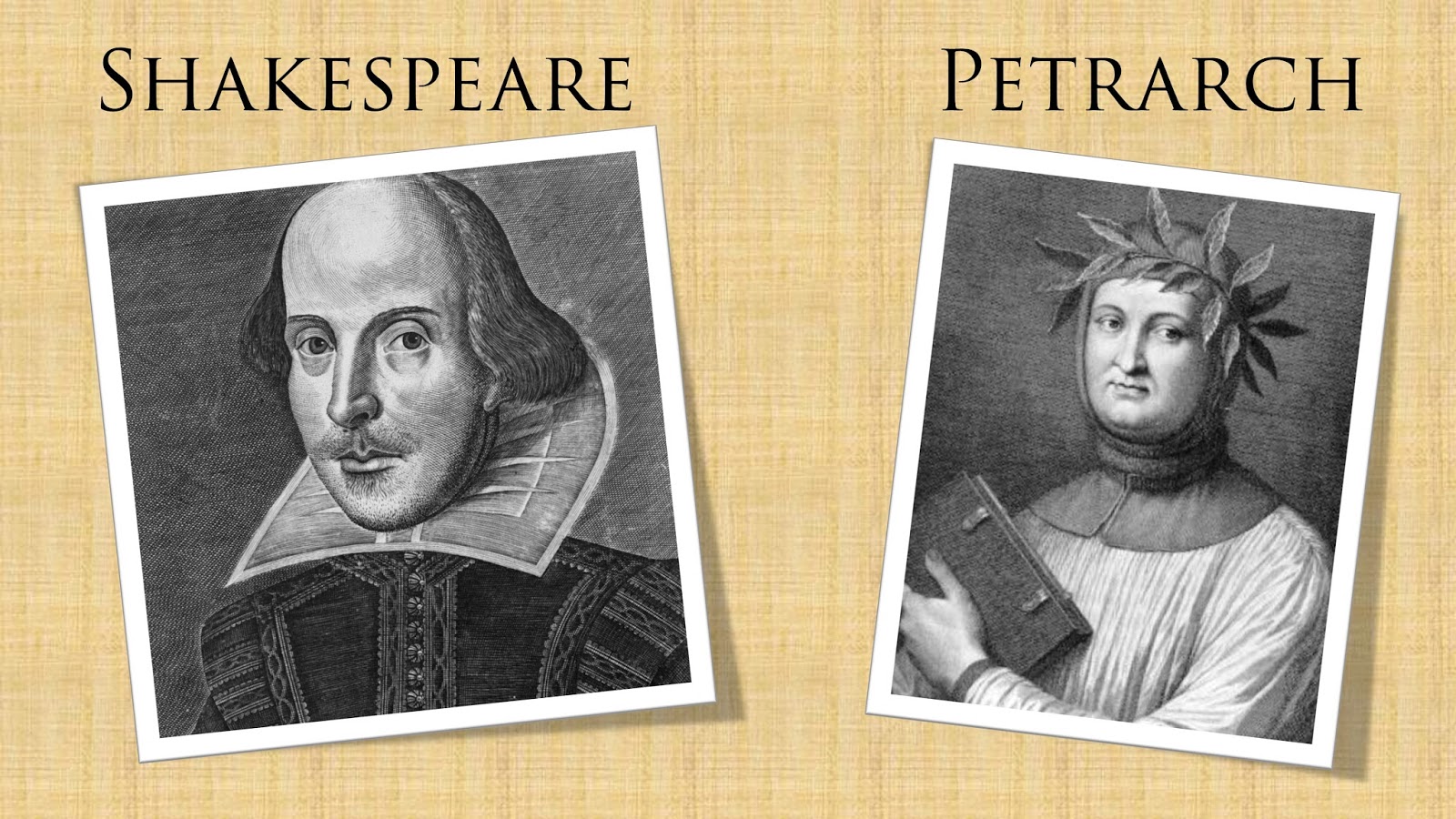
How to Identify a Sonnet: Italian and English Sonnet Forms

Which type of sonnet do you prefer?
Sonnets have been around since sometime within the 12th Century, which means they've been around for about 1000 years, give or take a few centuries and decades. That's a long, long time.

The most popular sonnets are generally known for their rhyming 14-line forms, each line having been written in iambic pentameter, or the rhythm of a heartbeat in one breath: ta TUM ta TUM ta TUM ta TUM ta TUM.

Although there are several forms of sonnets, as you can imagine of a form that has had a 1000 year lifespan, the most popular sonnets are usually one of two types: Italian, otherwise called Petrarchan, or English, otherwise called Shakespearean.  Understanding the external forms of these poems can help inform readers about the internal forms.

Italian or Petrarchan Sonnet

External Form

The Italian sonnet, named after the writer Petrarch, is divided into an octave (a stanza of 8 lines) and a sestet (a stanza of 6 lines).  The rhyme pattern can vary, but the pattern is often abbaabba and cdecde, cdcdcd, or cdccdc.  Interestingly, however, originals in Italian that are translated to English demonstrate adjustments to the rhyme scheme in order to maintain meaning.  In other words, the meaning of the poem is more important than the rhyme scheme.

Internal Form

The internal form of an Italian sonnet relies on, just like the external form, a division between the octave and the sestet.  The octave often presents a difficult or vexing situation that is resolved in the sestet. There is often a shift in the tone of the poem or the in the attitude of the speaker, as the ideas shift from problem to solution.

Example

This example from Edna St. Vincent Millay (1892 - 1950), a 20th Century American writer from Maine, follows the Italian rhyme scheme and internal form.  Notice the shift in the speaker's attitude in the sestet.

I Will Put Chaos into Fourteen Lines

I will put Chaos into fourteen lines (a)
And keep him there; and let him thence escape (b)
If he be lucky; let him twist, and ape (b)
Flood, fire, and demon — his adroit designs (a)
Will strain to nothing in the strict confines (a)
Of this sweet Order, where, in pious rape, (b)
I hold his essence and amorphous shape, (b)
Till he with Order mingles and combines. (a)
Past are the hours, the years, of our duress, (c)
His arrogance, our awful servitude: (d)
I have him. He is nothing more nor less (c)
Than something simple not yet understood; (d)
I shall not even force him to confess; (c)
Or answer. I will only make him good. (d)


English or Shakespearean Sonnet

External Form

The English sonnet is most often divided into three quatrains (3 stanzas of 4 lines each) followed by a couplet (2 rhyming lines). This rhyme scheme is easier for writers in English to follow than an Italian sonnet simply because English has fewer rhyming words than Italian.

Internal Form

Whereas the shift in attitude or meaning takes place between the octave and the sestet in an Italian sonnet, the shift in an English sonnet often occurs with the break between the final quatrain and the couplet.

Example

This example from "Visions" by Francesco Petrarch (1304 -1374) has been translated into English by the English writer of The Faerie Queene, Edmund Spenser (1552 - 1599).  This translation is written in Spenser's typically archaic style, using Middle English spelling and pronunciation. Although originally written in Italian, in translation it follows the English  rhyme scheme. Readers can look for a shift in meaning within the last two lines of the poem, as the ideas shift from the observations of the speaker to the speaker's insight about the situation.

Being one day at my window all alone, (a)
So manie strange things happened me to see, (b)
As much as it grieveth me to thinke thereon. (a)
At my right hand a hynde appear’d to mee, (b)
So faire as mote the greatest god delite; (c)
Two eager dogs did her pursue in chace. (d)
Of which the one was blacke, the other white: (c)
With deadly force so in their cruell race (d)
They pincht the haunches of that gentle beast, (e)
That at the last, and in short time, I spide, (f)
Under a rocke, where she alas, opprest, (e)
Fell to the ground, and there untimely dide. (f)
Cruell death vanquishing so noble beautie (g)
Oft makes me wayle so hard a desire. (g)


In order to better understand poems, it is necessary to be able to identify forms, both external and internal.  An external form can quickly inform a reader about specific shifts in meaning that he or she can expect to find within the internal structure of the poem.  In this case, when readers know they are reading an Italian sonnet, they can look for shifts in attitude or a solution to the initial problem within the last six lines of the poem.  Likewise, when readers know they are reading English sonnets, those readers can look for shifts in meaning in the last two lines.  The form can always help the reader determine the function.

Want to read more about poetry and literature?  Try

Denotative and Connotative Meaning in the Poetry of Denise Levertov
Diagramming Mina Loy's "Letters of the Unliving" as a Method for Close Reading
The Shoe as Image in the Poetry of Amy Lowell and Charles Simic


Copyright Amy Lynn Hess.  Please contact the author for permission to republish.
Thursday, April 14, 2016

Denotative and Connotative Meaning in the Poetry of Denise Levertov

From "Of Being" by Denise Levertov
Image curtesy of Amy Lynn Hess

Both the denotative and connotative meanings of words are of the utmost importance to poets, most of whom dedicate their lives to finding not just the right words, but the exact words to express their ideas as specifically and concretely as possible.  


Denise Levertov is no exception. In fact, her poetry relies upon her readers' dedication to investigating each carefully chosen word's definitions and associations.

Murray Bodo speaks of her use of words in the essay, "Denise Levertov: A Memoir and Appreciation." Bodo states, "She seldom spoke glibly. It was as if she were searching for the right word to emerge as she went along, much as she said a poem proceeds—organically word by word, image by image, line by line" (n.d.).  Armed with this knowledge of her proficiency with words and the expectations she has of her readers, those readers can begin the process of analyzing her poems one word at a time.


Analysis of Denise Levertov's "Of Being"

Denotation


In "Of Being," there is one word in particular that requires an exploration of its denotative meaning, its dictionary definition: "ineluctable."  Although it is similar in meaning to "inevitable," "inexorable," "unavoidable," or "unpreventable," its very subtle difference in meaning opens up the poem for better interpretation.


From "Of Being" by Denise Levertov
Image curtesy of Amy Lynn Hess

"Inevitable" implies that future consequences, results, or effects cannot be avoided.  "Inexorable" implies there is, much like the continuous tense, something happening in the continuous present, an action that cannot be stopped or prevented.

"Ineluctable," the word Levertov chooses in "Of Being," implies there is a fact that cannot be denied. 

If readers replace, much like in algebraic equations, "a fact that cannot be denied" for "ineluctable" in the poem, the truncated clause, with each subject paired with the predicate, reads:

This shimmering of wind in the blue leaves is a fact that cannot be denied.
This flood of stillness widening the lake of sky is a fact that cannot be denied.
This need to dance is a fact that cannot be denied.
This need to kneel is a fact that cannot be denied.
This mystery is a fact that cannot be denied.

These are undeniable facts, she says.  She doesn't say they are effects, consequences, results, or actions.  Because of the exact use of the exact word "ineluctable," she refers to this list as facts, undeniable facts.

Connotation


From "Of Being" by Denise Levertov
Image curtesy of Amy Lynn Hess

In addition to carefully examining denotative meanings of words in poems, like "ineluctable," readers should also examine connotative meanings, or the culturally or socially defined emotional associations of words.

Connotative word associations or feelings often appear in patterns. In "Of Being," such a pattern appears with the words "looming," "suffering," and "fear."

When analyzing word connotations, which are generally either in some way positive or in some way negative, some are difficult to interpret, and some are quite obvious.  In this instance, the negative emotions associated with "looming," "suffering," and "fear," are easy to notice.  This doesn't mean, however, that they were not carefully chosen.  When we think of "looming," we may feel a sort of oppression from above or from around a corner, just out of sight. We think of a predator, while we are the prey.  This connotative meaning reiterates the idea of "peripheral vision" that appears later in the clause.  The idea that suffering and fear wait just out of sight, ready to pounce like predators, is exceptionally important; important enough to be indicated twice.

Yet, she tells us, even though these predators wait for us, for a moment there is beauty:

This shimmering of wind in the blue leaves is a fact that cannot be denied.
This flood of stillness widening the lake of sky is a fact that cannot be denied.
This need to dance is a fact that cannot be denied.
This need to kneel is a fact that cannot be denied.
This mystery is a fact that cannot be denied.

In the face of "fear" and "suffering," "happiness" appears, even if "provisional," as she states in the first lines of the poem.  In the face of "looming presences," "happiness" appears.

Conclusion


In poetry, using the exact words matters.  It is the task of a careful reader to scrutinize and research the meanings of words while formulating an interpretation.


References

Bodo, M. (n.d.). Denise Levertov: A memoir and appreciation. Image, 27. Retrieved from http://www.imagejournal.org/article/denise-levertov-a-memoir-and-appreciation/


Levertov, D. (1997). Of Being. In E.V. Roberts & H. E. Jacobs (Eds.), Literature: an introduction to reading and writing (8th ed.), (pp. 480). Upper Saddle River, NJ: Pearson/Prentice Hall.


Want to read more about analyzing poetry?  Try

Diagramming Mina Loy's "Letters of the Unliving"
Ars Poetica: When a Poet's Fly is More Than a Fly
The Shoe as Image in the Poetry of Amy Lowell and Charles Simic


Want to learn even more about diagramming sentences?  


Take my complete online course, "Sentence Diagramming: From Beginner to Expert in 12 Lessons" on Udemy, or purchase my text, Diagramming Sentences: A Playful Way to Analyze Everyday Language (affiliate link) on Amazon.


Copyright Amy Lynn Hess.  Please contact the author for permission to republish.


Tuesday, May 12, 2015

If I Were 22 Challenge


"If I Were 22" is a new project started by the social media site, LinkedIn.  In this series of memoirs, articles, or blogs, people from all ages and all walks of life are looking back to when they were 22 and offering advice to their younger selves.


I challenged myself to complete this very difficult piece of self reflection, and what emerged was a poem.  I'd started with an outline for an exceptionally long essay, but in the end, continued to par down my ideas until they were the very few that I could honestly say wouldn't change my life.  Why wouldn't I change my life, correct my mistakes, and live an alternate reality?  Well, because I'm pretty happy, and I believe things happen for a reason.  So, I guess I cheated and didn't really give my younger self advice so much as I offered hints.

At any rate, I whittled it down to 80 words.  Can you?  Do you accept the challenge?


if i were 22 i'd
tell myself      that people
are really        tiny
and really
fragile             and
really
beautiful

be nice

be frugal generous grateful

travel              but
make home home

solve problems                           be independent

listen            be still                    eat fruit and
ice cream

listen to Tom Waits
do yoga or go swimming            repeat

grieve without fearing loss

read Mina Loy and all Kurt Vonnegut's books in order

make mistakes

and change your mind                sometimes
because people are tiny and
fragile
and beautiful


Copyright Amy Lynn Hess.  Please contact the author for permission to republish.

Monday, June 9, 2014

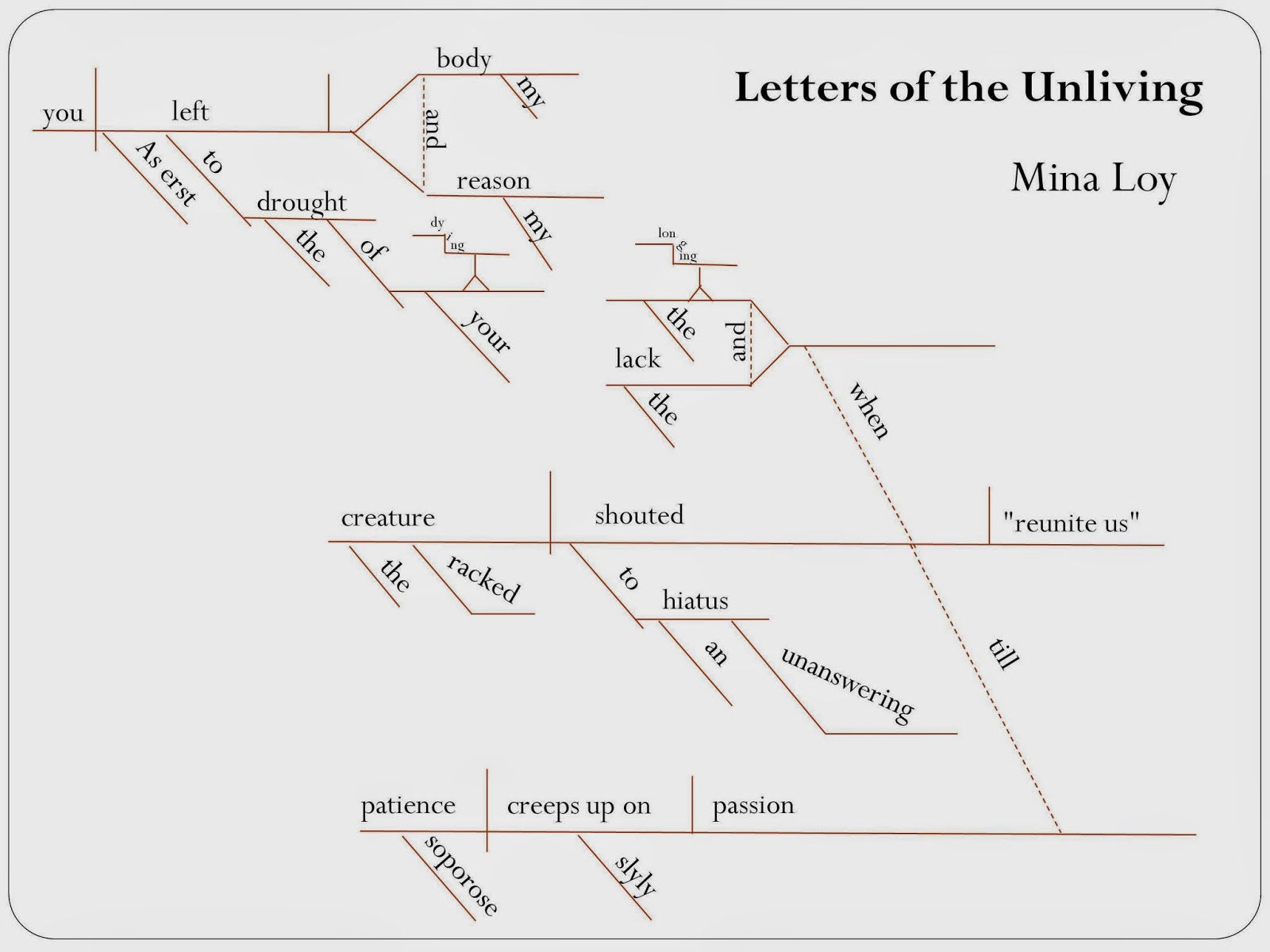
Diagramming Mina Loy's "Letters of the Unliving" as a Method for Close Reading

Diagramming Poetry as a Method for Close Reading
I have recently been working on a new collection of poetry that explores grief and loss.   In order to better study the poetry of loss, I've returned to the poet of my graduate thesis, Mina Loy.   I have found meaning in her poetry today that I could not find eight years ago. 


One of Loy's poems that quite literally makes me catch my breath is "Letters of the Unliving"  as published in The Lost Lunar Baedeker: Poems.


History and Syntax

Loy's history, thus the history of the poem is this: Loy met Arthur Cravan in 1917 and married him in 1918.  Opposed to serving in WWI, Cravan took Loy to Mexico to escape the military draft.  Once in Mexico, and after experiencing some trouble with both military authorities and the professional boxing crowd, "They bought a small, leaky sailing boat with the idea of patching it up and trading it in for a more seaworthy vessel"  so that Cravan might sail to Buenos Aires.  "In early November, only days before the Armistice was signed, Cravan set sail in the repaired craft for the nearby coastal village of Puerto Angel. The weather was fine and the boat apparently in good shape. Loy waited for days on the beach, gazing out to sea, but Cravan never returned" (Ford, 2007, para. 23).

However, no matter the interest in the tragic, romantic loss of love and self depicted this poem, the cathartic fear of loss we feel when we read the history, or perhaps because of the terrible beauty of the language of this poem, I have been having great difficulty sharing this poem with my students.  Although the idea, the elegy, makes the poem universal, the syntax makes the poem difficult to access.


Diagramming and Accessibility

Mina Loy
Image by Stephen Haweis, via Wikimedia Commons
In order to overcome the challenge of accessibility, I diagrammed a section of the poem to help my students better see and understand each unit of meaning, with all of its poetic license and grammatical truncation.  In its simplest form we can pick out subjects and predicates that, in and of themselves, are beautiful: "You left," she states.  "The racked creature shouted," she tells us, "'reunite us.'"  In the end, "Patience creeps up on passion."  The final diagram, though, is a mess, from a missing predicate in the second clause, to a phrasal verb in the final clause, to a fragmented quotation as part of an apostrophe in the third clause. Yet, no one said grief was grammatically pretty.  It's a tangle; a complicated tangle, and once my students and I saw it untangled for the first time, we shared a moment of understanding on one of its deepest levels.


The Gift of Excess

Of this poem and Loy, William Keckler beautifully and aptly states, "She creates a dignified superstructure in this dual elegy which allows for what might elsewhere be excessive; that is Loy's particular gift" (para. 3).  Once my students and I stripped excess from the poem, then put all of it back into place, we could all better understand this "dignified superstructure," this "dual elegy."  We could appreciate the language for what it gives us without leaving anything out.  Once we saw the poem for what it is we forgave what others might call "excess," and we embraced it, this looking back at grief from the future as a person forever changed by loss.


References


  • Ford, M. (1997). Spawn of Fantasies. New Republic, 216(21), 38-41.
  • Keckler, W. (2007). Mina Loy & Arthur Cravan: "Letters of the Unliving." [Web log, Joe Brainard's Pyjamas].  Retrieved June 4, 2014 from  http://joebrainardspyjamas.blogspot.com/2007/09/mina-loy-arthur-cravan-letters-of.html


Copyright Amy Lynn Hess.  Contact the author for permission to republish.

Monday, February 17, 2014

The Shoe as Image in the Poetry of Amy Lowell and Charles Simic

A black and white photograph of a pair of old work books with the caption "The Shoe as Poetic Image."
What do your shoes say about you?
Shoes contain a rich and powerful significance, an historical set of meanings and imagery that lend themselves to making just as powerful works of poetry.


Although shoes are something people often dismiss as objects to be tossed into the closet after a long day at work, an evening of blistering dancing, or a day spent in the park, there are also seemingly endless possibilities for metaphor and the human condition associated with shoes. “If you want to leave your footprints in the sand of time,” the saying goes, “wear work boots.” "Put your best foot forward," coaches tell their teams before a game. "If the shoes fits . . .” we say in vague reference to owning up to foibles.

Poignant Imagery


Two poems that tap into the poignant imagery of the shoe are Charles Simic's poem "My Shoes," and Amy Lowell's "Red Slippers." "My Shoes" first appeared in Charles Simic: Selected Early Poems in 1999. "Red Slippers" appears in Amy Lowell's 1916 Men, Women and Ghosts.

Simic's "My Shoes"


In Charles Simic’s poem, “My Shoes” (n.d.), the poet uses an extended metaphor to help illustrate his feelings about his life. The extended metaphor works wonders here because of the rich history preceding the image of the shoe. He compares his “secret” (line 1) life to a pair of shoes, but not just any pair of shoes. He describes his shoes as “toothless” (line 2), “decomposed” (line 3), "humble" (line14), “maternal” (line 17), and “patient” (line19). His shoes, he states, have endured as he has endured, and all we need know about him “it is possible to read” (line 10) in his shoes. Simic taps into our universal relationship to the shoe, and with it he writes an exceptionally powerful poem about his own life. It's a poem wherein the poet tells the reader what it's like to “walk a mile in his shoes."

Lowell's "Red Slippers"


Amy Lowell speaks directly to the forgettable nature of the shoe in her poem "Red Slippers." Although she dramatically describes a pair of red shoes in a shop window as more colorful than anything else in the street scene, in the end, the shoes are ignored and passed by shoppers in the street. The red shoes and their "crimson reflections" (line 3) that drip, jam, scream, and plop throughout the first stanza, are "multiplied in the mirror side of the window" in the second stanza and "they swing up over curved heels like whirling tanagers sucked in a wind-pocket" in the third. They are active images, and the poet is curious enough about them to dedicate the majority of the poem to their description. However, in the end the shoes seemingly capture only the attention of the poet as "People hurry by, for these are only shoes" (line 16). The everyday shoe, no matter how colorful, is not as novel as its rival, "a cardboard lotus bud" (line 19). As humans, we understand and feel sad on behalf of the red slippers, all readers somehow understanding how it feels to be passed when needing a little attention.

Shoes contain a rich and powerful significance, an historical set of meanings and imagery that lend themselves to making just as powerful works of poetry. Without having to explain the nature of the shoe, both Simic and Lowell make use of the idea of "shoe" to make eloquent statements about the human condition.

References


Lowell, A. (n.d.). Red slippers. Retrieved from Poets.org: From the Academy of American Poets.
Simic, C. (n.d.). My shoes. Retrieved from Poets.org: From the Academy of American Poets.


Need More Help Writing about Literature?

 Here are three additional posts that can help you learn to write about literature.


Copyright Amy Lynn Hess. Contact the author to obtain permission for republication.  First published Jul 5, 2011 by Amy Lynn Hess.

Thursday, September 19, 2013

Mina Loy's "Modern Poetry" and Its Relevance Today

An excerpt from an essay by Mina Loy: Poetry is prose bewitched, a music made of visual thoughts, the sound of an idea.
From Loy's "Modern Poetry" Image by Dave Bonta

Mina Loy's opinions about poetry are just as important today, if not more so, than in her own Modern Era.


One of the lesser-known poets of the Modern Era, Loy took seriously the tenets of Lowell and Pound's Imagism as stated in the "Imagist Manifesto," as well as Pound's challenge to make poetry new. She followed his example and joined the Modern literary conversation with an essay of her own called "Modern Poetry." What makes this essay relevant today is that what she praises as well-written poetry for the Modern Era remains true in our own time.


The Modern Era


The beginning of Modern poetry can be defined by the emergence of American avant-garde poets just before the start of World War I in 1914. Among the most famous of the Modern poets, and this list is certainly limited, are Ezra Pound, Gertrude Stein, T.S. Eliot, Marianne Moore, William Carlos Williams, Wallace Stevens, E.E. Cummings, and Hart Crane. These poets exhibit the sentiments of Pound, who challenged the poets of his time to “make it new.” Not only did they meet this challenge, but their influence has grown over the past poetic century as they have influenced new generations of poets.  How these poets made poetry "new" was defined not only by the most well known of the Era's poets, it was also explained by Mina Loy in her essay, "Modern Poetry."


Mina Loy's "Modern Poetry"


In Mina Loy's “Modern Poetry,” an essay first published in the non-literary magazine Charm in April of 1925 (Conover 217), Loy begins, “Poetry is prose bewitched, a music made of visual thoughts, the sound of an idea” (157). What follows that first sentence is a nine-point evaluation of Modern Era poetry. The majority of her essay focuses on using a natural rhythm for personal topics, and in the popular poetry of today, this acclaim for free verse, rhythm, and musicality is just as popular, if not more so than in 1925. As for the music of poetry, one only has to look at the popularity of rhythmic slam poetry, "music made of visual thoughts," to hear its spontaneity and see its effect on the popularity of poetry.


"Music Made of Visual Thoughts"


Several of Loy’s points in "Modern Poetry" praise the music of the then-new free-verse form. Almost with an air of knowing what was to come in the future of poetry, as over the years it has competed more and more with popular music as entertainment, she begins by saying music is more easily accessible to people than poetry because while music is “easy to get in touch with,” poetry requires “voluntary attention” (Conover 157). She continues to explain that poetry must be read as “pictured song” (157). Almost prophetically predicting the advent of slam or jam poetry, she explains that tempo and verse are used properly when found spontaneously, just as structured meter was at one time new and original, spontaneous thought. She extols Ezra Pound as the master at creating musical qualities in verse, and gives much credit to E.E. Cummings. Of Cummings she states his success lies in his “rich compassion” for “common things,” and his rhythms created by the combination of a free-verse form and “fresh rhymes.” Loy then gives examples of perfect poems, naming work by Hilda Doolittle, Marianne Moore, Lawrence Vail, and William Carlos Williams. Her last point again praises the “sublime” Williams. Loy cites his ability to create the new rhythm of poetry by his joining of bare fact with personal nature (161).

The poetry of the Modern Era has had a profound effect on the poetry we read and hear today - both as the written word and in popular song. Modern poets, famous and lesser-known alike, contributed to this evolution of rhythm, meter, image, and "the everyday" as acceptable poetic subjects. Most notably of the lesser-known poets is Mina Loy, whose opinions about poetry as explained in her essay, "Modern Poetry," are just as valid today as they were in 1925.


Want to read more about Mina Loy?  Try

Diagramming Mina Loy's "Letters of the Unliving" as a Method of Close Reading

Works Cited


  • Conover, R L. (ed.) (1996). The Lost Lunar Baedeker; Poems of Mina Loy. New York: Farrar, Straus and Giroux.


Works Consulted


Copyright Amy Lynn Hess. Contact the author to obtain permission for republication.

Thursday, August 22, 2013

Poetry and The Controversial: The Value of Truth

Controversy is Often Confused and Complicated
Do you value the truth?  Do you value the truth more than you value pride, decorum, holiness, obedience, respect, tradition, or wealth?  More than silence, skill, reason, happiness, discipline, art, or education?  Do you value the telling of truths?

As yet in my life, I have found nothing else in this world that raises hackles and brings on loud, menacing attacks so much as telling the truth; and what is poetry if not the telling of truths?  Such is the dilemma, then, that even when a poet strives to tell the truth as exactly as possible given the limitations of abstract language systems, the truth and the telling of it both bring about complicated controversies. 


Act I -  Exposition: One Defines and Redefines Controversy


Controversy


According to Merriam-Webster Online, a controversy is “a discussion marked especially by the expression of opposing views.”  They list “dispute” as a synonym.  The Oxford Dictionary defines it as a “prolonged public disagreement or heated discussion.” A discussion is a conversation marked by an exchange of ideas.  An opposing view is an argument that contradicts another argument.  An argument is the statement of position backed by reason and evidence, specifically true evidence.  The origin of the word truth is an Old English word that means "faithfulness."

In short, a “controversy” is, traditionally, a rational discussion about a truth or the telling of a truth with special consideration paid to opposing views.


Controversy Redefined


A “controversy” is a physical or verbal fight over perceived offenses either purposefully or unintentionally committed.  Offended, in this redefinition, meaning “in dislike of” a truth or someone’s telling of that truth.

If some truth within a piece of poetry, whether it's the theme, the language, the metaphor, the irony, the circumstances,  is called “controversial,” it means that there are those who dislike that truth and are very keen to eliminate, confuse, or silence that piece of writing, that truth.  If it's the telling of the truth that has offended the opposition, they are more likely to want to, and in no way am I being trite or dismissive, eliminate, confuse, or silence the writer.

The level of dislike for that truth can be mapped on a continuum marked “discomfort” on the far left, “anxiety” in the center, and “terror” to the far right.  The level of dislike marked on the continuum seems to have a direct correlation to the level of faithfulness one has to an opposing view, even when faced with incontrovertible evidence to the contrary.  See “sticky theory.”


Act II -  Rising Action: One Uses the Conventional Definition of Controversy and Creates Misunderstanding


“I do not find your work controversial” she said, meaning she, personally,  did not find anything with which to argue, meaning all of the poet’s premises and conclusions were sound and valid truths.

“You don’t find it controversial because you are solipsistic and ethnocentric” he said, thinking she overlooked or ignored the premises and conclusions entirely, thought them beneath the level of deserving of consideration.

“Wait!  What?”  she replied, wondering why anyone would be so upset about a level of complete  agreement.


Act III – Peripeteia, Anagnorisis and Dénouement: Another Explains the Redefinition of Controversy and Creates Clarity


I had an amazing conversation yesterday with an amazingly intelligent poet about the meaning of controversy within poetry.  Because I had always thoughtfully considered, then accepted entirely the premises and conclusions within his writing, I overlooked the fact that others would not be so apt to do so.  So, yes, I was being slightly solipsistic, and I had to be shown that there were opposing views and that there was controversy surrounding his work. I had to sit and think about it.  Whether or not a poem or book of poetry is protest poetry, and whether or not a poet is an activist poet, that work may cause an unexpected emotional reaction in others.

I also learned from the conversation that although it is a starting point to either accept or reject ideas and arguments on a personal level, a larger scope of literary analysis is also necessary.  Even when it’s completely outside my realm of understanding why a certain truth would be unacceptable to another reader, there are going to be readers for whom a truth, or the telling of the truth, is unacceptable.  Digging into the controversy and attempting to discover root causes of the discomfort, anxiety, or terror, could be far-reaching, culturally significant, and should not be ignored.

Writing raises hackles when writers tell the truth.  This truth-telling butts up against the desire of others to gloss over the truth for more preferred narratives or more tempered descriptions of the same truth.  The faithfulness a reader has to an opposing view will determine the level of emotional reaction to a work.  That level of reaction may cause the reader to want to eliminate, confuse, or silence the writing, or even the writer.  It’s a battleground, these pages of poetry and stories, and the war is between what is told and what is untold.   The war happens whether we’ve been drafted or not, whether we understand what we're fighting for or not, and whether we've proclaimed ourselves pacifists or not.  "Controversy" does not live only within the realm of civil discourse.


Want to read more about poetry?  Try

Ars Poetica: When a Poet's Fly is More Than a Fly


Copyright Amy Lynn Hess.  Contact the author for permission for republication.

Monday, July 29, 2013

Using the Personal Universe to Meet Literary Learning Objectives

"Galaxies and Universes" by Torley Olmstead
Licensor agreement Creative Commons 2.0 
Creating a Personal Universe Deck is an enlightening exercise for poets, but it can be a beneficial assignment for introductory literature students, as well.


At Naropa University's Summer Writing Program in 2006, I was lucky enough to take a workshop with Michael McClure, who explained to the workshop members how to create a Personal Universe Deck. Since that time, I have not only created several decks for my own use and practice, but I have learned to adapt the technique to use as an assignment in my Introductory Literature Classes. Slightly adapted, I use it as an assignment to meet two separate learning objectives. First, I use it to help students identify the difference between concrete and abstract diction. Additionally, I use it as a way to introduce textual analysis.

The "Original" Personal Universe Deck


McClure does not take credit as the originator of this exercise, but attributes its creation to the daughter of friends (Personal Communication, June 2006). The benefits poets find in creating one of McClure's Personal Universe Decks are explained on blogs and personal Web sites all across the Internet. Although he did not create this exercise, he has perfected and propagated it, teaching the rules to students for several decades.

Shortened versions of the rules for the exercise also can be found on several Web sites, but a more complete version of the rules can be found on Paul E. Nelson's blog.

Personal Universe Deck
(Michael McClure)
Your personal universe exemplified in 100 words.
Rules:
  1. These words are to exemplify your past, present and (ideally) your future.
  2. The words must sound good together, even beautiful, to you.
  3. Your good side AND bad side must be reflected.
  4. You can make up a word or two if you have feelings that current words can’t express.
  5. Use concrete words.
  6. Words should be root words, no words ending in “ing,” “ly” or “ies.” No plural words. Reduce words to their most concrete, original, basic grammatical structure.
  7. Use specific words, not categories. Beef instead of meatLily instead of flower.
  8. Divide 80 of the 100 words evenly among SIGHT, SOUND, TASTE, TOUCH AND SMELL, sixteen each. (To achieve derangement of the senses, of which Rimbaud spoke.)
  9. Use free association to determine the words.
  10. Use ten words of movement. Again, no “ing” words.
  11. Select the words in isolation, preferably alone, with no distractions, in candlelight. Approximate a meditative state. Even the cat must not bother you.
  12. One or two words will be parts of the body. It does not have to be your body. It can be the body of a mother, or lover.
  13. Include some words for personal heroes or SHEroes, places in the universe, invented words, times of night or day, symbolic signs like astrological signs, totemic animals, birds and plants and only one abstraction. What is the most significant abstraction in your life? You should not brood on it; you should possibly take the first answer that comes into your head. Patriotism, prayer and thriftiness are three examples.
  14. If the deck is done correctly, you will get a little high from it.
  15. Get at least 50 three-by-five index cards.
  16. Write each word in big letters on one side of each card. Each side of each of the fifty cards should end up with a word.
  17. Use the cards to play games, make conversations, tell jokes, make poems.

To summarize, a writer will create a list of 100 visceral, concrete words that exemplify his or her personal universe, the good and the bad, the past, present, and future, the real, and the mythological. The point of the exercise is for the writer to be able to tap into his or her psyche, or personal universe. Whether or not the exercise leads to better poetry is irrelevant in the making of the word deck, though it often does lead to such. It's an enjoyable, meditative exercise, hence its popularity and effectiveness.

Using the Personal Universe Assignment to Teach Concrete Diction


A selection of cards from a Personal Universe Deck.
 Personal Universe Deck
The Personal Universe Deck exercise can be adapted to help students identify the difference between concrete and abstract diction. Because the list of words students use for the Personal Universe Deck should, for the majority, be concrete, the use of this listing exercise as an in-class or homework assignment helps the students put the literary terminology to good use. Provided the rules for creating the 100-word list and perhaps a pre-printed table, students can construct their Personal Universes. As stated above, it's an enjoyable exercise, and it offers a teacher or professor the opportunity to immediately assess whether or not a student understands the difference between visceral, concrete language and abstract or vague language.

Using the Personal Universe Assignment to Teach Literary Analysis


After students have created their charts and met the requirements of the learning objective, they can then use the same blank, pre-printed chart to analyze work written by others. Students can, for example, deconstruct a series of three poems by the same poet by placing all of the words from the poems into columns on the chart, labeled “Sight,” “Sound,” “Smell,” “Taste,” “Touch,” “Movement,” or “Mythology.” The students will have to think carefully about the poems in order to make decisions about which words to place in which columns. Furthermore, after the charts have been completed, the students can then look at the charts and make additional analysis statements about the poems or poet. Students can look for consistency in connotations, archaic definitions, images, or sound devices. Using a chart with which they are already familiar is a fantastic bridging exercise to encourage learning across various levels of Bloom’s Taxonomy: understanding literary terms and being able to apply literary terminology to the analysis of literature.

As a poet, I very much value the Personal Universe Deck exercise as taught by Michael McClure. As an English Professor, I have found that both of these adapted Personal Universe assignments offer real learning opportunities beyond the use of the original exercise.


Want to read more about poetry?  


Copyright Amy Lynn Hess. Contact the author to obtain permission for republication.

Tuesday, June 4, 2013

Ars Poetica: When a Poet's Fly is More Than a Fly

Visceral details and figurative language doesn't have to be pretty.  Take flies on a fly strip, for example.  The image isn't pretty; it's just the most apt.
Like a Fly, "Like a Little Rock"
Image by Maggie McCain
Ron Riekki's poem "Marquette Branch, Oct. 26, 2009" published in his poetry chapbook Leave Me Alone I'm Bleeding, is an exceptional example of Ars Poetica, a poem about how to write poetry.


What is Ars Poetica?  What Does Ars Poetica Mean?


The term Ars Poetica stems from Horace, who wrote a poem entitled "Ars Poetica" “sometime between 20 B.C.E. and 13 B.C.E.” (Academy of American Poets, 1997, para. 1). In the original, Horace offers advice to other writers about how to write good poetry. Over time, the term Ars Poetica has come to be used to describe any poem that offers advice about how to write poetry.

There are many famous examples of Ars Poetica, including poems by Billy Collins, Emily Dickinson, John Keats, and William Carlos Williams. However, none are better at explaining the poetic concepts of concrete diction and metaphor like Ron Riekki’s "Marquette Branch, Oct. 26, 2009." In this poem, he teaches the reader that in a poem, a fly can be much more than a fly.

Teaching is the Essence of Ars Poetica


In Riekki’s poem, the speaker of the poem is teaching prisoners how to write poetry. This situation makes the poem an obvious example of Ars Poetica. What makes it such an effective example is that the poet has seamlessly integrated his advice for the prisoner-poets into a dialogue form that allows for the prisoner-poets to learn from the speaker. Simultaneously, this allows the reader of the poem to learn from the poet.

The two specific elements of poetry this poem teaches are the concepts of concrete diction and metaphor. The lesson hinges upon a hinge device the poet uses in the final stanza. The final stanza of this poem contains an ironic hinge: The speaker has a realization about poetry while having a dialogue with one of the prisoners. That hinge device draws attention to the lesson presented to the readers, the lesson that concrete diction and metaphor are essential concepts in understanding poetry.

Seeing the Everyday Tangible is the Essence of Concrete Diction


Concrete diction is a literary term that refers to words and phrases that name material things, tangible items, things that can be touched (Shakel & Ridl, 2008, pg. 1612). 

By offering advice and examples, the speaker teaches the prisoners and readers the definition of concrete diction. The first piece of advice the speaker offers the prisoners about concrete diction is in the first three lines of the poem: “First, I tell them not to write the obvious./ Don’t say that they’re prisoners./ Show that they’re prisoners” (Riekki, 2010, pg. 14). The speaker encourages the prisoners, in very accessible language, to move beyond the stereotype or cliché of “prison” and to find new ways to present the life they lead every day. This “showing” the speaker advises requires the use of concrete diction, a tangible piece of their everyday lives.

In the second stanza, the speaker offers the concrete, tangible example of “this fly strip” that “looks like it hasn’t been changed/ in eight years” (lines 7-9). He goes on to describe “all these flies” (line 14), and a “hard” (line 17) fly that is “like a little rock” (line 18), which are all example of the type of concrete diction required for effective comparison.

The Surprising Comparison is the Essence of Metaphor


A metaphor is a direct comparison that surprises the reader, and perhaps makes the reader think of something in a new or surprising way. A poet uses metaphor when he or she finds points of comparison between two things that are often thought of as dissimilar (Shakel & Ridl, 2008, pg. 1618).

At the end of Riekki’s "Marquette Branch, Oct. 26, 2009," the idea of concrete diction that was established early in the poem is used to teach the prisoners and readers the effective use of metaphor when one of the prisoners compares all of the prisoners to the “rotting” (Riekki, 2010, pg. 14, line 15) flies on the fly strip.

With a simple, “That’s us” (line 19) and “We’re those flies” (line 21), the prisoner, Troy, teaches the real lesson about poetry to both the speaker and the reader. Riekki’s prisoner, Troy, doesn’t say the prisoners are “like” the flies. He opts for the more poignant use of the metaphorical direct comparison, thereby demonstrating for the reader the use of metaphor as an effective literary device. Alongside the speaker, the reader has his or her realization about the use of effective metaphor. Excited by the realization, the speaker replies to the line, “We’re those flies” (line 21) with “Right, I say,/ exactly,/ if you understand that, you understand poetry” (lines 22-24).

Ron Riekki’s "Marquette Branch, Oct. 26, 2009" is an exceptional example of Ars Poetica, a poem about how to write poetry. Through the careful use of dialogue, irony, concrete diction, and metaphor, the poet teaches not only the meaning of these devices, but offers poignant examples.


Want to read more about poetry?  Try


Create a Poetry Chapbook
Publish Your Own Poetry Chapbook
The Shoe as Image in the Poetry of Amy Lowell and Charles Simic


References


  • Academy of American Poets. (1997). Ars Poetica: Poems about Poetry. Retrieved from http://www.poets.org/viewmedia.php/prmMID/20035
  • Riekki, R. (2010). Leave Me Alone I'm Bleeding. Tucker, GA: GypsyDaughter.
  • Shakel, P. & Ridl, J. (2008). Approaching Literature: Writing, Reading, Thinking. (2nd ed.). Boston, MA: Bedford/St. Martin's.


Copyright Amy Lynn Hess.  Please contact the author for permission to republish.
Tuesday, May 14, 2013

Create a Poetry Chapbook

A collection of chapbooks from an array of writers.
A Collection of Poetry Chapbooks 

A poetry chapbook is the perfect way to collect a series of poems with satisfying artistic expression.  


You can keep these works of literary art as keepsakes, or you can give them to family and friends as personalized gifts.  Additionally, when you design your chapbooks to be easily reproduced, you can sell them or hand them out as marketing materials at poetry readings and events.

Whatever your purpose for creating your chapbook, there are three basic stages of chapbook planning and production: preproduction, production, and post-production.  All three phases of creation will include both artistic tasks and administrative tasks.


Preproduction


In the preproduction stage, you will make artistic choices about a budgeted finished product.


First, you must decide which of your poems you would like to collect as a series.  This requires that you make a decision about how each poem communicates or relates to the previous poem and the following poem, in order.  This decision can be made based on a common theme in the poems, the subjects of the poems, the chronology of the poems, your intended audience, or any other unifying factor.

Next, you get to decide how you want your finished chapbook to look.  Decide how you will bind your book, what length you’d like it to be, how the cover will look, and what size pages and types of materials you’ll use.  For example, you might want to bind your book using spiral binding, using brads, staples, sewing it by hand, or placing it in an origami box or brown paper lunch bag.  Your pages can be any shape or size, and your poems can be on pages together, or one per page.  Your poems can be handwritten, typed on a typewriter, created in a word processor, or spoken into an audio program.  You can decorate the pages by hand, with clip art, as scrapbook pages, or with artist’s colors.   You can print pages at a local print shop, on a home printer, at work when no one is looking, by creating digital images, or by typesetting.  Your options are limited only by your budget.  You can, however, find extremely creative ways to overcome budget restrictions.


Production


During the production phase, you get to create and reproduce your drafts and final chapbook.


Once you have planned how you want your chapbook to look and how much you want it to cost, you can begin creating your chapbook.  Enjoy the creation process by taking what you have planned in your preproduction stage and making a mock version of your chapbook.  Investigate vendors, choices, and materials as you work to be sure you do not overextend your budget.  Make tweaks and changes to your plans as needed or required by your expectations of the project.

Most importantly, be sure your chapbook is exactly right before calling your chapbook finished.  This means you should not rush through the process.  Carefully, frequently, and thoroughly check your spelling, page numbers, titles, layout, and any front or back matter information.   If you duplicate print versions of your chapbook with an error, that error will be costly.


Post-production


The post-production phase of the chapbook creation process includes marketing and distribution activities.


If your book is meant as a gift or keepsake, these decisions will be easy.  If you want to use your chapbook as a marketing tool or sales product, on the other hand, you have to decide where you will read your work, which events you are going to attend, where and how you will sell your product, and how much you will charge.  These decisions may require research and administrative patience.  For example, there are electronic or web sales options to consider, which may or may not require official copyright or ISBN’s.

Whatever decisions you make before, during, or after production of your chapbook, just keep in mind that the most important part of the process is your enjoyment of the act of creating and the satisfaction that comes with producing a chapbook of your own work.


Want to know more?


Learn how to publish your own poetry chapbook.
Would you like to take a complete online course about how to publish your own poetry chapbook? 


Try my Udemy course! Publish Your Own Poetry Chapbook


Want to read more about poetry or publishing?  


Copyright Amy Lynn Hess.  Contact the author for permission to reuse.

Thursday, March 21, 2013

The Importance of the Mission Statement in Small Press Publishing


A publication's mission statement is the ruler
by which submissions are measured.
A well-worded mission statement is a must-have for small press and independent publishers. It's important not only to the publication's editors, but to its potential writers.


There are two angles to discuss when considering the importance of the mission statement in small press or independent publishing.

First, in addition to its publication guidelines, the mission statement acts as a measuring stick by which submissions can be judged by the publisher. Consequently, it is also the most valuable submission guideline a writer should review prior to submitting work to any publisher.

What's the Difference Between a Mission Statement and the Submission Guidelines? The Mission Statement is the Consistent Rubric.


The greatest value of the mission statement for the publisher is that it is a consistent rubric, or "yardstick," for an editor to use when having to make decisions about unsolicited manuscripts.

In addition to the submission guidelines, the mission statement can help editors quickly sort the "good" from the "bad." Whereas the submission guidelines might stipulate the length of a submitted work, the formatting or delivery method of a submission, a certain number of poems, or even the genre or subgenre wanted for a particular issue, the mission statement will give a much broader view of the editors' desires. 

Take The Ekphrastic Review, for example. Their "About" page reads:

The Ekphrastic Review is an online journal devoted entirely to writing inspired by visual art. Our objective is to promote ekphrastic writing, promote art appreciation, and experience how the two strengthen each other and bring enrichment to every facet of life. We want to inspire more ekphrastic writing and promote the best in ekphrasis far and wide.

They've also published their mission statement, with a heading, at the top of their submissions page:

The Ekphrastic Review is committed to the growth, expansion, and practice of the art form of literary writing inspired or prompted by visual art. We almost never publish ekphrastic work inspired by other arts like cinema, dance, or music. We define ekphrastic writing simply as "writing inspired by art." The piece can be an in-depth experience of the art work, or it can use the art as a starting point for expression. The connection to the artwork or artist can be subtle, or it can be central to the work. Work that is not in some way ekphrastic will be deleted without being returned. We don't mean to be harsh but receive hundreds of submissions like this and it takes too much time to send a friendly reminder in every instance. 

The editors' desire is to promote ekphrastic poetry, specifically poems inspired by visual art. On the submission page, they then go on to describe how they want submissions to be formatted and delivered, and they give a detailed reading schedule. 

Regardless of whether or not a manuscript or submission is "good" writing, if it does not meet requirements as stated in the mission statement, the writing should be returned to the writer so that he or she can submit the work to another publisher. Although this is arguably important to all publishing companies, large and small, the small or independent press is often run by a skeleton crew of people who probably also have day jobs. It's exceptionally important that their publishing business run as efficiently and effortlessly as possible.

Publishers, Stick to the Mission Statement. It's the Publication's Identity. 


An additional benefit to the publisher is that having a finely-worded mission statement available on a Web site will also reduce the number of ill-suited manuscripts and submissions publishers will have to read, judge, and otherwise handle. It's important, then, that the publisher include in the mission statement two pieces of invaluable information: what exactly they want to publish, and what it is they want to do, their desire. Once this information is made available, the quality of writing a publisher receives will shift and change to better meet the needs of its readers. Once this happens, the identity of the publication, as stated in the mission statement, is solidified. It becomes the center of their identity as an entity. If that center shifts, the publication may suffer.

The now defunct Brown Bagazine was established as a quarterly literary magazine that was stuffed into brown paper lunch bags and mailed to subscribers. The goal of the publisher was to make accessible poetry accessible. However, Brown Bagazine floundered when it published outside of that identity with its themes in its final year: maps, interviews, manifestos, and songwriting. Some of these themes did not fit into the paper bags, some were not poetry at all, and others were too inaccessible to appeal to readers. Eventually the publication went online in order to save money, and that was its death knell. Both the subscribers and the editors lost interest.

Writers, Read the Mission Statement. It's The Window to the Publisher's Soul.


For the writer, the mission statement of any given small or independent publishing company should be seen as the "window to its soul." The mission statement of any publisher should be reviewed as carefully as any of the other submission guidelines. For example, if a writer wants to publish chapbook of pastoral odes about Upper Michigan, he or she should not send the manuscript to a publisher whose mission statement reads, "We are publishers of regional Finnish and Polish recipes," whether or not they meet all of the other submission guidelines. Furthermore, a writer who has written a novella and wants to sell books internationally on a book tour should not submit the manuscript to a publisher whose mission statement reads, "We publish novellas in limited numbers for bookstores in the metro Atlanta area." Writers should always avoid the mistake of scatter-shot submissions and aim directly for publishers that can help them reach their intended audiences.

Although the advice here is simple, the benefits are numerous. All small press and independent publishers should have finely-worded mission statements published in prominent places on their Web sites. All writers wishing to be published by small press and independent publishers should carefully review the mission statement of any publisher prior to submitting work. In the end, it will help both writers and publishers work more efficiently to help put the right work into the hands of the right readers.

Works Cited

“Ekphrastic.” The Ekphrastic Review, www.ekphrastic.net/.

Want to read more? Try

Prompts for Freestyle Journaling
On Kaiseki and Haiku
The Power of Narrative


Copyright Amy Lynn Hess. Contact the author to obtain permission for republication.

Using ChatGPT for Essays in English Composition Classes

The best essays are written by people for people. "Corona Typewriter" image courtesy of the author ChatGPT and other AI language g...