Welcome!

Do you have APA formatting questions? Thesis statements got you down? Need to study grammar? Need some help with critical thinking? Having trouble with literary analysis or research? Want to take a look at some example essays? Well, I probably have a post here somewhere that can help you. Please use "Search This Blog," the "Labels," or my "Blog Archive" to help you find what you need. Have questions about what you find? Please feel free to comment or ask questions. I do moderate comments, and I try to respond to all topical questions and comments in a timely manner.
Showing posts with label Writing about Literature. Show all posts

Thursday, November 19, 2020

En Plein Air, Watercolor, and Haiku

Cat sitting behind a little greenhouse and watering can
En Plein Air Watercolor Image
by Amy Lynn Hess

I have recently taken up watercolor painting, and although I've been painting with acrylics for over 20 years, I have found using watercolor challenging. 

With watercolor, I have to work quickly to capture movement, and the paint itself can sometimes define my lines for me, seemingly of its own will. Hues and values are created by working in layers, some layers and puddles or plops drying more quickly than others. The watercolor paper I have, unlike the stretched canvas I use for acrylic painting, warps into humps and bumps that create even more puddles and plops, and I've had to release my desire to rigidly control the paint. It simply goes where the water goes. 

Over the past few weeks, however, I've started to think about watercolor in a new way. I've started to think of this finicky paint as a tool for creating visual haiku, a way to quickly capture a moment, a bit of life, an observation of what's outside.


Although there are times when painting outdoors is simply untenable, there are definite benefits to trying it - benefits both artistic and philosophical, and maybe even literary.


En Plein Air, A View of What's Outside

The Wayne Art Center, sponsors of The Plein Air Festival in Wayne Pennsylvania, defines en plein air clearly and concisely: "En plein air is a French expression meaning 'in the open air', and refers to the act of painting outdoors with the artist's subject in full view." More than simply being outdoors while painting, another key element of plein air is to, to build upon this definition, directly view, observe, and therefore interpret what the artist is gazing upon with one's own eyes. 

Yet, unlike painting a still life, which is often prearranged and static, and unlike painting from another image or photograph, painting en plein air captures the movement of life, its winds and dancing shadows, passing clouds, and changing light. 

Direct Observation

The value in direct observation is related partially to, well, value, in addition to the other characteristics of color and the elements of composition. Instead of working from a photograph, which is already representational and may or may not be a result of an artist's own direct observation, working from life allows for authentic representation of a moment, an articulation of the painter's gaze in the moment. To summarize Ingrid Christensen, a gallery artist and popular workshop instructor, the human eye is simply better than a camera's lens in almost every way. Whereas depth perception, saturation, focus, contrast, and brightness are fixed for the camera, and a two-dimensional representation of one fixed moment is produced by photography, our eyes adapt to the variability of life. Our eyes create a direct link with life, with a fleeting moment. 

In the Open Air

When painting en plein air, or in the open air, the observations painters make are of the outdoor environments in which they find themselves. In a few minimal strokes of paint, in perhaps only a few moments, a painter captures a scene, its season, with as much detail as necessary to help viewers enter that moment with the painter.

In writing haiku, the principles are similar. 

Principles of Haiku

The best explanation of haiku I have been able to find comes from writer Mark Blasini. He breaks down the principles into singularity, accuracy, accessibility, economy, and brevity.  

As Blasini explains these five principles, some of his verbiage seemingly applies to both plein air in general and watercolor painting, specifically: "Focus on a moment that you feel you have to share with another person," he says of the principle of singularity. As for accuracy, make it as "realistic, clear, and depictive as possible," he says. Accessibility refers to building a scene the readers can imagine, and in haiku this includes the principle of kigo, or the illustration of the season. The principles of economy and brevity should also both sound familiar to anyone who practices watercolor painting. Haiku and watercolor both require minimal use of materials, a layering of translucence,  and an ability to work quickly. Whereas Blasini explains that writers "keep the haiku sayable in one breath," watercolor painters keep images workable in one sitting, perhaps workable in one layer of water, maybe even in one unit of wetness.


Puddle and plop though they may, my watercolor challenges (and mistakes) have become something much more meaningful as my paradigm has shifted. Watercolor, especially when en plein air, is visual haiku.

As with haiku, my watercolor paintings can now become a single, observed moment I want to share with others, with an intended audience. They can become a fleeting moment I want to capture with as much detail as possible in order to help that intended audience experience my impressions of that moment. I can stop overworking the paper and overthinking my gaze, and think only of keeping my images to "one breath."

I can also get a little sunshine and fresh air, weather permitting.


Want to read more about haiku? 

On Kaiseki and Haiku 


Want to see my supplies?

The BEST job I ever had was as a bookkeeper and merchandiser in an independently owned art supply store in Athens, Georgia. My favorite task was to put together supply kits for new artists and art classes. That said, I’ve made a list! Interested in seeing my grown-up watercolor shopping list? The blue text is an affiliate link to my Amazon Idea list for watercolor supplies. As an Amazon Associate I earn from qualifying purchases.

Works Cited

Blasini, Mark. “The Five Principles.” The Way of Haiku, 9 Oct. 2013, thewayofhaiku.wordpress.com/the-five-principles/

Christensen, Ingrid. “Why You Should Draw from Real Life, Not a Photograph.” Artsy, 23 July 2019, www.artsy.net/article/artsy-editorial-draw-real-life-photograph 

“What Is Plein Air?” Plein Air Festival, Wayne Art Center, www.waynepleinair.org/about/what-is-plein air/


Copyright Amy Lynn Hess. Please contact the author for permission to republish.

Friday, November 4, 2016

Playwriting and Screenwriting: Seven Script Starters

An empty chair sits on an otherwise empty stage in an empty theater.
Theater by  Hernán Piñera.
Used with Creative Commons License

When playwrights and screenwriters develop new scripts, they must consider all of the elements of drama: plot, character, setting, dialogue, movement, and theme. New writers, those who are just learning the craft or writing in the genre for the first time, may need assistance pulling all the elements together to create a cohesive script. The following seven exercises can help new writers learn to synthesize their creative ideas.

Knock Knock Script Prompt

One quick prompt for getting started is based on the popular form of the knock-knock joke. This prompt helps writers make decisions by providing two built-in characters, a bit of conflict (one character wants to come in), and an inciting incident. The writers must provide, at minimum, characterization (names, actions, language, and motivations of each character), dialogue based on the characterization, rising action, and a resolution.  In doing this, a clear setting and theme may emerge, or writers can revise their exercises to include elements that are unclear or missing.

Comic Strip Script

The Comic Strip Script exercise, although difficult to enunciate, makes for an excellent exercise in writing stage directions.   The comic provides plot, character, setting, dialogue, movement, and theme. The writer must provide the complete script, sans images, in the appropriate screenwriting or playwriting format.  This requires clearly articulated stage directions to describe the actions, transitional actions, and actions of closure between panels. As an added lesson in Reader-Response Theory, writers in a workshop can compare interpretations of the given comic strip at the end of the exercise to demonstrate how differently people perceive the same work.

Swaperoo Script

This exercise requires some knowledge of famous characters and a bit of  playfulness. Writers will swap one character for another.  For example, a writer could write a scene from Hamlet that answers the question, "What if Xena were swapped for Hamlet?" or  "What if Kermit were swapped for Bob Cratchit?" That has already been done, but there are a multitude of additional options: Bugs Bunny for Mary Poppins, Tony Stark for Oedipus, Dexter for Snow White.   It's a great exercise for helping writers understand how each of the elements of drama must interact with one another to create a whole.  When a character is swapped, everything changes.

Collecting Dialogue

One very popular exercise is eavesdropping on unsuspecting others in order to "borrow" real dialogue. This is a great way to study the way people speak at a particular time and in a particular place.  What makes this ever more interesting, as I learned in a workshop with playwright Mac Wellman at Naropa University in 2006, is writing this dialogue as one long paragraph. The paragraph is then passed to another writer to bifurcate the lines, and passed to a third person to add stage directions.  With groups of four, the fourth writer can add a title, additional character and location descriptions, and format the final script.  By the time the short script makes it back to the original eavesdropper, the words may be unrecognizable, and therefore, eye opening.  

Insight and Theme

Writers can base scripts on real life.  One way to help writers write about their own lives is to ask them to write narrative essays about a time when they learned a valuable life lesson.  Most writers are familiar with how to write an essay, so it's a great way to get them thinking about insightful thesis statements.  Those thesis statements and the narrative sequence of events they tell in the body of their essays become the basis of their plays.  To add a step, ask writers to incorporate a narrative frame or first person narrator, much like in The Glass Menagerie when Tom breaks the fourth wall. In this exercise, theme and the idea of "the trustworthy narrator" are emphasized.

Design and Build

Designing a set helps emphasize
the importance of setting

Many beginning playwrights, especially those within English departments, have never studied theatre as an art form.  To get these new writers thinking specifically about setting, they should design a set for one of their own plays or one of a workshop or classmate's plays. These make for excellent presentations and can be as simple as 2D sketches of theoretical stage spaces, or as complex as 3D models with realistic budget projections on an existing stage or set. The same assignment can be used to emphasize characterization by asking writers to design costumes and make-up, planning for any required backstage changes.  Although these can be fun and enlightening assignments, especially important are justifications for each of their choices. 

Story Cubes

Generating characters and stories for script exercises doesn't have to be stressful. Writers can use Rory's Story Cubes (Amazon affiliate link) or other storytelling dice games to quickly generate a character traits and a story idea that has a beginning, middle, and end. Because it's quick and low stakes, it leaves writers more time to practice other steps in the writing process, like developing a plot that helps tell the story, creating dialogue that matches a character's traits, or revising for consistency in form or function.

When new writers are faced with writer's block or decision paralysis about their scripts, get them moving in the right direction by helping them get started.  These seven script starters can help those writers learn to synthesize and negotiate the elements of drama: plot, character, setting, dialogue, movement, and theme.

Copyright Amy Lynn Hess.  Please contact the author for permission to republish. 

Tuesday, October 11, 2016

How to Identify a Sonnet: Italian and English Sonnet Forms

Which type of sonnet do you prefer?
Sonnets have been around since sometime within the 12th Century, which means they've been around for about 1000 years, give or take a few centuries and decades. That's a long, long time.

The most popular sonnets are generally known for their rhyming 14-line forms, each line having been written in iambic pentameter, or the rhythm of a heartbeat in one breath: ta TUM ta TUM ta TUM ta TUM ta TUM.

Although there are several forms of sonnets, as you can imagine of a form that has had a 1000 year lifespan, the most popular sonnets are usually one of two types: Italian, otherwise called Petrarchan, or English, otherwise called Shakespearean.  Understanding the external forms of these poems can help inform readers about the internal forms.

Italian or Petrarchan Sonnet

External Form

The Italian sonnet, named after the writer Petrarch, is divided into an octave (a stanza of 8 lines) and a sestet (a stanza of 6 lines).  The rhyme pattern can vary, but the pattern is often abbaabba and cdecde, cdcdcd, or cdccdc.  Interestingly, however, originals in Italian that are translated to English demonstrate adjustments to the rhyme scheme in order to maintain meaning.  In other words, the meaning of the poem is more important than the rhyme scheme.

Internal Form

The internal form of an Italian sonnet relies on, just like the external form, a division between the octave and the sestet.  The octave often presents a difficult or vexing situation that is resolved in the sestet. There is often a shift in the tone of the poem or the in the attitude of the speaker, as the ideas shift from problem to solution.

Example

This example from Edna St. Vincent Millay (1892 - 1950), a 20th Century American writer from Maine, follows the Italian rhyme scheme and internal form.  Notice the shift in the speaker's attitude in the sestet.

I Will Put Chaos into Fourteen Lines

I will put Chaos into fourteen lines (a)
And keep him there; and let him thence escape (b)
If he be lucky; let him twist, and ape (b)
Flood, fire, and demon — his adroit designs (a)
Will strain to nothing in the strict confines (a)
Of this sweet Order, where, in pious rape, (b)
I hold his essence and amorphous shape, (b)
Till he with Order mingles and combines. (a)
Past are the hours, the years, of our duress, (c)
His arrogance, our awful servitude: (d)
I have him. He is nothing more nor less (c)
Than something simple not yet understood; (d)
I shall not even force him to confess; (c)
Or answer. I will only make him good. (d)


English or Shakespearean Sonnet

External Form

The English sonnet is most often divided into three quatrains (3 stanzas of 4 lines each) followed by a couplet (2 rhyming lines). This rhyme scheme is easier for writers in English to follow than an Italian sonnet simply because English has fewer rhyming words than Italian.

Internal Form

Whereas the shift in attitude or meaning takes place between the octave and the sestet in an Italian sonnet, the shift in an English sonnet often occurs with the break between the final quatrain and the couplet.

Example

This example from "Visions" by Francesco Petrarch (1304 -1374) has been translated into English by the English writer of The Faerie Queene, Edmund Spenser (1552 - 1599).  This translation is written in Spenser's typically archaic style, using Middle English spelling and pronunciation. Although originally written in Italian, in translation it follows the English  rhyme scheme. Readers can look for a shift in meaning within the last two lines of the poem, as the ideas shift from the observations of the speaker to the speaker's insight about the situation.

Being one day at my window all alone, (a)
So manie strange things happened me to see, (b)
As much as it grieveth me to thinke thereon. (a)
At my right hand a hynde appear’d to mee, (b)
So faire as mote the greatest god delite; (c)
Two eager dogs did her pursue in chace. (d)
Of which the one was blacke, the other white: (c)
With deadly force so in their cruell race (d)
They pincht the haunches of that gentle beast, (e)
That at the last, and in short time, I spide, (f)
Under a rocke, where she alas, opprest, (e)
Fell to the ground, and there untimely dide. (f)
Cruell death vanquishing so noble beautie (g)
Oft makes me wayle so hard a desire. (g)


In order to better understand poems, it is necessary to be able to identify forms, both external and internal.  An external form can quickly inform a reader about specific shifts in meaning that he or she can expect to find within the internal structure of the poem.  In this case, when readers know they are reading an Italian sonnet, they can look for shifts in attitude or a solution to the initial problem within the last six lines of the poem.  Likewise, when readers know they are reading English sonnets, those readers can look for shifts in meaning in the last two lines.  The form can always help the reader determine the function.

Want to read more about poetry and literature?  Try

Denotative and Connotative Meaning in the Poetry of Denise Levertov
Diagramming Mina Loy's "Letters of the Unliving" as a Method for Close Reading
The Shoe as Image in the Poetry of Amy Lowell and Charles Simic


Copyright Amy Lynn Hess.  Please contact the author for permission to republish.

Thursday, April 14, 2016

Denotative and Connotative Meaning in the Poetry of Denise Levertov

From "Of Being" by Denise Levertov
Image curtesy of Amy Lynn Hess

Both the denotative and connotative meanings of words are of the utmost importance to poets, most of whom dedicate their lives to finding not just the right words, but the exact words to express their ideas as specifically and concretely as possible.  


Denise Levertov is no exception. In fact, her poetry relies upon her readers' dedication to investigating each carefully chosen word's definitions and associations.

Murray Bodo speaks of her use of words in the essay, "Denise Levertov: A Memoir and Appreciation." Bodo states, "She seldom spoke glibly. It was as if she were searching for the right word to emerge as she went along, much as she said a poem proceeds—organically word by word, image by image, line by line" (n.d.).  Armed with this knowledge of her proficiency with words and the expectations she has of her readers, those readers can begin the process of analyzing her poems one word at a time.


Analysis of Denise Levertov's "Of Being"

Denotation


In "Of Being," there is one word in particular that requires an exploration of its denotative meaning, its dictionary definition: "ineluctable."  Although it is similar in meaning to "inevitable," "inexorable," "unavoidable," or "unpreventable," its very subtle difference in meaning opens up the poem for better interpretation.


From "Of Being" by Denise Levertov
Image curtesy of Amy Lynn Hess

"Inevitable" implies that future consequences, results, or effects cannot be avoided.  "Inexorable" implies there is, much like the continuous tense, something happening in the continuous present, an action that cannot be stopped or prevented.

"Ineluctable," the word Levertov chooses in "Of Being," implies there is a fact that cannot be denied. 

If readers replace, much like in algebraic equations, "a fact that cannot be denied" for "ineluctable" in the poem, the truncated clause, with each subject paired with the predicate, reads:

This shimmering of wind in the blue leaves is a fact that cannot be denied.
This flood of stillness widening the lake of sky is a fact that cannot be denied.
This need to dance is a fact that cannot be denied.
This need to kneel is a fact that cannot be denied.
This mystery is a fact that cannot be denied.

These are undeniable facts, she says.  She doesn't say they are effects, consequences, results, or actions.  Because of the exact use of the exact word "ineluctable," she refers to this list as facts, undeniable facts.

Connotation


From "Of Being" by Denise Levertov
Image curtesy of Amy Lynn Hess

In addition to carefully examining denotative meanings of words in poems, like "ineluctable," readers should also examine connotative meanings, or the culturally or socially defined emotional associations of words.

Connotative word associations or feelings often appear in patterns. In "Of Being," such a pattern appears with the words "looming," "suffering," and "fear."

When analyzing word connotations, which are generally either in some way positive or in some way negative, some are difficult to interpret, and some are quite obvious.  In this instance, the negative emotions associated with "looming," "suffering," and "fear," are easy to notice.  This doesn't mean, however, that they were not carefully chosen.  When we think of "looming," we may feel a sort of oppression from above or from around a corner, just out of sight. We think of a predator, while we are the prey.  This connotative meaning reiterates the idea of "peripheral vision" that appears later in the clause.  The idea that suffering and fear wait just out of sight, ready to pounce like predators, is exceptionally important; important enough to be indicated twice.

Yet, she tells us, even though these predators wait for us, for a moment there is beauty:

This shimmering of wind in the blue leaves is a fact that cannot be denied.
This flood of stillness widening the lake of sky is a fact that cannot be denied.
This need to dance is a fact that cannot be denied.
This need to kneel is a fact that cannot be denied.
This mystery is a fact that cannot be denied.

In the face of "fear" and "suffering," "happiness" appears, even if "provisional," as she states in the first lines of the poem.  In the face of "looming presences," "happiness" appears.

Conclusion


In poetry, using the exact words matters.  It is the task of a careful reader to scrutinize and research the meanings of words while formulating an interpretation.


References

Bodo, M. (n.d.). Denise Levertov: A memoir and appreciation. Image, 27. Retrieved from http://www.imagejournal.org/article/denise-levertov-a-memoir-and-appreciation/


Levertov, D. (1997). Of Being. In E.V. Roberts & H. E. Jacobs (Eds.), Literature: an introduction to reading and writing (8th ed.), (pp. 480). Upper Saddle River, NJ: Pearson/Prentice Hall.


Want to read more about analyzing poetry?  Try

Diagramming Mina Loy's "Letters of the Unliving"
Ars Poetica: When a Poet's Fly is More Than a Fly
The Shoe as Image in the Poetry of Amy Lowell and Charles Simic


Want to learn even more about diagramming sentences?  


Take my complete online course, "Sentence Diagramming: From Beginner to Expert in 12 Lessons" on Udemy, or purchase my text, Diagramming Sentences: A Playful Way to Analyze Everyday Language (affiliate link) on Amazon.


Copyright Amy Lynn Hess.  Please contact the author for permission to republish.


Wednesday, November 18, 2015

Diagramming Pangloss: All is for the Best in the Best of All Possible Worlds

In Candide, Voltaire presents one of the most famous lines in literature, putting it in the mouth of the one of the most famous philosphers in literature, Dr. Pangloss.


"All is for the best in the best of all possible worlds," Pangloss says.  "Tout est pour le mieux dans le meilleur des mondes possibles."

However, as easy as it is to find explanations of this philosophy in English or in French, your choice, it is not as easy to find grammatical analyses of the line.  This line's analysis requires the analyzer take a long, hard look at each of the three prepositional phrases and determine their best possible locations.  That is not to say, of course, that Voltaire did not place them in their best of all possible locations in the best of all possible lines, just that the analysis can lead to a better understanding.

Subject and Verb: "Tout est"


The subject and verb, "Tout est," is easy to determine.  The sentence has only one verb, "est," and "Tout" is the only noun that precedes the verb.  The subject sits to the left of the base line, and the verb sits to the right, divided by a perpendicular line that slightly crosses the base line. 

First Prepositional Phrase: "pour le mieux"


The first prepositional phrase, "pour le mieux," acts as a subject compliment in this sentence.  The subject and this first prepositional phrase are joined by the linking verb, "est." In other words "Tout" equals "pour le mieux."    In order to diagram the subject compliment, add a back-slanting line after the verb and diagram the prepositional phrase above the base line.  Connect the prepositional phrase element to the base line with a perpendicular line and legs.


Second Prepositional Phrase: "dans le meilleur"


The second prepositional phrase, "dans le meilleur," requires some interpretive sleuthing.  A prepositional phrase is a modifying phrase.  It behaves like an adjective or an adverb.  To determine its placement in a diagram, one must determine what the prepositional phrase is modifying.  In this case, it could describe what "is in the world," what "est dans le meilleur," or it could be telling us Dr. Pangloss means to tell us about "all in the world" (or "everything in the world"), "tout dans le meilleur."  Lastly, he could mean all is for the "best in the world," which would really emphasize the level of best, or "mieux."  As the interpreter of this sentence, I have chosen the second interpretation, "Tout dans le meilleur" as the subject, which emphasizes he really means everything. The phrase has been diagrammed under the subject.


Third Prepositional Phrase: "des mondes possibles"


The final prepositional phrase, "des mondes possibles," modifies the object of the preposition, "meilleur," which translates to "the best of all," or colloquially, "the absolute best." When analyzed grammatically, a reader can see that with the use of the two superlatives, "mieux" and "meilleur," the last prepositional phrase is really unnecessary.  However, when analyzed for interpretation or meaning, this last prepositional phrase adds to Dr. Pangloss's character development and echoes the philosophies of Liebniz - all for the effect of the novel's satire. 

Final Diagram: "Tout est pour le mieux dans le meilleur des mondes possibles."


The final diagram for Dr. Pangloss's philosophical sound byte looks to be a rearrangement of the original that does, indeed, assist with understanding, whether that understanding aligns with accepted meanings or semantically stands apart from accepted meanings: "All in the best of all possible worlds is for the best," or "Tout dans le meilleur des mondes possibles est pour le mieux."


Want to read more about analyzing literature?  Try


Diagramming a Poem by Mina Loy
Writing about Unctuous Characters
Using Existentialism as Literary Analysis

Want to learn more about diagramming sentences?  

Take my complete online course, "Sentence Diagramming: From Beginner to Expert in 12 Lessons" on Udemy, or purchase my text, Diagramming Sentences: A Playful Way to Analyze Everyday Language (affiliate link) on Amazon.


Copyright Amy Lynn Hess.  Please contact the author for permission to republish.


Monday, July 6, 2015

The "Reading Log" College English Composition Assignment

Keeping a journal of critical and personal reactions to literature can help a student study his or her own way of thinking.  


In order to facilitate thoughtful journal entries, faculty members can create journal prompts and hold students to a set of low-stakes standards.  The following are three literary journal prompts and accompanying responses. In my courses, I call these "Reading Logs."

Literary Theory and Interpretation: "Everyday Use" by Alice Walker 


Please tell me what "Everyday Use" by Alice Walker means to you.  Practice your theoretical interpretation skills.  Is there a moral lesson to be learned?  Is this story about culture or socioeconomics?  Is this a story related to the tenets of feminism?  Is it about family or personal psychology?  Pick only one approach to discuss. Check your syllabus for a due date, and be sure to check your response using the following checklist:

Quick Reading Log Checklist


1. Did you meet the 150 minimum word count and place it in parenthesis next to your
2. original title, centered, and in title case at the top of the post?
3. Are all quotations in quotation marks and cited in-text in MLA or APA style?
4. Did you run your post through Grammarly and correct all errors?
5. Did you underline your original thesis or topic sentence
6. and use moments or lines from the reading to support that main idea?

Here is an example that utilizes the moral approach.  Notice the response points out the choices made by the author, not just the characters:

Living History (240)


At the end of “Everyday Use” by Alice Walker (1973, p. 109), Dee and Maggie’s mother must decide which daughter will keep her heirloom quilts.  Each daughter represents conflicting values, and the mother must decide which value to uphold.  Walker uses that construct to help teach the reader a life lesson.  In the end, Walker teaches us that living artifacts are to be valued beyond archival novelties when she chooses to write the mother giving the quilts to Maggie.

On the one hand, the quilts have been promised to Maggie, who will put the quilts to use and give the objects the dignity of being used for what they were made to do.  On the other hand, her daughter Dee wants to preserve her personal heritage by preserving the quilts.   However, Walker nicely sets up earlier in the story that Dee is less concerned with her true heritage (not knowing the name of the relative who made the dasher, for example), and more concerned with the appearance of appreciation. While Maggie “lives” the family’s history, Dee looks at it as though a stranger.  The mother must decide whether or not she wants the items to be living artifacts put to use by Maggie, or dead, “museum” artifacts preserved by the stranger, Dee.  In the end, Walker teaches us that living artifacts are to be valued beyond archival novelties when she chooses to write the mother giving the quilts to Maggie.

Argumentation and Outside Research: "The Things They Carried" by Tim O'Brien


Check your syllabus for the due date!  Following is a sample entry that cites outside research in APA format.  Notice the first sentence; this is the thesis statement.  It makes an argument about the story. The rest of this short essay supports the thesis statement with evidence from the story, reasoned argument, and outside research.  Again, be sure to check your response using the Quick Reading Log Checklist.

Distant Time and Place (360)


In the short story “The Things They Carried”  by Tim O'Brien (1986, p. 150), O’Brien crosses his reality with fictional elements to create a story that can touch any reader.  Though a very “close” memory for those who were a part of the time, and even “closer” for those who were a part of the place, the story evokes only memories of memories and depictions of descriptions for those of us who were not in Vietnam or part of the conflict at home.  The question, then, for a writer like O’Brien is how to make the memory real for readers separated from the setting by both time and place.  O’Brien does a fantastic job solving that problem.  Because the story is based on memory, he uses an episodic structure that evokes the feeling of memory.  Because he was there, he has been able to reconstruct for us an experience shaped as a story.  He tells us Vietnam can never seem real because it no longer exists as it did.  The truth is that it is now a distant place from a distant time.  It is a memory.

When Jill Taft-Kaufman wrote and directed a stage adaptation of the complete novel The Things They Carried (the novel) for the stage, she knew the actors involved in the production were too young to have been in Vietnam.  However, she invited fathers, uncles, and friends who had been soldiers during that time and asked them to speak to the cast and crew (Taft-Kaufman, 2000, p. 28).  Some of the veterans volunteered, while others had to be asked several times to speak (p. 29).  Hearing the true stories of the veterans helped the students become more knowledgeable about the truth of their memories, because no matter the length of the true stories, the students still had not been there.  As the student cast was reminded by a veteran named Frank at a rehearsal for the play, “One could control stories, not the vicissitudes of war” (p. 31).  

References

Taft-Kaufman, J. (2000). How to tell a true war story: The dramaturgy and staging of narrative theatre. Theatre Topics, 10(1), 17-38.

Poetry Form and Function: "Harlem" by Langston Hughes


For short stories, we were pointing out a line and explaining its importance to the meaning of the story, or we were utilizing a literary approach to find meaning and theme.  For poems, let's add another layer.  Please point out something the poet has done within the poem (name or describe the technique) that helps you come to a conclusion about the meaning of the poem.  Then, cite an example of that technique within the text of the poem.  Be sure to clearly state your interpretation of the poem.   In this way you will be stating how the form of the poem contributes to its function, or meaning.

Please notice how  the following example refers to specific lines and line numbers within the poem to support the writer's ideas. This post discusses the juxtaposition of concrete imagery.  Take notice of the phrase in the thesis, “Hughes uses . . . .”

Choices and Reactions (194)


Langston Hughes’s poem, “Harlem” (1951, p. 634), makes me remember a lesson my grandmother taught me as a child: The choices we make in life (or behaviors we exhibit) sometimes cause reactions we may or may not expect (like a swat on the behind).  In this poem, Hughes uses a juxtaposition of concrete imagery to discuss a dreamer’s choice to defer an action, a dream.

Of course, the lesson’s delivery in “Harlem” is much more mature a discussion than my example. Hughes depicts reactions in very visceral ways, some pleasant, and other repugnant.  For example, some “dreams deferred” (p. 634, line 1) become “sores” (p. 634, line 4), and others become a “sweet” (p. 634, line 8).  It makes me wonder if the difference in reactions stems from the dreamer’s personality, the dreamer’s particular dream, or simply the dreamer’s choices: to pursue or not to pursue.  In the definition of “defer,” I find my answer: It’s the dreamer’s choice to not act, or to ignore, his or her dream.   This poem uses concrete imagery to issue a warning to all dreamers to beware dreams that are not pursued, and therefore beware dreamers too, who choose to ignore dreams.


Summary

An effective approach for students studying literature is for those students to keep a literary journal. This "Reading Log" will not only document students' required reading for the course, but it offers students a place to record impressions of, responses to, and reflections on assigned short stories and poems at the conclusion of each reading. Furthermore, this type of journal provides students with a place to complete low-stakes writing, experimentation with critical approaches, and analysis and provides students with a reservoir of ideas to use for class discussion throughout the course.  


Want to read more about pedagogy and composition? Try


Copyright Amy Lynn Hess.  Please contact the author for permission to republish.

Tuesday, June 2, 2015

Character Study: Unctuous, Oily, and Overly Flattering

I'm the kind of person who likes to delve into how characters work or what makes them tic, whether "good" characters or "bad" characters.  I like to find ways to pinpoint characters' traits, motives, and methods.  One way to get started with this type of character analysis is to simply find the most appropriate word to describe that character. 


One of my favorite words to more accurately describe "bad" characters is unctuous.

Merriam-Webster's online dictionary defines unctuous as "revealing or marked by a smug, ingratiating, and false earnestness or spirituality."  The key to understanding unctuousness is to remember that it is usually obvious to other characters or to the audience that the unctuous character is not sincere, therefore the character is unpleasant and untrustworthy.  

When we watch unctuous characters on television or in the movies, we get a sense that they are untrustworthy, lack goodwill, or are in some other way "oily."  As a matter of fact, the etymology of "unctuous" points back to the Latin word that meant to anoint with oil, then later to the Medieval Latin word for "greasy."


Three examples of unctuous characters from television, literature, and film are Eddie Haskell, Draco Malfoy, and Obadiah Stane.


Eddie Haskell from Leave It to Beaver

Eddie Haskell, played by Ken Osmond from 1957-1963, was the smooth-talking, over-flattering friend of Wally Cleaver.  Always trying to impress Mr. and Mrs. Cleaver with his obsequious small talk, one of his lines goes like this:

"Wally, if your dumb brother tags along, I'm gonna - oh, good afternoon, Mrs. Cleaver. I was just telling Wallace how pleasant it would be for Theodore to accompany us to the movies."

As you can see, he stops mid-sentence to shift his tone to impress June Cleaver.  It doesn't work, by the way, as Mrs. Cleaver, played by Barbara Billingsley, generally reacted politely, yet unfavorably, to Eddie's unctuousness.  Because these scenes with unctuous Eddie were ironically humorous, his scenes were always punctuated with audience laughter.


Draco Malfoy from Harry Potter 

Draco Malfoy, who appears in each of the Harry Potter books, is also unctuous on occasion.  For example, we see he flatters both Professor Snape and Professor Slughorn in order to win favor, not to mention how he brags about his family's favorable relationships with Minister of Magic Cornelius Fudge and Undersecretary Dolores Umbridge.  

Malfoy desires favor with Snape and Slughorn because favor from these faculty members can earn him better marks and preferential treatment: He also believes they can help raise his social status.  On the other hand, he behaves disrespectfully toward Rubeus Hagrid, a half giant, because Malfoy believes he is inherently "better" than Hagrid.  Draco Malfoy is certain that flattery toward Hagrid would not get him any closer to the top of the social ladder.  Instead, he disparages Hagrid as a way to try to elevate himself.

Of course, the reader can discern Malfoy's insincere flattery and selfish, one-sided desires, especially after he realizes he no longer needs Snape's favor to achieve a higher status with the big baddie at the top, Voldemort.  In the end, Malfoy learns that this favor he seeks might not be so favorable,  but in the meantime, he is pretty unctuous when he wants to be.


Obadiah Stane from Iron Man 

Jeff Bridges plays Obadiah Stane in the the 2008 Iron Man film.  In this film, Stane is Tony Stark's longtime mentor, having been a friend and business partner with his father, Howard Stark.  Stane frets over Stark's health when he returns from the cave, puts his arm over his shoulder like a father figure, and psychologically manipulates him into making business decisions that help Stane reach his own goals. Yet, behind the scenes he was the person who attempted to have Stark assassinated.

Stane's lines in the film show both his admiration (flattery) of Tony Stark's abilities, and his own "oiliness," and villainy. For example, as he accepts an award in lieu of Stark, he states: "Thank you, Colonel. This is beautiful. Thank you all very much. This is wonderful. Well, I'm not Tony Stark. [laughter] But if I were Tony, I would tell you how honored I feel, and what a joy it is to receive this very prestigious award. Tony, you know, the best thing about Tony is also the worst thing - he's always working."  While he admires Stark's abilities and calls him a "golden goose," he also tells Stark: "For thirty years, I've been holding you up! I built this company up from nothing! Nothing's gonna stand in my way - least of all, you!"

Stane is certainly both over-flattering at times, and an "oily" super villain. 


Summary

Unctuous is a wonderful character word, as it implies a whole lot more than just "good" or "bad."

Calling a character "unctuous" means we know he or she is "oily," an insincere flatterer, and that perhaps the other characters know as much, as well.  Beyond that, unctuous characters make for interesting study, as we can attempt to pinpoint their motives and understand their choices.  It could be they appear as ironic comic characters, like Eddie Haskell.  It could be they are on their own character arcs, learning about life as they try to win favor, like Draco Malfoy.  Or, it could just be they are super villains out for revenge and power, like Obadiah Stane.  

Can you think of any other unctuous characters from television, literature, or film?  Do you have a character word you like to use to better describe "good" characters or "bad" character?  Feel free to share in the comments!  


Copyright Amy Lynn Hess.  Please contact the author for permission to republish.

Friday, September 5, 2014

Diagramming Sentences: Folk Song Friday

A sentence diagram of "You Are My Sunshine."
"You Are My Sunshine" is a great song to use for diagramming and analysis!

Diagramming sentences is a playful way to analyze everyday language.  Part of our everyday language includes music and song. Why not practice our grammar and analysis skills by diagramming a song?


"You Are My Sunshine" was written by Oliver Hood and the Rice Brothers' Gang in 1933.  It makes a great song for analysis because of its complicated sentence structures and catchy, popular tune.  Furthermore, as we begin to diagram and analyze this song, we start to see that there is more to it, and this speaker, than just life with sunshine.


Do you know how it goes? One, two, three, four, one . . .


The Chorus


The lyrics to the chorus of "You Are My Sunshine."
"You Are My Sunshine" Chorus

The chorus of the song, the most well-known part of the song, contains an appositive, a complex sentence structure, a personal address, an imperative sentence that uses understood you, linking verbs followed by subject complements, and an interjection.  It also includes contractions and a noun clause.  Can you pick them out?  I'll give you a hint: Appositives and understood you will always be placed on a diagram in parenthesis.

Verse One


"You Are My Sunshine" Verse One

Just like the chorus, the first verse of the song contains a personal address, a linking verb, a noun clause, and a complex sentence structure.  In addition, this verse also includes a compound verb, a present participle, a prepositional phrase, and a compound-complex sentence structure.

As a matter of comparison to the chorus, we can easily see in this verse that there are a lot of I's as subjects. All six clauses have "I" to the left of the subject-verb divider line.  What do you think that might mean?  What might that imply about the speaker in the song?

Verse Two


"You Are My Sunshine" Verse Two

The second verse introduces an infinitive phrase, "to love another,"  and the object complement, "happy." There is also another good example of an appositive, the renaming of "it" for "all."

The double  inclusion of the word "if," a subordinating conjunction, tells us even more about the speaker than the many uses of the word "I" in the previous verse.  Think about the circumstances that people are in when they most often use the word "if." The circumstances are often uncertain, or a person may be examining his or her potential future paths.  This type of sentence is called a conditional sentence.

Verse Three


"You Are My Sunshine" Verse Three

The third verse offers an excellent example of an indirect object and an excellent test of our abilities to diagram a compound-complex sentence.  The compound-complex sentence in this verse contains four clauses.  Do you see all four?  Here is a hint: "You told," "you loved," "no one could come," and "you've left and love," are the four subject-verb pairs.

Because songs and music are such an integral part of our daily lives, taking the time to analyze them can truly help us understand them better.  Diagramming, though exceptionally helpful when learning about grammar and usage, can also help us find ways to analyze a song's meaning by helping us see patterns in the language. Those patterns prompt us to ask questions and dig deeper into the song's greater implications.  As we can see here, this particular song is about a lot more than just life with "sunshine."

Want to learn more about diagramming sentences?  

Take my complete online course, "Sentence Diagramming: From Beginner to Expert in 12 Lessons" on Udemy, or purchase my text, Diagramming Sentences: A Playful Way to Analyze Everyday Language (affiliate link) on Amazon.


Monday, June 9, 2014

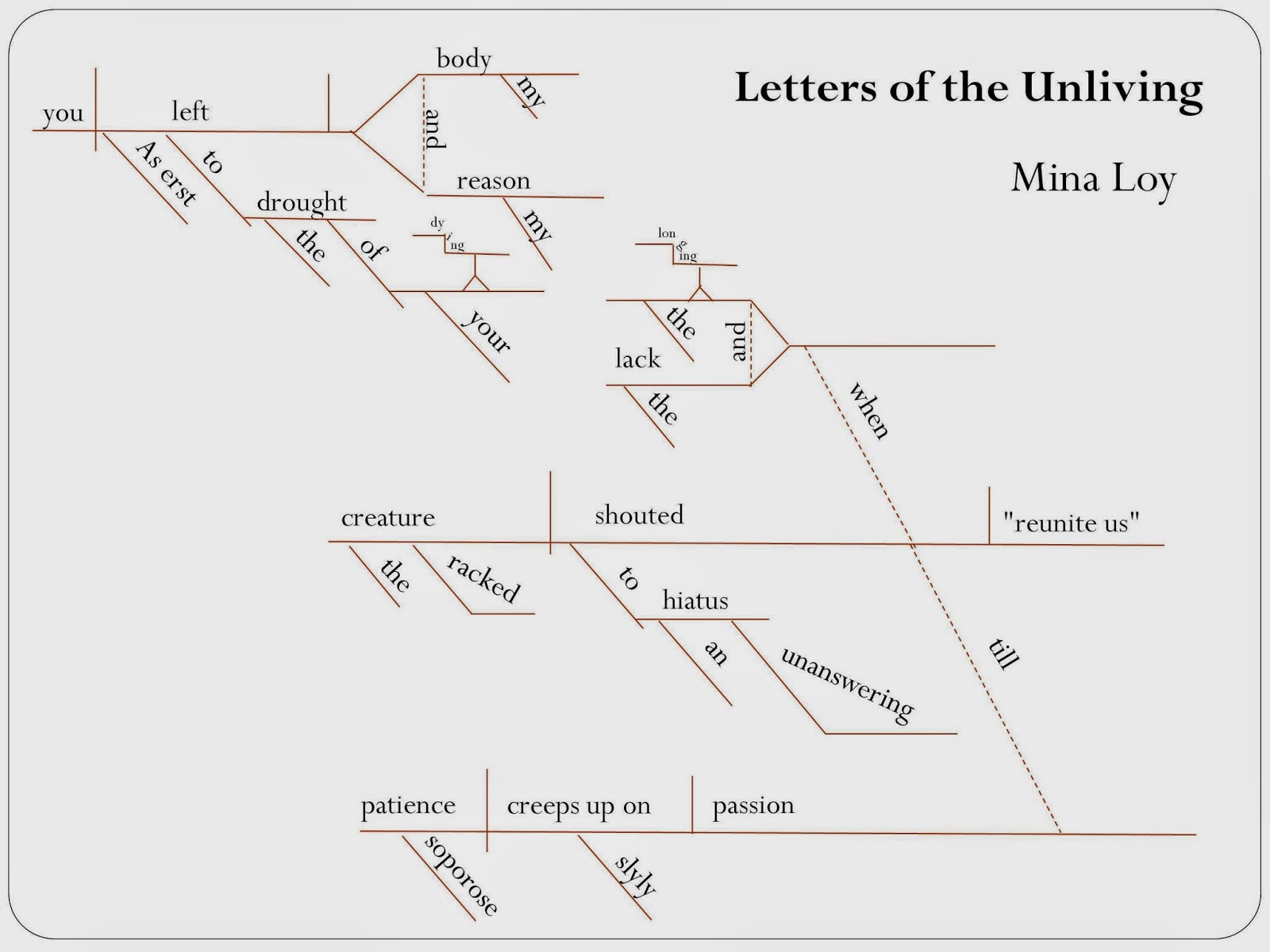
Diagramming Mina Loy's "Letters of the Unliving" as a Method for Close Reading

Diagramming Poetry as a Method for Close Reading
I have recently been working on a new collection of poetry that explores grief and loss.   In order to better study the poetry of loss, I've returned to the poet of my graduate thesis, Mina Loy.   I have found meaning in her poetry today that I could not find eight years ago. 


One of Loy's poems that quite literally makes me catch my breath is "Letters of the Unliving"  as published in The Lost Lunar Baedeker: Poems.


History and Syntax

Loy's history, thus the history of the poem is this: Loy met Arthur Cravan in 1917 and married him in 1918.  Opposed to serving in WWI, Cravan took Loy to Mexico to escape the military draft.  Once in Mexico, and after experiencing some trouble with both military authorities and the professional boxing crowd, "They bought a small, leaky sailing boat with the idea of patching it up and trading it in for a more seaworthy vessel"  so that Cravan might sail to Buenos Aires.  "In early November, only days before the Armistice was signed, Cravan set sail in the repaired craft for the nearby coastal village of Puerto Angel. The weather was fine and the boat apparently in good shape. Loy waited for days on the beach, gazing out to sea, but Cravan never returned" (Ford, 2007, para. 23).

However, no matter the interest in the tragic, romantic loss of love and self depicted this poem, the cathartic fear of loss we feel when we read the history, or perhaps because of the terrible beauty of the language of this poem, I have been having great difficulty sharing this poem with my students.  Although the idea, the elegy, makes the poem universal, the syntax makes the poem difficult to access.


Diagramming and Accessibility

Mina Loy
Image by Stephen Haweis, via Wikimedia Commons
In order to overcome the challenge of accessibility, I diagrammed a section of the poem to help my students better see and understand each unit of meaning, with all of its poetic license and grammatical truncation.  In its simplest form we can pick out subjects and predicates that, in and of themselves, are beautiful: "You left," she states.  "The racked creature shouted," she tells us, "'reunite us.'"  In the end, "Patience creeps up on passion."  The final diagram, though, is a mess, from a missing predicate in the second clause, to a phrasal verb in the final clause, to a fragmented quotation as part of an apostrophe in the third clause. Yet, no one said grief was grammatically pretty.  It's a tangle; a complicated tangle, and once my students and I saw it untangled for the first time, we shared a moment of understanding on one of its deepest levels.


The Gift of Excess

Of this poem and Loy, William Keckler beautifully and aptly states, "She creates a dignified superstructure in this dual elegy which allows for what might elsewhere be excessive; that is Loy's particular gift" (para. 3).  Once my students and I stripped excess from the poem, then put all of it back into place, we could all better understand this "dignified superstructure," this "dual elegy."  We could appreciate the language for what it gives us without leaving anything out.  Once we saw the poem for what it is we forgave what others might call "excess," and we embraced it, this looking back at grief from the future as a person forever changed by loss.


References


  • Ford, M. (1997). Spawn of Fantasies. New Republic, 216(21), 38-41.
  • Keckler, W. (2007). Mina Loy & Arthur Cravan: "Letters of the Unliving." [Web log, Joe Brainard's Pyjamas].  Retrieved June 4, 2014 from  http://joebrainardspyjamas.blogspot.com/2007/09/mina-loy-arthur-cravan-letters-of.html


Copyright Amy Lynn Hess.  Contact the author for permission to republish.

Monday, March 31, 2014

Harry Potter Jr. and Torok the Troll

A troll sits on a log, agog, in Harry Potter's attire.
Harry Potter, Jr., of Course!

Did you know Harry once saved his sister from an evil wizard-turned-troll named Torok who was holding her captive in a magical trance?


No, not that Harry. Harry Potter, Jr.

If you have been missing the witches, trolls, magic, and classic story of good versus evil, try taking an adventure with Harry Potter, Jr. by watching the 1986 family adventure, Troll, directed by John Carl Buechler.


The Original Harry Potter

In September of 2009, Buechler announced in an interview that he was planning to remake Troll, his 1986 film (Gilchrist, 2009). Curious about the correlation that might exist between the original, big brother Harry Potter, Jr. from the 1986 film and J.K. Rowling’s boy wizard, Harry Potter, I watched Troll with a critical eye, trying to imagine if or how Rowling had been, even unwittingly, inspired by this earlier story.

When Troll first came out, I did not see the film, and I had very low expectations up until the moment I pressed “play” on the DVD player. I was pleasantly surprised, however, and I found Troll charming, albeit eerie. Charmingly, for example, Harry Potter, Sr. dances to a punk-rock version of "Summertime Blues" while worried about his daughter’s odd behavior. Eerily, on the other hand, during a family dinner sequence, the shot transitions from the family to singing trolls, to a kindly witch and her magical mushroom, and back to the family dinner. Throughout, the puppet-prop trolls and the magic mushroom sing a choral called Cantos Profanae while yet another character recites Spenser’s "The Fairie Queene."

Harry Meets Harry

Yet, in spite of the obvious differences in storytelling (Rowling's Harry Potter doesn't have a sister he thinks is an alien pod from Mars, for instance), Troll’s Harry Potter, Jr. and Rowling’s Harry Potter share an archetypal similarity. As I watched this film I was reminded of the feelings I had when first reading, then watching, Harry Potter and the Sorcerer’s Stone: feelings of discovery, innocence, and stubborn resolve.

Troll is the story of a boy named Harry Potter, Jr., a dark-haired boy with a sensitive and caring nature. A malevolent troll takes his sister captive and magically disguises himself as the girl. Harry, Jr. sees through the disguise, but he is reluctant to confide in his parents. He allies himself, instead, with a kindly neighbor, who happens to be a witch, and together they foil the troll’s plans of taking over the world by building an army of magical creatures spawned from unwitting neighbors.

Similarly, the Harry Potter books and films are the story of a boy named Harry Potter, a dark-haired boy with a sensitive and caring nature. A malevolent wizard kills his parents and then attempts to kill Harry, and at one point even takes his future-wife captive after magically controlling the girl. Harry, reluctant to confide in the adults who surround him, eventually allies himself with a kindly professor, who happens to be a wizard, and together they foil the evil wizard’s plans of taking over the world by building an army of magical creatures, including trolls, giants, gigantic spiders, dead bodies, and other witches and wizards.

Hero-Harry, A Familiar Motif

Although the stories differ radically in their lengths and breadths of expression, the motif of each story is familiar; a boy becomes a reluctant hero by demonstrating radical self-reliance and willpower in the face of seemingly insurmountable evil. No matter their differences, 1986’s Harry Potter, Jr. has at least that in common with Rowling’s unforgettable boy wizard, Harry Potter.


References

Gilchrist, T. (2009.) Creator plans a remake of the first Harry Potter movie: Troll. Retrieved from http://blastr.com/2009/09/creator-plans-a-remake-of.php


Copyright Amy Lynn Hess. Contact the author to obtain permission for republication.  Originally published Sep 28, 2011.

Monday, February 17, 2014

The Shoe as Image in the Poetry of Amy Lowell and Charles Simic

A black and white photograph of a pair of old work books with the caption "The Shoe as Poetic Image."
What do your shoes say about you?
Shoes contain a rich and powerful significance, an historical set of meanings and imagery that lend themselves to making just as powerful works of poetry.


Although shoes are something people often dismiss as objects to be tossed into the closet after a long day at work, an evening of blistering dancing, or a day spent in the park, there are also seemingly endless possibilities for metaphor and the human condition associated with shoes. “If you want to leave your footprints in the sand of time,” the saying goes, “wear work boots.” "Put your best foot forward," coaches tell their teams before a game. "If the shoes fits . . .” we say in vague reference to owning up to foibles.

Poignant Imagery


Two poems that tap into the poignant imagery of the shoe are Charles Simic's poem "My Shoes," and Amy Lowell's "Red Slippers." "My Shoes" first appeared in Charles Simic: Selected Early Poems in 1999. "Red Slippers" appears in Amy Lowell's 1916 Men, Women and Ghosts.

Simic's "My Shoes"


In Charles Simic’s poem, “My Shoes” (n.d.), the poet uses an extended metaphor to help illustrate his feelings about his life. The extended metaphor works wonders here because of the rich history preceding the image of the shoe. He compares his “secret” (line 1) life to a pair of shoes, but not just any pair of shoes. He describes his shoes as “toothless” (line 2), “decomposed” (line 3), "humble" (line14), “maternal” (line 17), and “patient” (line19). His shoes, he states, have endured as he has endured, and all we need know about him “it is possible to read” (line 10) in his shoes. Simic taps into our universal relationship to the shoe, and with it he writes an exceptionally powerful poem about his own life. It's a poem wherein the poet tells the reader what it's like to “walk a mile in his shoes."

Lowell's "Red Slippers"


Amy Lowell speaks directly to the forgettable nature of the shoe in her poem "Red Slippers." Although she dramatically describes a pair of red shoes in a shop window as more colorful than anything else in the street scene, in the end, the shoes are ignored and passed by shoppers in the street. The red shoes and their "crimson reflections" (line 3) that drip, jam, scream, and plop throughout the first stanza, are "multiplied in the mirror side of the window" in the second stanza and "they swing up over curved heels like whirling tanagers sucked in a wind-pocket" in the third. They are active images, and the poet is curious enough about them to dedicate the majority of the poem to their description. However, in the end the shoes seemingly capture only the attention of the poet as "People hurry by, for these are only shoes" (line 16). The everyday shoe, no matter how colorful, is not as novel as its rival, "a cardboard lotus bud" (line 19). As humans, we understand and feel sad on behalf of the red slippers, all readers somehow understanding how it feels to be passed when needing a little attention.

Shoes contain a rich and powerful significance, an historical set of meanings and imagery that lend themselves to making just as powerful works of poetry. Without having to explain the nature of the shoe, both Simic and Lowell make use of the idea of "shoe" to make eloquent statements about the human condition.

References


Lowell, A. (n.d.). Red slippers. Retrieved from Poets.org: From the Academy of American Poets.
Simic, C. (n.d.). My shoes. Retrieved from Poets.org: From the Academy of American Poets.


Need More Help Writing about Literature?

 Here are three additional posts that can help you learn to write about literature.


Copyright Amy Lynn Hess. Contact the author to obtain permission for republication.  First published Jul 5, 2011 by Amy Lynn Hess.

Using ChatGPT for Essays in English Composition Classes

The best essays are written by people for people. "Corona Typewriter" image courtesy of the author ChatGPT and other AI language g...