Welcome!

Do you have APA formatting questions? Thesis statements got you down? Need to study grammar? Need some help with critical thinking? Having trouble with literary analysis or research? Want to take a look at some example essays? Well, I probably have a post here somewhere that can help you. Please use "Search This Blog," the "Labels," or my "Blog Archive" to help you find what you need. Have questions about what you find? Please feel free to comment or ask questions. I do moderate comments, and I try to respond to all topical questions and comments in a timely manner.

Friday, September 8, 2023

Using ChatGPT for Essays in English Composition Classes

Photograph of an antique Corona Typewriter
The best essays are written by people for people.
"Corona Typewriter" image courtesy of the author

ChatGPT and other AI language generators can be a great tool to have in your essay-writing toolbox, but using any of them comes with one really big warning: If you try to get AI to write your whole essay, you're going to be disappointed.

Recognizing Cheating and Plagiarism

Buying an essay online, reusing an old essay you turned in for another class, getting someone else's paper from another class and turning it in as your own, or taking parts of an article or study without attributing those ideas to the original author: Most students recognize each of these examples as cheating or plagiarism. Using ChatGPT to generate an essay and then turning in that essay as your own work is the same: cheating and plagiarism. When you turn in someone else's work as your own, that's cheating and plagiarism, even if the someone isn't really a someone. Even worse, ChatGPT does not cite its sources, which means part of that essay it generates for you might very well be plagiarized, as well, and if you turn it in you'll be plagiarizing the words of others in the words you've plagiarized! Double trouble! Yikes!

How can you use ChatGPT ethically, without cheating or plagiarism?

If you need to use ChatGPT to help you get started, try asking it for three different perspectives on an issue or topic. Ask it to generate a list of writers who write about that topic in each perspective. ChatGPT excels at mimicking conversation about a topic, so instead of using it as a substitution for thinking through your own ideas, use it to help you come to your own conclusions about a topic. Chat with ChatGPT. But! Continue to be cautious: Beware false facts when chatting with ChatGPT.

Recognizing Inaccuracies

Not only does ChatGPT plagiarize the words and ideas of other authors, it even sometimes makes up false facts and presents them as true, ruining the ethos and logos (link) of the work it's generated. 

For instance, I recently asked GhatGPT to provide a list of poets who've written poems about poison ivy. It spit out a poem called Poison Ivy and attributed it to Langston Hughes. When I didn't recognize it and asked in a follow-up question for it to tell me when and where that poem was published, it "apologized," as sincerely as AI can apologize, and told me it had simply made up the poem in the style of Langston Hughes and that Langston Hughes didn't really write it. Although that was an easy error to forgive if not forget, it gets much worse, even deadly.

In a recent online article published in Fortune by Senior Editor Steve Mollman, Mollman explains that experts are warning that because texts are now being generated by AI and published and sold by unethical writers on platforms like Amazon, the quality of such content may literally be deadly. Imagine reading a book by a person posing as an expert forager only to realize too late that you've eaten a deadly mushroom you found on the forest floor, a mushroom the "writer" of your text on foraging presented and described as edible. 

How do you check the content of ChatGPT's chats? 

You must ask follow-up questions of ChatGPT, like I had to do with Poison Ivy, and you need to check the content against other sources. As stated earlier, you can even ask the AI to provide the names of authors who write about the topic from different perspectives. Once you have those names, read those writers' works. When it comes to content, "When in doubt, leave it out," is a good rule of thumb. That means if you doubt the accuracy of the content, don't use it. As for the credibility of source authors or publications, if the writer doesn't have credibility or authority, you may want to doubt their content, as well, or at least cross-reference it again. If you're having trouble finding recent or credible articles or studies by the given authors, head to the library to ask for assistance from a reference librarian. They're there to help!

Recognizing Bad Writing

Not only does ChatGPT plagiarize and make stuff up, it produces bad writing. Grammatically correct or not, the writing lacks voice and style, sentence variety, authenticity, or even specific examples from real life that appeal to an intended audience. After all, an AI cannot provide real examples from real life because it doesn't have one. It cannot fully write for an intended audience because it isn't part of one. Real examples must originate with a real-life writer who has experience communicating with a variety of other real-life people! 

The best essays I read from student writers include their own realizations about humanity, moments and experiences from their lives, and other subtle indications that they care about their topic. Regardless of the grammar and mechanics, those are the essays I want to read. That said, the bestest bestest essays do both: they include the real-life voice of the real-life writer and they have been carefully edited and revised for unity, coherence, clarity, content, and formatting.

How can you get ChatGPT to correct your grammar without making your writing sound robotic and dull?

First, you have to do your own prewriting, outlining, research, and drafting, the first of the steps in the writing process (link). You can then enter your own writing, one sentence or a few sentences at a time and ask ChatGPT to help you make the writing more grammatically correct. You could ask it to 

  • correct punctuation, mechanics, and citation style
  • check your use of transitional words and phrases (link) 
  • review your level of language or formality
  • assess your use of examples for a particular intended audience
  • clarify a thesis statement for a specific mode of communication 

Although you never want to use ChatGPT to write your whole essay because it's a form of cheating, it plagiarizes the content you'd be plagiarizing, it makes stuff up, and the writing is bad, there are ways to use it effectively and ethically. In short, do your own thinking, do your own writing, and use ChatGPT with caution for how it was intended: to have a chat about your topic, about your sources, or about your writing. Ultimately, you are responsible for making decisions about your final draft and the work you present.

Works Cited

Mollman, Steve. “Mycologists Warn of ‘life or Death’ Consequences as Foraging Guides Written with A.I. Chatbots Crop up on Amazon.” Fortune, 7 Sept. 2023, fortune.com/2023/09/03/ai-written-mushroom-hunting-guides-sold-on-amazon-potentially-deadly/



Tuesday, May 9, 2023

Write Like a Naturalist

A cat sits on the other side of an old wooden window
"Cat and Lavender through Window," Image curtesy of the Amy Lynn Hess


Many of the activities I suggest in my Write Outside text are the types of activities that might appeal to a naturalist, which might leave a student wondering what a naturalist is or what a person who engages in naturalism really does. To be honest, I never considered what a naturalist does or what naturalism entails before writing my book, so when these terms were presented to me, it made me very curious, as well.

Can you define naturalism?

The definition of naturalism I found that I most appreciate is from The Environmental Science Web page, which defines naturalism as “the study of the natural world as a whole and the study of each species within its environment(s), as well as how species interact with each other.” I especially like the phrase "as a whole" because it reminds me of the interconnectedness I feel when I am physically engaged in nature-based activities.

What do naturalists do?

The examples that best helped me understand the type of work professional naturalists do are located within natural history museums and are fun to explore. The types of exhibits that appear in a natural history museum have often been studied or curated by naturalists, from the dinosaur skeletons assembled by paleontologists, to the tiny shells collected by oceanic biologists, and from the planetary solar system exhibits created by planetary scientists, to the diagrams drawn by biologists of how trees communicate through fungi in the soil.

In addition to the scientists who study space, marine life, dinosaurs, and fungi, professions related to naturalists and naturalism also include geologists, botanists, wildlife biologists, park rangers, environmental scientists, civil engineers, etymologists, natural resource managers, botanical or wildlife illustrators or photographers, ecopoets, and ecotourism guides.

Do you know any naturalists?

There have been many famous naturalists throughout history, and there are even contemporary naturalists you can take classes with today. The following are just a few examples of the many famous naturalists who have made significant contributions to the understanding of the natural world. Although each is known as a naturalist, each also has a distinct profession and unique professional accomplishments.

  • Charles Darwin: Darwin was an English naturalist who is best known for his theory of evolution by natural selection. He is also known for his extensive research and documentation of the flora and fauna of South America and the Galapagos Islands. Many contemporary works refer to Darwin, and to understand his work is to better understand several contemporary ideologies.
  • John Muir Laws: According to Laws’s Web site, “He is a naturalist, artist, and educator who has dedicated his work to connecting people to nature through art and science. From an early age, his parents instilled in him a deep love and respect for nature. Over the years, that love has grown into a commitment to stewardship and a passion to share the delight of exploring nature with others.” He has also posted some excellent resources and YouTube videos to help new naturalists get started with nature journaling.
  • John James Audubon: Audubon was an American ornithologist and naturalist who is best known for his detailed illustrations and descriptions of North American birds. He also contributed to our understanding of North American mammals and their behavior.
  • Alexander von Humboldt: Humboldt was a German naturalist and explorer who is known for his extensive travels throughout South America and other parts of the world. He is credited with laying the foundation for modern biogeography and ecology.
  • Greta Thunberg: Thunberg is a young climate change activist who is well known for a speech she delivered to the 2019 UN Climate Action Summit entitled How Dare You?
  • Rachel Carson: Carson was an American marine biologist and conservationist who is best known for her book Silent Spring, which warned of the dangers of pesticide use and helped to launch the modern environmental movement.
  • David Attenborough: Attenborough, who has one of my favorite voices, is a British naturalist and broadcaster who is known for his documentaries on wildlife and the natural world. He has also written several books on natural history and conservation.

Although each of these listed examples is known as a naturalist, each also has a distinct profession and unique professional accomplishments.

What are some projects for new naturalists?

After satisfying my own curiosity, I certainly recognize how I can potentially lean into the inclusion of naturalism and projects for new naturalists in my next few posts and in my next edition of Write Outside, especially when it comes to nature journaling. Although it’s main intent as a text is to help students learn to be better writers, the focus on writing like a naturalist would only help to better define the course aims.

Want to read the 2nd edition of Write Outside? Check out Write Outside on the Kendall Hunt Web site.

Wednesday, August 24, 2022

Argumentation Two Ways: Enthymeme or Thesis


Structuring an argumentative essay or speech can be tricky. Writers have to make important decisions about the type of structure that most benefits the intended audience: Which structure will most effectively help the intended audience understand the topic and accept the given claim or position? One way to make a determination about a work's structure is to try outlining it two ways and then choose the one that will have the greatest impact on a reader: Outline it once using a thesis, and outline it once using a special type of thesis called an enthymeme. 

Thesis and Topic Sentences as Reasons

In an argumentative speech or essay, a thesis should present the writer's claim or position on a topic or issue. For example, if asked if they believe shoppers should be responsible for the environmental impact of the things they buy, a writer might answer one of two ways. First, however, a writer will need to investigate the issue, read about the environmental impacts of various industries or specific products, look through their own inventories, identify experts, and talk to or read what have to say about the issue. After investigating, they will come to a conclusion based on their new knowledge, and they might say that shoppers are not responsible for the environmental impact of the things they buy, or they might say that shoppers are responsible for the environmental impact of the things they buy. Either one of those two statements could be a thesis. In order to write a speech or essay about the topic, however, they will also need to explain their reasons for coming to that conclusion, and those reasons will appear in an essay or speech as topic sentences.

The following is a minimal outline that demonstrates how a thesis and topic sentences stated as reasons might appear in an essay or speech outline. Because the thesis does not include a reason for the claim, the topic sentences should be stated as reasons for the claim.

Thesis: Shoppers are responsible for the environmental impact of the products they buy.

Topic Sentence One: Shoppers are ultimately responsible for the environmental impact of the things they buy because of the impact of capitalism, supply and demand.

Topic Sentence Two: Because of the global economy, and an unknowing of regional environmental issues, shoppers are responsible for the environmental impact of the things they buy. 

Topic Sentence Three: Shoppers are responsible for the environmental impact of the things they buy because only shoppers can control their individual conspicuous consumption.

Enthymeme and Examples or Categorical Topic Sentences

An enthymeme is a statement of a writer's claim or position on an issue that includes the reason why the writer came to that conclusion about the issue at hand. For example, a writer might generate a rough draft or working thesis in which they state, "Shoppers should look into the environmental practices of the companies they buy from." In order to revise and elevate that claim, the writer might later state,  "Responsible shoppers investigate the source of their products before buying in order to avoid rewarding environmentally destructive practices." The revised claim includes the writer's reason for making their claim. Because the enthymeme includes a reason for the claim, the topic sentences need not be stated as reasons. Instead, the writer might use the topic sentences to break their paragraphs into examples or types of destructive practices to be avoided or ways to do so.

The following is a very minimal outline of an enthymeme and its topic sentences. Notice that the topic sentences introduce examples or categories instead of listing additional reasons. The main reason "trickles down" to the paragraphs from the enthymeme.

Enthymeme: Responsible shoppers investigate the source of their products before buying in order to avoid rewarding environmentally destructive practices.

Topic Sentence One: Palo Santo wood, sage, turquoise, and other natural or unprocessed materials are one example of a type of resource that is endangered because of irresponsible sourcing and shopping practices.

Topic Sentence Two: The fast fashion industry is also well known for its negative impact on the environment.

Topic Sentence Three: The most often cited industry for its negative impact on the environment is, unfortunately, something everyone buys: food.

Summary

Which of the two minimal outline above are more interesting to you? Personally, I like the second a bit better and would opt to use it as my structure if I were assigned this writing prompt. However, the first leaves room for exploring some economic philosophies, and that would be interesting reading, as well. It's hard to decide!

No matter which type of claim a writer makes, thesis or enthymeme, the reasons for why they came to their conclusion about the topic are an essential part of making a complete argument. When using a thesis, topic sentences become reasons why the writer came to the conclusion. When using an enthymeme, the reason becomes part of the claim statement. 

Want to read more about argumentation and argumentative essays and speeches? Try

Writing an Argumentative Essay: Basic Terminology

Revising Thesis Statements

Writing for an Intended Audience

The Difference Between Persuasion and Argumentation


Copyright Amy Lynn Hess. Please contact the author for permission to republish.


Wednesday, May 18, 2022

A Contemplative Approach to Prewriting: The Higher "Why"

A Subtle Shift in Thinking

In an article entitled "Embracing the Higher Why," writer Danielle Poitras interviews Lyndsay Farrant, who holds an MA in Transpersonal Counseling Psychology and is the Executive Director of Strategic Projects at Naropa University. Farrant introduces the idea that when we ask "why," we often follow our response with a "because." As an alternative, we may sometimes want to practice contemplating "why" followed by "in order to." When we ask "'why in order to,'" we are embracing "'the higher why,'" the "'why that embraces curiosity and meaning and involves questioning and looking at fresh perspectives'" (Poitras 25). 

When writers ask "why in order to" instead of "why because," they think more divergently about their topics during the prewriting step of the writing process, which elevates and strengthens their argumentative essays.

Enthymemes: Reason or Purpose

One common way to formulate a thesis statement in an argumentative essay is to construct an enthymeme, a statement of the writer's position and the word "because" followed by a reason why the writer has come to that conclusion. The following is a simple enthymeme: "The campus should institute a recycling program because it will help the environment." As an alternative, the writer might formulate an enthymeme with a "higher why," such as "The campus should institute a recycling program in order to help the environment." 

How are these different?

Using the subordinating conjunction "because" indicates the writer is about to present a reason why they have come to adopt a particular position. It indicates the writer has looked at evidence that had already been written and documented. There is a sense the writer is looking to the past to come to a conclusion and is asking the reader to do the same.

Using the subordinating conjunction "in order to" indicates the writer is about to present a purpose for their position. It indicates the writer is looking into the future and anticipating outcomes that align with their position and purpose. The writer in this scenario is asking the reader to do the same.

Although the language itself is only subtly different, the way the writer is asking readers to think about a topic are quite different: It's the difference between looking at what has happened, unchangeable, and that which has yet to happen, a future with an abundance of possibility. 

Shifting Thoughts from Past to Future

When faculty or mentors ask students why they are interested in a specific major or career path, students may respond with, "I want to be a psychologist because it sounds interesting," or "I want to be a nurse because I want to help people." While a connection to the future is implied in these responses, it becomes a direct connection when students apply the "higher why." "I want to be a psychologist in order to lead an interesting life," or "I want to be a nurse in order to continue helping people." Whereas the initial statements indicate the student has looked back at their lives or have read evidence about being a psychologist or being a nurse, the revised statements clearly indicate the students have shifted their thinking to the future. 

Even in more scholarly essays or research papers, the shift can be profound. A poorly articulated thesis such as "Research shows working outdoors is beneficial for students," might be shifted using the "higher why" to "Working outdoors is a beneficial pedagogical method teachers use in order to incorporate experiential learning." The experiment in thinking of the "higher why" yields results both in the writer's ability to develop an idea and to articulate it as a well-written thesis.

 To return to the words of Lyndsay Farrant used to open this post, there is a "higher why," we can access when we explore not only the "because" but the "in order to." Shifting the use of language, even ever so slightly, allows writers to  embrace curiosity, explore meaning, and "involves questioning and looking at fresh perspectives'" (Poitras 25). 

Works Cited

Poitras, Danielle. "Embracing the Higher Why: The Entrepreneurial Mindset of Naropa Students." Naropa Magazine 2021-22, pp. 23-25.

Friday, October 8, 2021

How to Build Dungeon Tiles and Terrain: Felt Four Ways

Felt is an inexpensive and easy medium to use to create dungeon tiles and battle map terrain for a tabletop role-playing game (TTRPG) like Dungeons and Dragons. 

Felt comes in a variety of thicknesses, sizes, colors, and textures, and it's easily shaped into tiles and maps using a ruler, a fine tip marker or fabric chalk, some good craft scissors, a glue gun, and a plentiful batch of glue gun sticks. With the addition of a few needle-felting supplies, like felting needles, a felting pad, and wool roving or wool top coat, felt can even be used to create 3-dimensional objects or blended surface colors.

Mosaic-Style Interior Build

The mosaic-style build is a great option when duplicating a previously published map with complicated forms, like from an official Wizards of the Coast adventure that includes circular or organic spaces, like towers and caverns. The major benefits of using this building method include the ease of creating a measured replica and the end product having a usable grid and engaging texture.

At its most basic, a mosaic-style build is simply a matter of counting out and cutting enough squares to fit each room of a build. After cutting enough squares to meet the specifications of the map, they can be arranged in the pre-established pattern on a large base, leaving base-color gaps or using base-color squares for walls and doorways, depending on the map.

For example, as shown in figure 1, a mosaic build of a 4” tower room requires 12 full tiles and 4 triangles to complete the room. The outer walls can also be constructed using 1” tiles of a varying color, depending on the size indicated on the map that’s being duplicated, or a builder may want to use ¼” or ½” rectangles or squares to match previously built dungeon or terrain tiles.

Figure 1.


Measured Interior with ¼, ½, or 1-Inch Walls

Sometimes maps, especially those consisting mostly of interiors or stand-alone buildings, do not require grids in order to calculate movement. A game master might simply know that a room is 4” across and therefore know how much of a character’s movement it takes to cross the room or how far a spell can travel. Alternatively, rulers can be used to calculate distances in rooms without grids. The benefits of gridless tiles are the ease and efficiency of creating them and the “less busy” look of the finished product.

Creating rooms without grids requires, like the mosaic-type build, careful measuring and marking. If the map requires a 20’ x 40’ room, and 1” = 5’, the room itself will need to be 4” x 8” plus the additional space required to create walls. A room with ¼” walls will need to be 4 ½ by 8 ½ inches, for example. The example in figure 2 shows a 4” x 4” inch room that’s been cut at 4 ½” x 4 ½” to accommodate ¼” walls. The two doorways are 1” across.

Gridless tiles can also be used to create new and original configurations. The grey tiles with cream walls shown below are based on a 4" x 4" set, and I've added doors, stairs, larger rooms based on the 4" x 4" measurements, and a 4" x 6" tower room. 

When building multiple rooms that fit tightly together, it sometimes helps to create the build on a large base and later cut the rooms along the walls. Parts of the map can be added during a session as characters explore the space, or an uncut map can be revealed by uncovering parts of it as the character’s explore. 

Figure 2.


Felt dungeon tiles
4" x 4" Dungeon Tiles with 1" Walls


Needle-Felting

Including needle-felted elements in a build adds both texture and dimension. A needle-felted base can be constructed by carefully measuring and marking squares onto plain craft felt and using core wool or top wool to create the grid pattern. The colors of wool roving can be blended to good effect, and with some work, 3-dimensional objects can be constructed: firepits, boulders, boxes, sacks, greenery, and other reusable elements. 

Felted grids can be used as a base battle map for outdoor spaces, as a base for stand-alone buildings, or as a gridded area within a build’s negative space, as shown in figure 3. 

Figure 3.


Hints and Tips

No matter which type of felt build a person chooses, there are some general hints and tips for the felt build

  • Measure carefully before cutting. 
  • Arrange pieces (walls, tiles, doors) before gluing.
  • Only glue those elements that will never be removed or that need to be used elsewhere.
  • Glue on a protected surface to avoid damaging a table or countertop.
  • Glue carefully. Hot glue is very hot.
  • Felt safely. Felting needles are very sharp.


Wednesday, September 22, 2021

Illustrated Maps: A Cartography Project


Hand Illustrated Map of Manhattan by Kening Zhu
Hand Illustrated Map of Manhattan
by Kening Zhu
Used with CC License
Some of my favorite types of artwork to scroll through online are illustrated or cartoon maps. They remind me of the map I picked up in the student center when I first moved to college. One side depicted the campus, mostly green with grassy areas and tree-lined campus paths, with each building on campus illustrated in an outlandish, yet aesthetically pleasing, perspective and scale. The reverse side was the entire city, covered with illustrations for local bars, coffee shops, restaurants, off-campus book and comic shops, thrift, and specialty stores. The names of the roads were impeccably hand-lettered, and the legend clearly labeled all of the important places, like the hospital, the police and fire stations, and the public parking areas. The map was gridded and included lists of places by name and grid identification. The compass rose was cleverly and artistically incorporated into the wooded area to the south of town. 

I picked up that map over twenty years ago, and I can still picture it clearly. It made an impression. That map represented my home, new at the time, but familiar after my five years of undergraduate courses. I used it and wore out its seams. I walked it and made mental notes. 

I suspect there's a lot I can continue to learn about myself and my ever-changing definition of "home" if I attempt to map and remap, both physical and metaphysical aspects, of wherever I might be at any given time.

Step One: Defining "Home"

The first step in this personal cartography project is to define "home," and not just by opening Webster's Dictionary. The lock-making company Schlage makes a point of defining home outside the boundaries of the dictionary in a 2020 blog post entitled "What is the meaning of home? Hint: It’s not just a place." This post specifically juxtaposes the Merriam-Webster definition: Home isn't just a "residence," "domicile," or "house," they argue. Instead, the post defines it as "the intangible feeling" a person might experience in a specific place, "a sense of peace, joy from loved ones or an environment where everyone knows they’re welcome." They go on to include several definitions of home that extend far beyond the dictionary definition.

"Home" is also not always delineated as simply as my introductory map example might suggest. "Home" is complicated. "Home" often includes, but is not limited to a house, per Webster's, and at the end of the day when someone says, "I'm heading home," they might mean their house. However, if someone was going on vacation, they might also respond, "I'm heading home," but mean the place where they grew up. This might be entirely different from where a person feels most "at home." For some, a special place in the woods where they first went camping feels the most "like home." For others, their grandparents' property most fits their definition of "home." Although very rarely just a single house, "home" might evoke a collage of houses, all linked by the roads and bridges and telephone lines that keep a family connected. "Home" might be a hotel room or a specific aisle in a specific library. "Home" might be a neighborhood or college campus. Some "homes"  have no boundaries at all, and when asked, a person might tell you the world is their "home," or wherever they currently live is their "home."  Some people, on the other hand, have no answer ready and haven't considered the question until asked. Each response depends entirely on a person's experiences in the world and their reactions to those experiences, both positive and negative.

Step Two: Narrowing the Topic

After defining "home" based on personal experiences, the second step is to narrow the scope of the cartography project. 

Just as when narrowing a writing topic, the scope of a map can be narrowed by choosing an intended audience. For example, if the intended audience is "family members," including the homes of all the family members would be important, so the boundary of the map should encompass all the homes. The intended audience might also be a group of friends who play a table-top role playing game together. Perhaps their "home" is a specific location or area on a fantasy map. A couple who takes a meaningful road trip might choose to map the path and places of interest as a memento for themselves.

A second way to narrow the scope of the project is to construct a theme or motif.  A meaningful map might include all places a person has kayaked, canoed, or rafted, especially if that person feels "at home" when engaged with those activities. A foodie might mark all of their favorite hometown restaurants on a map. A person living in a new place might take the opportunity to walk their new neighborhood and construct a map from memory afterwards to mark the occasion, or a person who'll soon be moving might want to construct a map of the place they'll be leaving. 

Step Three: Drawing and Labeling Places and Landmarks 

The third step of the personal cartography project requires ranking landmarks and places. 

"Home" becomes a matter of inclusion and exclusion as map-makers finish deciding where to place boundaries and begin to decide which places or landmarks will be included or emphasized on the map. A person's house may have prominence and be placed in the center of the map, or a series of places might be of equal importance and be drawn around a central point. Places that have more importance might be drawn larger than places of lesser importance. The importance of specific roads will determine the level at which the map is drawn, as well. If all important locations are on major roads, only major roads might be labeled. If some important locations are on minor roads or side streets, the maker will have to decide if labeling the side streets is important. The maker will have to decide the scale or "zoom level" of their map. 

Step Four: Taking Pencil to Paper

The final step of the personal cartography project is taking pencil to paper and making the map. 

It's worth pointing out that there are several reasons why a person may prefer a paper map to an electronic map, including that paper maps don't need to recalculate (Berendsohn). Beyond the pragmatic and practical reasons, however, the act of mapmaking on paper can be both a kinesthetic and meditative practice. 

After deciding which important landmarks and places will be emphasized and labeled within the confines of the boundary of the map, a maker must take pencil to paper and begin making the map. It can either be finished on paper, or electronically. After drawing out initial ideas, the map can be constructed isometrically using computer software or special drawing paper and tools. The map might be painted in watercolor, or it could be constructed using collage techniques. The map might be created using a vintage style, in fantasy style, or look more like a cartoon. It could be meticulously created in CAD. The decisions about the style and form of the map might be made based on pragmatic matters, like budget, skillset, and time constraints, or it might be more meaningful. For example, a watercolor map of places a person has made plein air paintings would be reiterative.

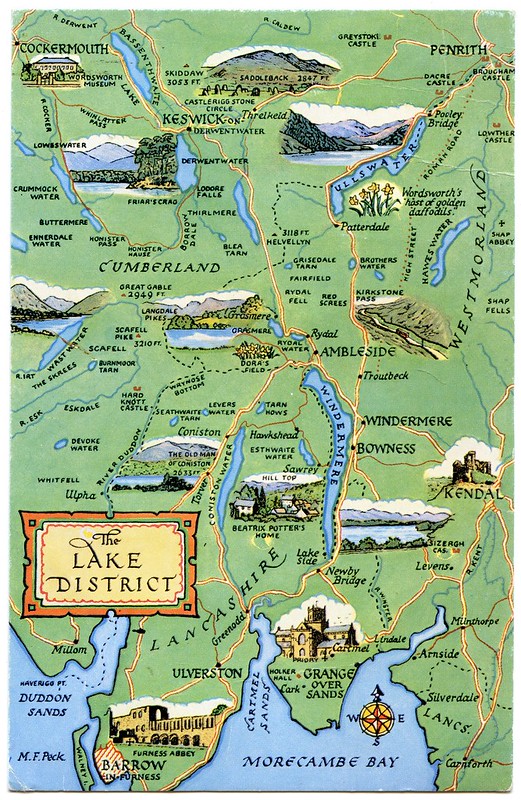
Postcard Map of the Lake District
Postcard Map of the Lake District 
Used with CC License
 I suspect there's a lot we can learn about ourselves if we attempt to map such a concept as "home."

The more I've travelled, the more of those same types of city maps I've encountered, like the one made for Mt. Pleasant Michigan that I picked up back in 1994. I've collected a number of similar-looking Discovery Map International tourist maps and MapCo Marketing event maps. I've drawn maps in art journals and even attempted postcard maps. Sometimes the map-making occurs spontaneously and I can think about my choices after the fact, and sometimes it's meticulously planned. Some have been successful, and others were simply steps in the process of becoming better - better at understanding myself, a better artist, better at remembering a place or how it evoked a certain feeling.

 Sometimes the maps evoke powerful feelings of home, depending on my affection for the city. However, the more important considerations are how I choose to define the map, its intended audience or purpose, and any thematic or meaningful principles. 

Each day might, in that way, bring a new map onto the page.

Works Cited

Berendsohn, Roy. "6 Reasons You Should Always Have a Paper Map." Popular Mechanics, 19 Nov. 2018, www.popularmechanics.com/adventure/outdoors/a25228379/paper-map/.

“What Is the Meaning of Home? Hint: It’s Not Just a Place.”  www.schlage.com/blog/categories/2020/11/meaning-of-home.html. Accessed 22 Sept. 2023.

Friday, May 21, 2021

Small Class Sizes and Course Load


"Time" by Emil
Used with CC License 
As a faculty member, I've always taught composition at colleges and universities with relatively small class sizes. These classes, between 12 and 30 students, are touted as a benefit to students and to faculty. However, small class sizes are only a benefit to those faculty - and their students - who also have a moderate course load. 

Because students in small classes are promised personalized assistance and feedback on assignments, faculty spend much of their time giving that assistance or answering those questions - sometimes by text, email, phone, video conference, or in-person meetings either during or outside their office hours. Some students come to class, some do not. Some students ask questions during class, but many do not.  Faculty who teach 2 or 3 courses a semester might spend 9-12 hours in classes each week, then work with their 60-90 students, plan lessons, create videos, grade 60-90 papers, commit to committee meetings, service responsibilities, write, and complete professional development for around 30-40 hours a week, working a total of between 40-60 hours a week. Much like an iceberg, most of a faculty member's work is completed "below the surface" and "out of sight." The job requires Herculean efforts in time management.

The workload of faculty who teach 2 or 3 of these more personalized courses is reasonable, and when compared to faculty who teach 4 or 5 of those "small" classes, that workload seems dreamy. Faculty who teach 4 or 5 courses might spend 15-20 hours in class each week, and in addition to the "below the surface work" explained above, also work with around 120-150 students each week, giving as much personalized feedback as they can muster - which may not be much given the unreasonable time constraints. The math: 40 hours a week minus 20 in the classroom leaves 20 hours to assist 150 students equals 8 minutes per student and 0 minutes for committees, service, professional development or writing. Those working beyond 40 hours might achieve the minimum productivity levels in their scholarly and professional development, but even the most stalwart faculty need to eat and sleep occasionally, not to mention raise their children, take care of aging parents, and participate in life with their spouses.  

So what's the tradeoff? As faculty teach more and more courses, which equals more and more students - even in increments of 12-30 - time and effort might be "borrowed" from other areas of their "below the surface" work. They stop writing or producing their own professional work. They may stop completing their committee assignments and rely on others to complete the bulk of the work. They, in other words, stop being a scholar, give up working within the academic community, and lack the time to develop their teaching philosophies or even practical pedagogy.  In some cases, they assign less work to students, give less feedback, and their courses might consequently lose any semblance of academic rigor. They might even sacrifice their family's well-being.

More math: Faculty might teach 30 students for 75 minutes, then teach another 30 students the same content or activity for another 75 minutes, back-to-back, and sometimes up to 5 times per week. Teaching the same class only twice, with 60 students in each class, would save the faculty member hours per week, time that could be given back to the students in their classes in the form of personalized assistance or feedback on assignments. The time might also be spent working toward becoming a better teacher, scholar, or mentor.

The lesson here is that both faculty and students should carefully consider the call to teach or take "small classes" because there's so much more involved than simply how many students enroll in each class section. Certainly the discipline matters, as chemistry and composition are taught much differently, but the main consideration to keep in mind is the assigned course load.


Tuesday, March 9, 2021

Write Outside: Annotated Bibliography Example

Russian Comfrey by Suzanne Schroeter
Russian Comfrey by Suzanne Schroeter
Included under Creative Commons License
An annotated bibliography is a list of sources a writer or research group might potentially wish to use for a research paper or project. An annotated bibliography is more than just a list, however. It includes annotations, or notes, that help the writers capture the qualities and main ideas of a source. The annotated bibliography can be used by writers during the outlining and drafting parts of the writing process as a bank of information from which source content can be pulled.

For writers who've never written an annotated bibliography, the task can seem herculean. Breaking the annotated bibliography entries into their component parts can make it much more achievable. 


Breaking the annotated bibliography into smaller tasks can help beginners learn to cite sources, identify claims and evidence, evaluate the content's rhetorical appeals, and plan their next steps.


Annotated Bibliography Example

The following table in an example entry that's been broken into its component parts on a table. For this example, the research question is "What are the practical and safe medicinal uses of the comfrey I grow in my backyard?" This example table includes the prompts necessary to properly evaluate and annotate an article called "Three Travelers," written by Katherine Yvinskas and published in The Herbarist in 2010. 

Prompt

Responses

Where did you find your source and why did you choose it?

Provide the complete MLA citation for the source.

I found my first source in the GGC Library databases. I searched for the term “comfrey” in the database called Academic Search Complete (and updated my citation to include the name of the database instead of the name of the service, Ebscohost). This source was on the third page of results, and I chose it because I am interested in the medicinal properties of comfrey and this was published in a journal called Herbalist.

Yvinskas, Katherine. “Three Travelers.” Herbalist, no. 76, Nov. 2010, pp. 16–20. Academic Search Complete, http://search.ebscohost.com/login.aspx?direct=true&AuthType=ip,shib&db=a9h&AN=79329981&site=ehost-live&scope=site&custid=gwin

Research and explain each author’s credentials and authority. If there is no author, provide information about the organization or publisher. Think about how the author’s credentials affect the intended audience’s acceptance of the information.

There is a short bio in the article that explains the author’s credentials. Although her main vocation is as an artist, it seems she is also a self-taught herbalist. This might be a concern, but she has also been acknowledged as a Master Gardener.

“Katherine Yvinskas is a member at large of The Herb Society of America. She is an artist, Master Gardener and herbalist living in New Jersey. She has created many original works inspired by plants and nature. Katherine received her MFA in 1981 from Northern Illinois University and is a member of the American Society of Botanical Artists. Her work has been widely exhibited and published” (20).

Quote or paraphrase the main idea (thesis, enthymeme, or hypothesis and findings).


If there is an abstract, you may also wish to quote it here.

Thesis: "I’ve called them ‘The Three Travelers’ in honor of their centuries-old reputation as journeymen having healing abilities that affect the lungs, bones, ears, digestive system, and support wound healing. Imagine seeing comfrey, mullein and coltsfoot standing together, taking on various ailments that come their way. A mighty trio! And they can grow in your own garden, as they do in my home herbal apothecary" (18).

Abstract: “The article offers information on coltsfoot, comfrey and mullein, which are called the three travelers due to their ability to treat diseases. Coltsfoot is a spring bloomer and is dubbed Filius ante patrem. It treats coughs, asthma and bronchitis. Comfrey is high in calcium, potassium, phosphorus and other minerals and its leaves are rich in vitamins A and C. Mullein can grow anywhere, was used as toilet paper in the wild, or placed in the holes of shoes or if the feet were tired from walking.”


Summarize or quote each section’s or paragraph’s main idea sentence or main idea (if it’s implied). Be sure to point out where the most relevant information appears.

Each section describes the three plants and explains their herbal uses. Most relevantly, the article answers my research question on page 19 by saying that comfrey is best used as a healing cream and as a poultice. It is used externally.

Identify the main types of evidence the author(s) used. Use the list that’s been provided for you.

Types of evidence may vary by paragraph or section. Please see “types of evidence” at the end of this document. Think about how the types of evidence affect the intended audience's acceptance of the information. 

The author uses visual descriptions and verifiable, cited facts throughout the article, including in the section on comfrey.

The references and bibliography for the cited information will be very helpful for continuing my research.

Explain how the source does or does not demonstrate each of the three main rhetorical appeals: ethos, logos, and pathos. What will you do to overcome any weaknesses presented in the source’s rhetorical appeals?

Think about how the use of rhetorical appeals can affect the intended audience's acceptance of the information. 

Ethos: The lead-in to the article is the author’s narrative about having the plants in her garden, which, by virtue of her experience, establishes a level of ethos. Because of the discrepancy between the author being an artist and being a self-taught herbalist, however, I want to find additional information to confirm and validate the information in her article, especially the idea of the herbs being called “three travelers.” Does this originate with her?

Logos: Although the information is in a coherent order (categorical order in an expository essay format), and is presented with a bibliography, none of the information is timely, so there may be new information available. I will need to look for more up-to-date information.

Pathos: The author has done a good job introducing the article with a narrative that includes positive connotations of the plants without exceeding the limits of a proper use of pathos.

Define unfamiliar words or phrases (up to 10). Include the original sentence from the source that contains the word or phrase. Be sure to attribute the source of the additional information in case you want to use it in your research project. These words may help you learn more about your topic.

Pyrrolizidine alkaloids : “Early leaves or cuttings harvested in the spring will contain high levels of dangerous pyrrolizidine alkaloids whereas the later cuttings and mature leaves have much smaller amounts” (18).

I found more about this phrase in a source called Safety Issues Affecting Foods: Pyrrolizidine Alkaloids by Subhuti Dharmananda, Ph.D., Director, Institute for Traditional Medicine, Portland, Oregon (http://www.itmonline.org/arts/pas.htm):

“Pyrrolizidine alkaloids (PAs) are of special interest currently because several of them have been shown to cause toxic reactions in humans, primarily veno-occlusive liver disease, when ingested with foods or herbal medicines. Comfrey, a well-known medicinal herb characterized by U.S. FDA researchers as having been ‘one of the most popular herb teas in the world,’ contains PAs that are capable of causing liver damage (10).”


Glossary of Key Words and Phrases

Annotate: Take notes on a text to help establish meaning and context. Annotations should be substantive enough to use as notes for a paper without having to look back at the original.

APA Format: The American Psychological Association’s guidelines for how to format a paper and its source content; emphasizes the author and publication date of a work with content page numbers if available. Generally used when the publication date is important in establishing ethos or logos, as in papers about medical advances or new technology.

Attribution: Giving credit to the original source of the information within the context of the sentence; usually requires transitions like “according to” or “Source states.”

Credentials: Qualifications, achievements, qualities, or aspects of a background, typically used to indicate suitability.

Enthymeme: Argumentative thesis statements work best with the idea of enthymeme. An enthymeme is a relationship between reason and conclusion. In thesis statements, this takes the form of making a clear connection between an assertion (claim, opinion) and the reasons used to support that assertion. “Recycling should be required nationwide because . . . .”

Hypothesis: In science, a hypothesis is an idea or explanation that is tested through study and experimentation. Outside science, a theory or guess can also be called a hypothesis. A hypothesis is something more than a wild guess but less than a well-established theory. “Planting carrot seeds in the fall may lead to greater yields the following summer.” Findings are generally found at the end of a paper that begins with a hypothesis.

MLA Format: Modern Language Association’s guidelines for how to format a paper and its source content; emphasizes the author and title of a work with content page numbers, if available. Generally used when the publication date is not important in establishing ethos or logos, as in papers about Hamlet.

Modes of Persuasion: Ethos, or ethical appeal, means to convince an audience of the author's credibility or character or by use of expert testimony. Pathos, or emotional appeal, means to persuade an audience by appealing to their emotions, usually using sensory description or narration. Logos, or the appeal to logic, means to convince an audience by use of logic or reason, verifiable facts, statistics, real examples, and descriptions or personal observations.

Paraphrase: A paraphrase is about the same length as a quotation, usually one or two sentence (in a short essay). The words are changed to fit stylistically into a paper, with any original words or phrases placed in quotation marks.

Quotation: The exact words used by another writer. Use the exact words only when no other word will express the same idea. Always enclose quotation in quotation marks except in the case of a block quotation.

RRAT: We have to ask ourselves if sources include reliable, relevant information, if the author, publisher, or editor is authoritative and credentialed. We also ask, “Is it timely?” It is timely if the content uses information with an appropriate publication date.

Summary: To summarize is to take a longer piece of writing and condense it into its main ideas. You summarize an article by restating its thesis and topic sentences or its findings. Although a summary can be followed by an evaluation, a summary is not the same as an evaluation. An evaluation rates an article’s worth, and a summary just explains its main ideas.

Thesis: A thesis statement is a sentence that states the topic and purpose of a paper. A good thesis statement will direct the structure of an essay and will allow your reader to understand the ideas you will discuss within your paper. “Students should take Composition courses their freshman year.”

Types of Evidence: Evidence includes 1. real and 2. hypothetical examples, 3. verifiable facts and 4. statistics, 5. testimony from experts and 6. laypersons, 7. logic and reason, 8. chronological narratives, 9. sensory descriptions, and 10. personal observations. 


Want to learn more about research and writing?

Annotated Bibliography Assignment for Students

Evaluating Source Content

Write Outside: Outdoor Activities and Writing Prompts for English Composition


Copyright Amy Lynn Hess. Please contact the author for permission to republish.

Tuesday, March 2, 2021

Write Outside: Knowing Fauna Activity and Writing Prompt

A collection of fauna. Images by Amy Lynn Hess

I looked into my garden. I knelt between the plants. I held my cupped hand to my eye to focus my gaze on its smallest details. I saw snails, grasshoppers, ladybugs, caterpillars, and bees. I watched them eat and rest, acknowledge one another, and go about their business. 


In Write Outside: Outdoor Activities and Writing Prompts for English Composition, I begin the section on rhetorical appeals with a chapter explaining the importance of a writer's intended audience. The outdoor activity for the chapter is to collect notes, renderings, or images of fauna. The subsequent writing prompt asks students to explain the symbolic characteristics for one or more of the fauna, and to remain focused on the needs of one specific person throughout the paragraph or essay that emerges. 

Depending on the needs of the specific reader a writer has in mind, this may emerge as a narrative, a concrete description, an expository explanation, or even an argumentative piece of writing. The following are drafts of paragraphs in each of the four modes. Main idea sentences have been underlined.

Sample Narrative Paragraph with Statement of Realization

    I had moved over fifteen times in ten years, and this was the sixteenth move, from Ohio to Georgia after graduate school. It wasn't the first time my car had died during a move, though. The first time my car had died during a move was three years earlier, as I was leaving Mt. Pleasant, Michigan after finishing my undergraduate degree. I'd come a long way during that time. My belongings were now packed in suitcases instead of trash bags, and I'd racked up another degree. My car was a few years newer, and I'd made a few more life-long friends. Yet there I sat, and as I sat at the intersection of I-285 and Roswell Road in Atlanta, Georgia, in a broken-down car full of all my possessions, I couldn't help but feel a bit like a snail with its home slung across its back. If only I'd known how wise a totem the snail would turn out to be for me, I would have embraced it and allowed myself to absorb and appreciate how life was right then instead of restlessly pushing for life to "go, go, go," always forward in a ceaseless state of change. 

Sample Descriptive Paragraph with Dominant Impression

    We walked together along the cobblestone streets of Athens, Ohio. I wore jeans and a military jacket, so I blended into the grey of the sidewalk and sky. I could smell the impending snow. Clouds of breath that emerged from our faces and hung over our heads. It was cold, and there may have been snow, but the salt and traffic turned all of it to dirty slush. You, however, wore a red dress, refusing to be daunted by the cold, the dreary, the depressing mess of winter. It wrapped around your legs in the wind. Instead of huddling inside your black wrap, you let it fly behind you like a cape. You were the ladybug, the ladybird beetle, the coccinella novemnotata, destroyer of the smaller, parasitic insects, the aphids who were sucking all the sweetness from the bars we visited that night. It wasn’t the only time, though, that you took on the persona of that deceptively beautiful warrior. Time and again you donned your red dress, accessorized with black boots and a black rose for your hair, and time and again you protected all of us from the hoards at the bar, like we were your garden and it was your job. The memory of you, Donatella, in your red dress, will always remind me of the ladybird beetle.

Sample Expository Paragraph with Concluding Topic Sentence

    The AMC Hornet was produced between 1970 and 1977. The cars themselves had nothing in common with the insects. They certainly didn't look like hornets. The association was purely symbolic. According to the Spirit Animal Totems web site,  wasps symbolize making a plan and following through on that plan passionately, without the fear of change. The wasp is a reminder to express thoughts freely and for people to "do their own thing." Wendy Jackson relates much the same on a web page called "Wasp Spirit Animal: Meaning, Symbolism, Dream of the Wasp Totem." She adds, however, that a "Wasp, at times, works as a group and, in some instances, work as one," which means they represent both teamwork and independence. If ever there was a totem animal that symbolized the road trip with friends, the hornet or wasp may be it. For people ready for a change of scenery, ready to hop in a car and follow through on a plan to hit the open road with a group of independent, adventurous friends, a car called a Hornet might just be the most sensible choice.

Sample Argumentative Paragraph with Topic Sentence

Aesop got it wrong. In the story of the ant and the grasshopper, one of Aesop's fables, the grasshopper is depicted as lazier than the ant, and deserving of his impending starvation when the enterprising ant refuses to feed the grasshopper. What Aesop's fable fails to recognize, however, is that the grasshopper represents something sometimes far more important than being enterprising: appreciating the life that surrounds us. "Stop and smell the roses," goes the old adage. "Appreciate the moment," people are told again and again: "Live in the present." Instead of socking away seeds all summer and fall, Grasshopper socked away memories, sensory descriptions, and the soulful energy of a thousand observations. For this the grasshopper should not be punished. He was doing what grasshoppers do. Artists, writers, and scientists alike must observe the life around them in order to do the work important to them, to live up to their potential. Imagine a world where artists, writers, and scientists lack the time to observe. Aesop got it wrong.

Works Cited

Raven, Silken. "Wasp." Spirit Animal Totems,  https://www.spirit-animals.com/wasp-symbolism/, Accessed March 2, 2021.

Jackson, Wendy. "Wasp Spirit Animal: Meaning, Symbolism, Dream of the Wasp Totem,"  https://www.zodiacsigns-horoscope.com/spirit-animals/wasp-spirit-animal-totem/, Accessed March 2, 2021.


Copyright Amy Lynn Hess. Please contact the author for permission to republish.

Using ChatGPT for Essays in English Composition Classes

The best essays are written by people for people. "Corona Typewriter" image courtesy of the author ChatGPT and other AI language g...