Welcome!

Do you have APA formatting questions? Thesis statements got you down? Need to study grammar? Need some help with critical thinking? Having trouble with literary analysis or research? Want to take a look at some example essays? Well, I probably have a post here somewhere that can help you. Please use "Search This Blog," the "Labels," or my "Blog Archive" to help you find what you need. Have questions about what you find? Please feel free to comment or ask questions. I do moderate comments, and I try to respond to all topical questions and comments in a timely manner.

Friday, July 11, 2014

How to Use Quotations as Source Content in Essays or Speeches

A man take an oath on a bible and swears to tell the whole truth and nothing but the truth about his source content.
Quotations can add a lot of credibility to your argument.
However, you should use them carefully and sparingly.

When using the words of others, an ethical consideration writers must make is to credit those others.  Failing to give credit to original authors, or severely overusing content written by others, is a serious violation of academic honesty.  That violation is called plagiarism.


Here are three key ideas to keep in mind when you feel you must quote, or use the exact words of others, to support your own ideas.


1. What's the first rule of using quotations in your papers?  Quote only when necessary.


There are times when only the exact words of a source author will do the information justice.  For example, when quoting something clever, figurative, or full of expression that adds to its meaning, only the exact words of the writer will suffice.  On the other hand, there are a lot of times when information could more easily be paraphrased or summarized to fit more neatly into your own writing.  Of course, you must still give credit by attribution or using a citation whether the information is quoted, summarized, or paraphrased. 

Fair warning: Never quote material out of context or with an incomplete understanding of the material.  This always leads to weak writing, or worse, inaccurate or even unethical writing.


2. Weave quotations seamlessly into your own sentences. Use attribution to add ethos.


Even when using the exact words of another writer, you must weave those words into your own writing.  What I mean is, you should introduce the quotation, give the quotation, and show its relevance to your own ideas all within one or two connected sentences.

Take a look at the difference between the following two examples.  The first is choppy and seems incomplete.  The second weaves the quotation seamlessly into the author's own sentences, the first of which is a topic sentence that is then supported by and added to by the quotation from an identified expert.  There is also a transitional device, "According to," that makes it clear to the reader the idea is shifting from the writer's own writing to the ideas of a source author.


  • Original

“It’s overuse in the last part of the century (especially by Euripides, who often employed gods to resolve his plots) led to the term deus ex machina, god from the machine, to describe any contrived ending” (Brockett & Hildy, 2008, pg. 27). 


  • Revised

However, as time went on the physical mekane came to be relied upon not only as part of plays’ spectacle and staging, but as a plot device. According to Brocket and Hildy, writers of History of the Theatre, “It’s overuse in the last part of the century (especially by Euripides, who often employed gods to resolve his plots) led to the term deus ex machina, god from the machine, to describe any contrived ending” (2008, pg. 27). 

As a bonus, when you use the words or ideas of credible and authoritative experts and brag about them a little bit the first time you refer to them, you borrow a bit of their credibility and authority, which adds to the ethos of your own ideas.

3. Give full credit to the original author.

Most importantly, even if you aren't bragging about the credibility and authority of your source, always give full credit for quoted source content to the source author, publisher, or editor.  

  • Always write down all pertinent information about a source when you find it, so that no matter which style guide you are asked to use, you will have the information necessary to cite your sources, both in the text of the paper and on a bibliography page.  
  • Always use quotation marks to designate quoted material.  Make sure quoted material is transparent and easy to distinguish from your own ideas.
  • Always revise if there is ever any ambiguity about whether information in a paper is source content or the writer's own words.

In other words, use source content you're proud to use, and briefly brag about your sources in the text of the paper (i.e., "writers of History of the Theatre").  Make the reader understand that your source content is both relevant and authoritative.

To summarize, using source content requires an ethical consideration, which is to avoid stealing source content and claiming it as your own.  In order to avoid that plagiarism pitfall, always give credit to the original author, weave quotations into your own writing, and only use quotations when necessary.


Need to know more?  Try

Giving Speeches: The Ethical Use of Source Content
Avoid Unintentional Plagiarism
Evidence: Writing Well-Supported Paragraphs
Research and Writing Basics: Evaluating Source Content


Looking for a complete online writing course?

Try my complete online essay writing course on Udemy Writing for English Composition: College Essays.

Enjoy!

Tuesday, July 8, 2014

Four Thieves Blend Hand Salve

Image of a lemon, cinnamon, rosemary sprig, and eucalyptus sprig.
It keeps my hands soft and is rumored to ward off the plague!

I recently learned of an essential oil blend called Four Thieves Blend, and I decided to put its use to test in the form of a hand salve.


Four Thieves Blend has a long and varied history, including use by physicians and citizens in England and France during the long history of the plague (Young Living Essential Oils, 2012).  It is rumored that grave robbers during the 15th Century used a blend of herbs and vinegar to protect themselves from the plague-ridden bodies they were robbing.  When caught, the rumor goes, they fessed-up to having used the herbs in order to be given a lighter sentence (Wolansky, 2012; Young Living Essential Oils, 2012).

The Four Thieves Blend Oils

There are several practical applications for this blend in the 21st Century, including cleaning kitchen and bathroom surfaces, scrubbing floors, polishing furniture, warding off illnesses, and making homes smell nice. Whether or not the historical plague-fighting rumors are true, the oils used in the blend, including clove, lemon, cinnamon bark, eucalyptus, and rosemary, have “antiseptic, antiviral, antibacterial, and anti-infectious properties” (Wolansky, 2012).

Although there is a brand name for this blend of essential oils, I chose to create my own blend using the recipe available on the Mountain Rose Blog and essential oils from our local health food store.  Because I am already aware of the warming properties of clove and cinnamon by way of teas and powders, I was interested in taking full advantage of the warming properties of the clove, cinnamon and eucalyptus oils in a new way. I looked for ways to incorporate this blend into a solution for my often cold hands and feet, and after looking through several books and Web sites about herbal properties and the use of essential oils, I decided to create a simple salve to apply to my hands and feet that should warm them when applied.  That the salve might ward off the plague without harsh pharmaceuticals I feel is definitely a bonus.

Making a Hand Salve

My first step was the test my sensitivity to the oils, so I applied one drop each of clove, cinnamon, lemon, rosemary, and eucalyptus to my wrist.  I could feel the skin tingle and warm, but my skin did not turn red or irritated, so I continued with my salve.

In order to create my salve, I used items I had in my home.  I used ¾ cup safflower oil, an oil known for its moisturizing and anti-inflammatory properties, and approximately 1 ounce of paraffin wax.  To the bottoms of each of two small canning jars, I added 15 drops of my homemade Four Thieves Blend, plus an extra 10 drops each of clove, cinnamon, and eucalyptus oils. I melted the paraffin wax with the Safflower oil in a saucepan on the stove, and I slowly spooned it into the small canning jars.  I let the salve cool completely before adding the lids so as to prevent would-be condensation in the jars.

Using the Hand Salve

The salve firmed to a state the consistency of petroleum-jelly, and a little went a long way when applied.  I applied a fingertip amount to my hands, then used what was left on my hands to rub my feet.  I put socks over my feet and went to bed.  The tingling and warming was weaker, of course, than with the undiluted drops I had tested, but I could feel the warmth of the oils. The Safflower oil also lived up to its reputation, and my hands and feet felt exceptionally smooth in the morning.

If you try or have tried various uses and recipes for Four Thieves Blend, please share your own experiences and recipes with me in the comments section below this post.  As a side note, if I were to make another batch, I would probably use coconut oil instead of safflower oil to keep the salve more firm.

Special Note

Please keep in mind that if you choose to try this for yourself, you must follow some safety precautions. When creating my salve, I did heed the safety warnings given by the makers and sellers of the essential oils. First and foremost, these essential oils are not meant to be ingested. Secondly, I played it safe with the salve and did not add too much of any one of the essential oils because some people have sensitivity to certain oils. I will test the salve and strengthen or weaken it as per my family’s needs.  Even though my method was more experimental than professional, I took the appropriate measure to remain safe in the kitchen.

Additionally, please consult a doctor for any serious medical condition.  I do not recommend essential oils in lieu of proper medical care.

References


  • Young Living Essential Oils. (2012). Four Thieves Vinegar: Evolution of a Medieval Medicine. Retrieved from http://www.secretofthieves.com/four-thieves-vinegar.cfm
  • Wolansky, I. (2012). Recipe: Four Thieves Oil. The Mountain Rose Blog Daily Herbal Musings. Retrieved from http://mountainroseblog.com/thieves-oil/


Copyright Amy Lynn Hess. Contact the author to obtain permission for republication.

Sunday, June 29, 2014

Crochet Some Slippers!

A bright blue crochet slipper with stitch direction arrows.
Crochet this slipper by following the stitch direction arrows.

Everyone gets cold feet. When there's a nip in the air, nip cold feet in the bud!


Crochet Slippers Pattern

This is a crochet pattern for the average lady's size slipper, American sizes 7 - 9, UK sizes 5 - 7, or European sizes 38 - 41.  I adapted this pattern from some other patterns I have seen online that require sewing together either the heel or toe of the slipper.  Instead, the body of my adapted slipper is made in one piece, with no need to sew or bind off until the end.

To create this slipper I used a size "G-6" 4 mm hook with a worsted medium acrylic yarn.  I have approximately 4.5 stitches per inch.


Required Skills


  • Chain (ch)
  • American single crochet (sc)
  • Slip stitch (sl st)
  • Increasing the single crochet
  • Decreasing the single crochet
  • Turning
  • Working in the round (rnd)


Begin with the Toe

The toe of the slipper will be worked in the round, with a slight increase nearest the toes.


  • Foundation Rnd: Ch 10.  Sc in 2nd ch from hook, sc in next 7 sts, 3 sc in last ch. Do not turn. Rotate work 180 degrees. Sc in bottom loop of next 7, 2 sc in bottom loop of last, sl st to beg sc to join rnd -- 20 sts total.
  • Rnd 1: Ch 1 (counts as 1st sc), sc in same st, sc in next 7, 2 sc in next st, sc in next st, 2 sc in next st, sc in next 7, 2 sc in next st, sc in last st, sl st to beg ch to join rnd -- 24 sts total.
  • Rnd 2: Ch 1 (counts as 1st sc), sc in same st, sc in next 9, 2 sc in next st, 1 sc in next st, 2 sc in next st, sc in next 9, 2 sc in next st, 1 sc in last st, sl st to beg ch to join rnd -- 28 sts total.
  • Rnd 3: Ch 1 (counts as 1st sc), sc in same st, sc in next 11, 2 sc in next st, 1 sc in next st, 2 sc in next st, sc in next 11, 2 sc in next st, 1 sc in last st, sl st to beg ch to join rnd -- 32 sts total.
  • These crochet slippers are made as one piece.
    No extra sewing!
  • Rnd 4: Ch 1 (counts as 1st sc), sc in each st around, sl st to beg ch to end -- 32 sts total. Repeat Rnd 4 until the piece measures 4 - 5" from toe, depending on your preference.


Working the Side Quarters

You will now begin working flat rows to create the side quarters of the slipper.


  • Row 1: Do not ch. Sc in next 4 sts, turn.
  • Row 2: Ch 1, sc in next 24 sts, turn.  Repeat Row 2, crocheting back and forth, until the sole of the slipper measures between 8 - 10 inches, depending on the desired length.


Creating the Heel

Once your slipper reaches the desired length, you must finish the slipper by creating the heel.  You will be creating a circle that grows smaller with each new round.  Begin at the end of the last row.


  • Row 1: Do not turn.  Ch 8. Sl in st of the opposite side to create a rnd.
  • Row 2: You may now turn if you have crocheted on the "wrong side" or inside of the pattern.  You should work on the outside of the slipper.  Ch 1.  Sc in each st of the round, including the new chain. Sl st to beg ch to end.
  • Row 3: Ch1. Sc in next st.  Decrease by skipping a st.  Sc in next 2 sts.  Repeat until you end the round.  Sl st to beg ch to end.
  • Row 4: Ch1. Sc in next st.  Decrease by skipping a st.  Sc in next 2 sts.  Repeat until you end the round.  Sl st to beg ch to end.
  • Row 5: Ch1. Sc in next st.  Decrease by skipping a st.  Sc in next 2 sts.  Repeat until you end the round.  Sl st to beg ch to end.
  • Row 6: Do not ch.  Sl st across the remainder of the sts and bind off.


Slipper Edging

Join the yarn the back of the heel to create an edging.


  • Rnd 1: Work sc evenly around entire ankle opening as an edging. Use the formula of 4 - 5 sts per inch to help you space your sts.
  • To finish: Be creative! Choose an edging that is attractive to you: Change colors, perhaps add a rnd of double crochet and weave in a ribbon, or create a tall ankle and fold it over.  Add buttons, flowers, or bows.  However you finish them, make them distinctly yours.

Want to learn more about crochet?  

This lush afghan is colorful and easy enough for any beginner to create.

Try my complete online course, "Crochet for Stress Relief" at Udemy.com.   Once you sign up, you have lifetime access.  Learn at your own pace; there's no hurry.


Copyright Amy Lynn Hess. Contact the author to obtain permission for republication

Monday, June 16, 2014

Cheesy Kale Salad with Blueberries and Almonds

Parmesan cheese sprinkled on a lightly warmed kale and served with almonds and blueberries.
Cheesy Kale Salad with Blueberries and Almonds

What kind of salad do I serve at Chez Moi when we haven't been grocery shopping in a while? Leftover salad, of course!  


I took a little bit of "this" and a little bit of "that" from our weekly leftovers, and voila:  I came up with a tasty salad!  Blueberries from pancakes on Sunday, kale from the soup on Monday, and grated Parmesan cheese from the spaghetti on Tuesday . . . . That's how this wonderful concoction came to be, and I'm really glad  I thought of it because it was a hit!

Ingredients

There are 6 ingredients in this salad, and none are difficult to come by.  As I said, I had all of these in my fridge as leftovers or staples.


  •  2 Cups Chopped Kale
  • 1/2 Cup Fresh Blueberries
  • 1/4 Cup Raw Almonds
  • 3 Tablespoons Parmesan Cheese
  • 3 Tablespoons Coconut Oil
  • 1 Tablespoon Apple Cider Vinegar


Warming the Kale & Presenting the Salad

  1. Slice your kale leaves from the spines.  Chop your kale into pieces to suit your taste.   
  2. Toss the chopped kale and almonds in coconut oil and apple cider vinegar.   I placed mine in a large mixing bowl, covered the bowl with a lid, and shook it all up a bit.  The idea is to make sure the kale is evenly coated with the oil and vinegar.
  3. Place the kale and almonds onto a baking sheet, and put the baking sheet on the center rack in the oven at 350 degrees for 5 - 10 minutes to warm it or crisp the edges, depending on your preference.  If using a toaster oven, shorten the time and watch it closely because the kale will be much closer to the heating element in a toaster oven.  
  4. Remove the baking sheet from oven and, while it's warm, sprinkle the kale with the grated Parmesan cheese . 
  5. Place the salad in a serving dish or dishes,  and add the blueberries on the side for a pretty presentation.


Nutrition Information

I used the handy MyFitnessPal recipe calculator to compile a few brief nutritional facts about this salad.  This salad, divided evenly between two people, is 354 Calories per person and contains 140% the recommended daily allowance (RDA) of Vitamin C.  So, not only is this salad easy, but it's not too bad for you, either!

Hopefully, I'll have all of these leftovers in my fridge, again, in the near future.  We can't wait to have this with dinner, again!


Copyright Amy Lynn Hess.  Please contact the author for permission to republish.

Monday, June 9, 2014

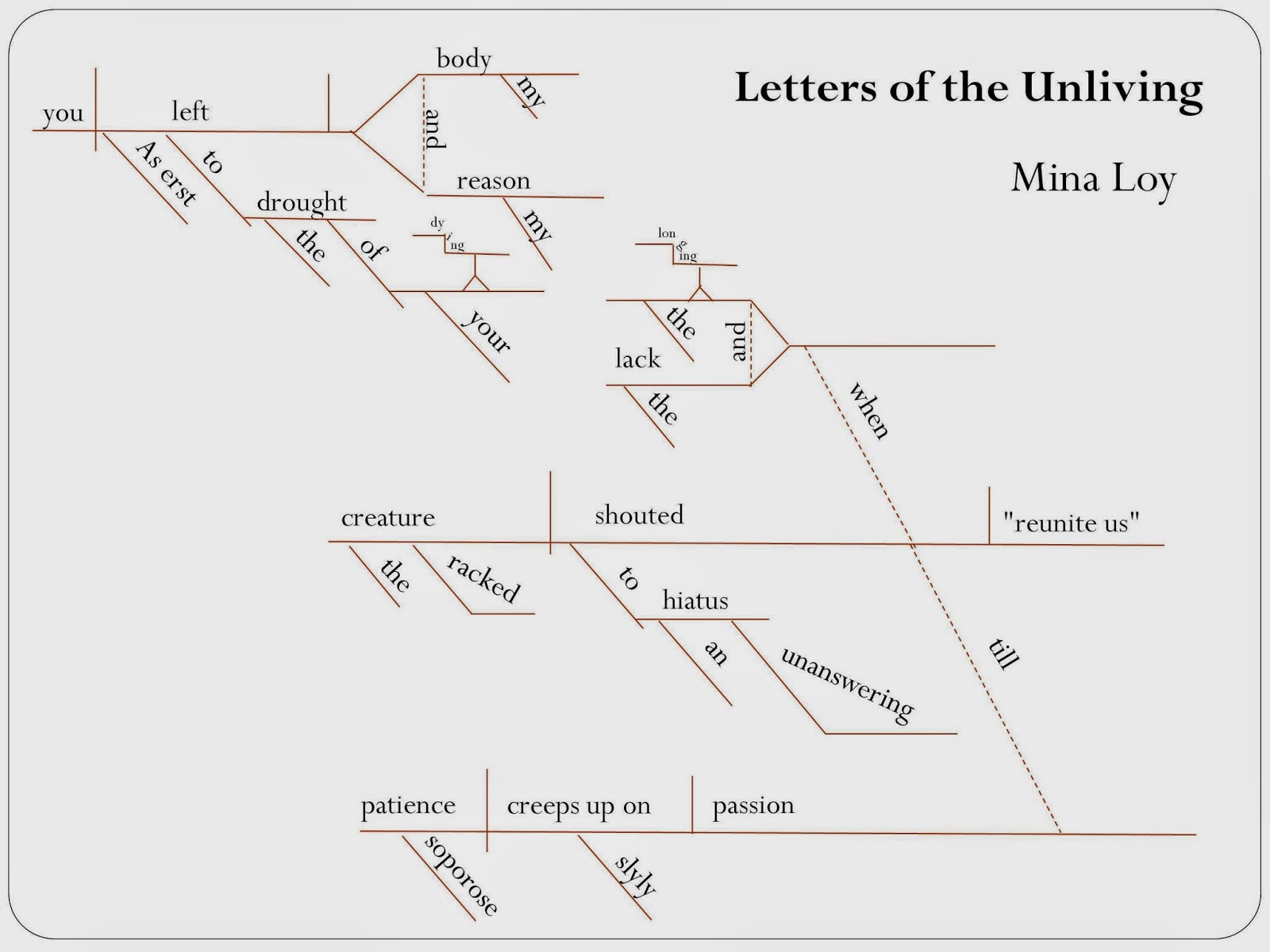
Diagramming Mina Loy's "Letters of the Unliving" as a Method for Close Reading

Diagramming Poetry as a Method for Close Reading
I have recently been working on a new collection of poetry that explores grief and loss.   In order to better study the poetry of loss, I've returned to the poet of my graduate thesis, Mina Loy.   I have found meaning in her poetry today that I could not find eight years ago. 


One of Loy's poems that quite literally makes me catch my breath is "Letters of the Unliving"  as published in The Lost Lunar Baedeker: Poems.


History and Syntax

Loy's history, thus the history of the poem is this: Loy met Arthur Cravan in 1917 and married him in 1918.  Opposed to serving in WWI, Cravan took Loy to Mexico to escape the military draft.  Once in Mexico, and after experiencing some trouble with both military authorities and the professional boxing crowd, "They bought a small, leaky sailing boat with the idea of patching it up and trading it in for a more seaworthy vessel"  so that Cravan might sail to Buenos Aires.  "In early November, only days before the Armistice was signed, Cravan set sail in the repaired craft for the nearby coastal village of Puerto Angel. The weather was fine and the boat apparently in good shape. Loy waited for days on the beach, gazing out to sea, but Cravan never returned" (Ford, 2007, para. 23).

However, no matter the interest in the tragic, romantic loss of love and self depicted this poem, the cathartic fear of loss we feel when we read the history, or perhaps because of the terrible beauty of the language of this poem, I have been having great difficulty sharing this poem with my students.  Although the idea, the elegy, makes the poem universal, the syntax makes the poem difficult to access.


Diagramming and Accessibility

Mina Loy
Image by Stephen Haweis, via Wikimedia Commons
In order to overcome the challenge of accessibility, I diagrammed a section of the poem to help my students better see and understand each unit of meaning, with all of its poetic license and grammatical truncation.  In its simplest form we can pick out subjects and predicates that, in and of themselves, are beautiful: "You left," she states.  "The racked creature shouted," she tells us, "'reunite us.'"  In the end, "Patience creeps up on passion."  The final diagram, though, is a mess, from a missing predicate in the second clause, to a phrasal verb in the final clause, to a fragmented quotation as part of an apostrophe in the third clause. Yet, no one said grief was grammatically pretty.  It's a tangle; a complicated tangle, and once my students and I saw it untangled for the first time, we shared a moment of understanding on one of its deepest levels.


The Gift of Excess

Of this poem and Loy, William Keckler beautifully and aptly states, "She creates a dignified superstructure in this dual elegy which allows for what might elsewhere be excessive; that is Loy's particular gift" (para. 3).  Once my students and I stripped excess from the poem, then put all of it back into place, we could all better understand this "dignified superstructure," this "dual elegy."  We could appreciate the language for what it gives us without leaving anything out.  Once we saw the poem for what it is we forgave what others might call "excess," and we embraced it, this looking back at grief from the future as a person forever changed by loss.


References


  • Ford, M. (1997). Spawn of Fantasies. New Republic, 216(21), 38-41.
  • Keckler, W. (2007). Mina Loy & Arthur Cravan: "Letters of the Unliving." [Web log, Joe Brainard's Pyjamas].  Retrieved June 4, 2014 from  http://joebrainardspyjamas.blogspot.com/2007/09/mina-loy-arthur-cravan-letters-of.html


Copyright Amy Lynn Hess.  Contact the author for permission to republish.

Wednesday, May 28, 2014

Gluten Free and Dairy Free Peanut Butter Cookies

Five little peanut butter cookies waiting to be eaten.
Homemade Peanut Butter Cookies
Image by Sarah B.

Want to learn how to make a dozen gluten and dairy-free peanut butter cookies? No problem!  This recipe calls for only four ingredients, and you probably have them in your cupboard! 


A few nights ago we had company.  We took our guests to dinner, and we all returned to our apartment to chat and catch up.  We had been satisfied with dinner at the restaurant, so we had not ordered dessert.  Once we got settled into our conversation, however, we were all craving something sweet. I checked the cupboards, and they were bare of anything I could think to make, but one of my guests came to my rescue. Together we threw together some peanut butter cookies – both dairy and gluten free!

Ingredients for Throw-Together Peanut Butter Cookies

  • 1 cup salted peanut butter
  • 1 egg
  • 1 cup granulated sugar (to mix)
  • 1/2 cup granulated sugar (to roll)
  • 1 tsp baking powder


Mixing Instructions

  1. Preheat your oven to 350 degrees.
  2. Set aside your ½ cup granulated sugar.
  3. Using a stiff spatula or spoon, mix the peanut butter with the egg.
  4. Whisk the 1 cup sugar and baking powder together.
  5. Stir the dry ingredients (sugar and baking powder) into the peanut butter and egg.
  6. Sprinkle the ½ cup sugar onto a small, flat plate.
  7. Roll a tablespoon of your peanut butter mixture into the sugar on your flat plate.
  8. Place the sugar-coated drop onto an ungreased cookie sheet. Do not flatten.


Baking the Cookies

  • Bake the cookies for 10 minutes, then flatten with a fork, cross-hatching the tine pattern.
  • Bake 5 more minutes.
  • Remove the cookie sheet from the oven and let stand until stiff.


Statistics

  • Approximate Prep Time: 15 minutes
  • Approximate Bake and Cool Time: 25 minutes
  • Approximate Time Until Completely Eaten by Four Adults Who Know Better: 20 minutes

Enjoy these cookies!  Hopefully, you have what you need in your cupboard.  Give them a shot, and let me know what you think in the comments section.


Copyright Amy Lynn Hess. Contact the author to obtain permission for republication.

Tuesday, May 27, 2014

Qualities of Effective Writing: Write with Clarity

Explain your ideas . . . clearly.
Use proper grammar and enough of the best evidence available.

To write with clarity is to ensure your ideas have been supported with enough of the best evidence available.


When a writer presents an essay to readers, that essay must explain the writer's ideas and main point all on its own.  That essay is the writer's only outlet for saying all of the things that need to be said to support the writer's position or claim. In order to achieve that level of clarity, the writer must use enough of the right kind of evidence to support the thesis and topic sentences.


Revising for Clarity

An Underdeveloped Paragraph

Take a look at this example of a paragraph that doesn't clearly support its main idea.  It lacks enough evidence to prove the position taken in the topic sentence.

I deserve an "A" for my project.  I was professional during the presentation, and it was easy to be respectful and have integrity.  I cared about the project.  It was engaging.

Do you buy it?  Do you think this student presents enough evidence to prove he deserves an "A" for his project?  Do you have any additional questions for this writer about why he claims to be professional, or what he means by respect and integrity being easy?  Does he prove to you that he cared about the project, or that he was engaged with it?

It doesn't convince me, so let's revise it to make it more convincing by adding a variety of types of evidence.

A Paragraph Revised for Clarity

The previous paragraph has good "bones," but it's missing evidence.  It needs examples and explanation to prove the points the writer is trying to make.  Remember, you cannot expect a reader to always "take your word for it."  Your job as a writer is to prove the point you are trying to make. Notice all of the real examples in the following revision.

I deserve an "A" for my class presentation about gerunds.  Not only did I wear professional dress during the presentation, but I spoke clearly, had a practiced and revised speech, and supported the content with a visual aid.  I respected my classmates by arriving on time and paying close attention to their presentations, as well.  I demonstrated academic honesty and integrity throughout the presentation: All of my sources were clearly cited, and I used the best and most credible information I could find.  Having a partner who was slightly confused, I cared enough to reach out to her to be sure she understood the information, and I jumped in and assisted her with the visual aid when I realized she was struggling.  I truly engaged with the course material I presented, and I achieved an "A" on the quiz I took early in order to be sure I was presenting the material accurately.  I truly believe I demonstrated these five qualities and more during this presentation project, and I therefore deserve an "A."

Better?  

I think so.  

Remember, clarity does not just mean you use good grammar to make yourself clear.  More importantly, clarity is the quality of having presented enough of the right kind of evidence to prove the point you are making in your thesis statement and topic sentences.


Want to learn more about writing essays?


Or try my complete online essay writing course on Udemy Writing for English Composition: College Essays.


Copyright Amy Lynn Hess.  Please contact the author for permission to republish.

Friday, May 23, 2014

Diagramming Sentences: Silly Sentence Saturday

Question: Will Will Smith smith?
Answer: Will Smith will smith.

Diagramming sentences is so much fun, sometimes I go in search of silly sentences to diagram on a Silly Sentence Saturday.


Today's silly sentences are "Will Will Smith smith?" and "Will Smith will smith."  Pretty silly, right?  But silly or not, both are grammatically correct sentences that can be diagrammed quite easily.  These sentences are simple sentences, and they have only one subject and one predicate, each.


Will Will Smith smith?


The first silly sentence, "Will Will Smith smith?" is an interrogative sentence.  The first "Will" in the sentence is part of the verb, which is in the future tense, "will smith."  "Smith" is both the last name of our subject and the main verb, which means to make or craft a product, generally of iron.  

First, we must rearrange the sentence because it is in the interrogative form: The helping verb and subject have traded places. Second, the subject of the sentence is placed on the left side of the base line.  The predicate, in this case the future simple tense of the verb, is placed on the right side of the base line.  Third, the subject-verb divider line is placed across the base line.  Last, but not least, all of the proper nouns and the first word of the sentence must be checked to be sure they are still properly capitalized.

Will Smith will smith.


The second silly sentence, "Will Smith will smith" is a declarative sentence.  The first "Will" in the sentence is part of the subject, and the first "Smith" is part of the subject, too.  Both words, together, are a person's name, and they are proper nouns, so they are capitalized.  The second "will" in the sentence is a helping verb, and the second "smith" is the main verb.  Together, "will smith" is the predicate of the sentence, the future simple tense of the verb "to smith."

First, the subject of the sentence, "Will Smith," is placed on the left side of the base line.  The predicate, in this case the future simple tense of the verb, "will smith," is placed on the right side of the base line.  Third, the subject-verb divider line is placed across the base line.  Last, but not least, all of the proper nouns and the first word of the sentence must be checked to be sure they are still properly capitalized.

Do you have any additional sentences that would be great for a Silly Sentence Saturday explanation?  Let me know in the comments!


Want to know more about diagramming sentences?


Try my text, Diagramming Sentences: A Playful Way to Analyze Everyday Language, or my online course, Sentence Diagramming; From Beginner to Expert in 12 Lessons. 


Copyright Amy Lynn Hess.  Please contact the author for permission to republish.


Monday, May 19, 2014

Add Coherence to an Essay

When an essay has order and flow, the essay is said to have the quality of "coherence."  


There are several ways for writers to ensure their essays have coherence, including the addition of appropriate transitional words and phrases, a repetition of key words and synonyms, similarly structured topic sentences, and a planned, logical order of paragraphs and evidence.

All of these techniques help readers follow along with thought process of the writer.


Revising for Coherence


A Paragraph that Lacks Coherence


Notice that each individual sentence in this paragraph by Sherman Alexie from an essay called "Superman and Me" makes complete sense.  However, I moved things around a bit, and the sentences are now out of order.   That makes it difficult to understand how one idea flows to the next.  I've also deleted some words and phrases that help us follow his train of thought.

Words inside a paragraph worked together for a common purpose.  Our reservation was a small paragraph within the United States. I remember my father's books. I can see my changed family as an essay of seven paragraphs: mother, father, older brother, the deceased sister, my younger twin sisters and our adopted little brother. Words themselves were mostly foreign, but I still remember when I first understood the purpose of a paragraph. I didn't have the vocabulary to say "paragraph."  I realized that a paragraph was a fence that held words.  This knowledge delighted me.  Words had some specific reason for being inside the same fence.   My family's house was a paragraph, distinct from the other paragraphs of the LeBrets, the Fords and the Tribal School. Inside our house, each family member existed as a separate paragraph but still had genetics and common experiences to link each family member. I began to think of everything in terms of paragraphs. 


A Paragraph with Coherence


Here is that same paragraph from Sherman Alexie's essay returned to its original form.  Notice that the details
Coherence is the quality of having order and flow.
are now in order, and the words that let us know more about his thought process help us move with him from one idea to the next.  Notice the order of the details in his explanation about paragraphs getting smaller and smaller in scope from "United States" to "little brother."  The paragraph, in its original form, is well planned and has a logical and smooth flow.


I can remember picking up my father's books before I could read. The words themselves were mostly foreign, but I still remember the exact moment when I first understood, with a sudden clarity, the purpose of a paragraph. I didn't have the vocabulary to say "paragraph," but I realized that a paragraph was a fence that held words. The words inside a paragraph worked together for a common purpose. They had some specific reason for being inside the same fence. This knowledge delighted me. I began to think of everything in terms of paragraphs. Our reservation was a small paragraph within the United States. My family's house was a paragraph, distinct from the other paragraphs of the LeBrets to the north, the Fords to our south and the Tribal School to the west. Inside our house, each family member existed as a separate paragraph but still had genetics and common experiences to link us. Now, using this logic, I can see my changed family as an essay of seven paragraphs: mother, father, older brother, the deceased sister, my younger twin sisters and our adopted little brother.


In conclusion, when your essays and paragraphs require a bit more order and flow, be sure you have chosen a logical order for your paragraphs and evidence, and make sure your readers can follow along with you by including transitional words and phrases, using key words and phrases about your main idea, and using a repetition of sentence structure.  


Want to learn more about writing essays?

A vintage typewriter sits, waiting for words to be typed, on a beautiful striped tablecloth.

Try my complete online essay writing course on Udemy Writing for English Composition: College Essays.


Copyright Amy Lynn Hess.  Please contact the writer for permission to republish.

Tuesday, May 13, 2014

Write a Unified Essay

Unity, in writing, is the quality of having one main thought sustained and supported throughout the piece of writing.  

In an essay, that one main thought has a name: the thesis statement.  That thesis statement is supported by a number of paragraphs, each of which covers its own little piece of the main thought.  Those "mini main thoughts" are called topic sentences.  The rest of each paragraph is comprised of evidence, analysis, interpretation, and explanation - each as required to prove the main thought.


When all of those elements, the thesis, topic sentences, and support, combine to seamlessly advocate one position about one topic, the essay has the quality of unity.  When any one of those elements is a bit wonky-skewed or off-topic, the writing must be revised to get it back on track.  The most common error new writers make is to forget to unify evidence in a paragraph with that paragraph's topic sentence.


Aligning Topic Sentences and Evidence

Revising for Unity


A paragraph that lacks unity:


My uncle Fred dresses like an old-fashioned cowboy.  He always wanted to be one, so he bought a hat and it went from there.  He acts like a cowboy, too.  He even eats like one when he has cookouts, which he has all the time, and puts his accounting skills to the test.  My aunt wears a cowboy hat sometimes, too.  It's really the boots that everyone likes, including the spurs.

In order to revise this paragraph for unity, we have to first pick out the one idea we feel is the most important.  It seems as though the main idea isn't really the first sentence of the paragraph because not all of the sentences in the paragraph are about how the uncle dresses.  It seems all of the sentences are about the uncle wanting to be a cowboy in some way.  Let's revise the topic sentence.

Instead of writing My uncle Fred dresses like an old-fashioned cowboy, let's emphasize the real main idea: My uncle Fred has always wanted to be a cowboy.

Now, if you were to say "My uncle Fred has always wanted to be a cowboy," to someone, that person's most likely response would be, "Why do you say that?"  That means the rest of the paragraph must answer that question.  Let's add the new topic sentence to the beginning of the paragraph and look carefully at the rest of the sentences and ideas to make sure they are clearly supporting the topic sentence.

A paragraph that demonstrates unity:


My uncle Fred has always wanted to be a cowboy.  My uncle Fred He dresses like an old-fashioned cowboy.  He always wanted to be one, so  He bought a hat, and it grew  from there.  He even wears boots with spurs.  Uncle Fred acts like a cowboy, too.  He even eats like one when he has open pit cookouts, which he has all the time. and puts his accounting skills to the test.  My aunt wears a cowboy hat sometimes, too. It's really the boots that everyone likes, including the spurs. He also married a woman who looks like a cowgirl.  If I didn't know he was just an accountant, I might truly believe uncle Fred was a cowboy.

With a bit of revision, sentences that refer to the uncle's job as an accountant and his wife now more clearly support the main idea.  As they were stated previously, they were off-topic, making the paragraph difficult to read.

When writing your essays, keep in mind the quality of unity, the idea that a piece of writing should express one clear position about one narrowed topic.


Want to learn more about writing?  Try my online paragraph and essay writing class - at a discount, just for being a blog reader!


Try my complete online essay writing course on Udemy Writing for English Composition: College Essays.


Monday, May 5, 2014

Beginning Yoga: No More Excuses

A group practices yoga oceanside.
Bondi Beach Yoga
Image by Taro Taylor

I put off learning yoga for a long time. I had preconceived ideas about its cost, my level of flexibility, and how it could be of benefit in my daily life.


Many times over the years I've been invited by others to join them and participate in their yoga classes, but I've always offered one of my many rotating excuses. "I'm not flexible," "I have a bad neck," "I don't have a mat," "I can't pay for the class," "My allergies are bothering me, and when I hang my head my nose runs," I'd say. What it all boils down to, no matter what types of excuses I've used, is that I have always been stand-offish about new activities whenever there is any kind of possibility I might look foolish. Because of a stiff shoulder and continuous tension headaches over the past several months, however, I finally considered the possibility that yoga might be a better answer than the ibuprofen tablets I was taking each day - and so far so good!

Thanks to my local yoga studio and the amazing people who work and teach there, I've tucked my excuses neatly into this essay. I will never need to use them, again.

Minimal Expense

Once I started investigating the costs of classes in my area, I was really astounded at the variety and affordability of yoga classes. 


I typed in my zip code and looked into various studios in the area. There are Hatha, Ashtanga, Vinyasa, and Pilates classes all within a 7-mile radius. Prices here range from $15.00 for a drop-in class to around $600.00 for a yearly membership. There seem to be several series deals, as well, like an unlimited week for $25.00. As for the auxiliary costs, some of the studios offered mat rental for $2.00, and others supply mats and other props during the class. Purchasing a mat will cost from $14.00 to $65.00, but I have not purchased a mat, yet. All told, I've attended four classes in the Hatha Yoga tradition for a total investment of $25.00.

Flexibility

To be honest, the "I'm not flexible" excuse is quite true. However, when beginning to practice yoga, a person does not already have to be flexible. 


Yoga will help a person become more flexible over time. For example, in my first class, although I could not reach the floor to properly support myself during certain poses, my instructor brought me over some exceptionally handy yoga blocks so I could support and extend my body in the right way. Now that I've finished a fourth class and have a better idea of how my body works, I can complete some of those same poses without blocks. Part of my problems with flexibility were really an unknowing about what I could and could not achieve. I've physically and mentally become more flexible.

Neck and Shoulders

Even though I've had headaches at the start of my second and third yoga classes, by the end of the classes the headaches were subsiding. 


Many times my headaches originate because of tension in my neck and shoulders, which then causes my head to hang or jut out in front of my body while I'm working at my desk. During my few yoga classes, I've noticed that when I'm really mindful of my breath and enjoying stillness, I can feel where I need to relax and stretch in order to alleviate some of that neck and shoulder pressure. The more I practice, the more this awareness trickles into my daily routine and I find myself sitting taller and breathing more deeply. The ability to control the tension before it becomes overwhelming has, as a bonus, helped my mood tremendously.

So, contrary to my preconceived notions about yoga, I've learned that beginning a yoga practice requires very minimal expense, even when beginning with excellent teachers. I've also learned that beginning yoga does not require a person to be flexible, but will help a person become flexible over time. Additionally, as I've practiced I've noticed a great improvement in the alleviation of my neck and shoulder tension, which has elevated my overall mood. My only wish is that I hadn't been so stubborn about it for so long.


Copyright Amy Lynn Hess. Contact the author to obtain permission for republication.  First published Jul 7, 2011 by Amy Lynn Hess.

Using ChatGPT for Essays in English Composition Classes

The best essays are written by people for people. "Corona Typewriter" image courtesy of the author ChatGPT and other AI language g...