Welcome!

Do you have APA formatting questions? Thesis statements got you down? Need to study grammar? Need some help with critical thinking? Having trouble with literary analysis or research? Want to take a look at some example essays? Well, I probably have a post here somewhere that can help you. Please use "Search This Blog," the "Labels," or my "Blog Archive" to help you find what you need. Have questions about what you find? Please feel free to comment or ask questions. I do moderate comments, and I try to respond to all topical questions and comments in a timely manner.

Tuesday, April 29, 2014

Flipped Classroom: Before Making Videos

Some little helpers help a traditional teacher flip her classroom.
Are you ready to flip your class?
It can be intimidating to flip a classroom, especially for professors!  Most often, flipping a classroom is associated with creating videos or finding technology the students use at home so that class time can be used for workshop or group work instead of for lecture.

However, flipping a classroom doesn't have to be a long leap with a short USB cord.  The process can be initiated in small steps.


 This approach, instead of focusing on creating or finding videos, focuses on what happens in the classroom.

Short Reading Quizzes

Course textbooks are carefully reviewed and chosen by faculty for the value they add to a specific course's content.  However, sometimes students are overwhelmed by their college textbooks, and they are unaccustomed to reading entire chapters in one sitting.  Furthermore, some students have never been taught how to take notes or pick main points or arguments from textbooks or supplemental reading.

Using the flipped classroom approach, we can help students make sense of their assigned reading, teach them how to take note of important information, and give them an opportunity to validate their own understanding.  How do we do that?  Using quizzes we create online!  The key is to set up the quiz so that the students can get their scores immediately and can take the quiz multiple times.  Being able to take the quiz multiple times (perhaps with the promise that the highest grade will count) encourages the students to go back to the reading and re-evaluate the content in order to correct their responses.  Although the creation of the quizzes takes time on the front end, helping the students reach a high competency in learning objectives is worth it!

Research Projects and Presentations

Another way to flip a classroom is to ask students to prepare their own lecture content to share with others during class time.  Not only should the students use their textbooks as a resource, they should use original examples and source content from reputable authors and publishers to create lively, engaging presentations.

When students complete research and gather materials as homework, class time can be devoted to helping students work on their presentations, either in groups or by themselves.  Not only is it a fantastic opportunity to help the students develop ethos and other presentation skills, but to experiment with finding and evaluating evidence about the class's specific discipline area.  Additionally, it allows a professor to assess students' understanding of course content in real time, as projects or presentations take shape in front of that professor's eyes.

Self Assessment Narratives

In addition to, or in lieu of quizzing students about assigned reading, a professor can assign narrative essays in which students assess their own understanding of course content.  Assessment, normally a task that takes place in a professor's office after students spend class time creating assessment documents (quizzes, exams, essays), becomes a homework assignment.  Students must look back at the content, and the understanding of that content, in order to complete the essay.  The students must review their notes, look back through any assigned reading, and figure out what they do and do not know about a given topic.

When students self assess, they come back to the class with a greater understanding of not only the content of the course, but of their own strengths and weaknesses, which leads to more in depth class discussions and more poignant questions.

In summary, a flipped classroom does not require a professor to create or find videos in order to flip the classroom.  The "flip" is between lecture and activity.  When students are reading, writing, or reviewing content outside of the classroom, more active learning activity can take place within the classroom.


Want to read more about pedagogy and learning?  Try
The Benefit of "Play" in the Composition Classroom
Motivate the WIIFM Student with a Learning Audit Assignment
Stages in the Development of Critical Thinking


Copyright Amy Lynn Hess.  Please contact the author for permission to republish.

Monday, April 21, 2014

Adding Comments to Word Documents


A print screen of a Word 2010 document with added comments.
Adding Comments in a Word Document Helps Streamline the Review Process

Have you ever wished you could add questions or comments to your writing to get extra help from your reviewer?  Have you ever wanted to make a note to yourself as you're writing so you can remember to look at something later?  You can!


Comments are notes a writer or proofreader can add to a Word document.  Writers and readers can both add comments to a document, to themselves or to each other, making the revising and editing processes more efficient.


Adding Comments to Text

Before a comment can be added a Word document, the reviewer must determine where the comment will be most beneficial.  The reviewer has to decide to which word, phrase, sentence, or paragraph the comment will apply. For example, if the comment is about proper comma use, the reviewer should highlight the comma and perhaps the phrase, clause, or sentence related to the comma.  In order to choose the text, the reviewer should highlight the text by holding the left mouse button and scrolling over the chosen text.  After the text is highlighted, the reviewer can release the mouse button.

The Comment Function and The Review Tab

Because comments are used extensively when a writer or reader is reviewing a document, the comment function can be found under the "Review" tab.  In order to add a comment to a piece of text, after highlighting the text the reviewer should choose "Review" > "Add Comment."   A text box will appear in the right margin.   The text box will be initialed and numbered.  The comments will print if the document is printed, or they will be saved if the document is saved.  An additional reviewer's comments will be a different color and will have that person's initials.  

Reviewing Comments

A print screen of a Word 2010 document with added comments.
Comments are Easily Navigated
Once a document is reviewed and comments are added, those comments can also be navigated and deleted from the Ribbon Toolbar.  The writer or reviewer can scroll through each comment using the "Previous" and "Next" buttons, or they can be deleted one at a time or all at once.  

Additionally, comments can be deleted directly from the comment.  The reviewer simply uses the right mouse button to click on the comment, and a comment menu will appear.  

A print screen of a Word 2010 document with added comments and menu.
The Comment Menu Offers Several Formatting Options

Next time you truly feel the need to ask your reviewer a question or make a comment about your writing, feel free to use the Comments function in Microsoft Word.  When writers and reviewers use the Comment function, reviewing is made more efficient in the process.  


Want to learn more about writing essays?  Try my complete online writing course on Udemy - at a discount, just for being a blog reader!


Try my complete online essay writing course on Udemy Writing for English Composition: College Essays.


Copyright Amy Lynn Hess.  Please contact the author for permission to reproduce.

Monday, April 14, 2014

Learn to Crochet for Stress Relief

A woman meditates in a crochet world.
Crocheting Can Keep Your Mind in a Happy Place

Have you been thinking about learning to crochet, or have you been feeling like crocheting more often?  


There may be no time like the present to pick up a hook and give it a try.  Some of the benefits of the craft include a decrease in symptoms of stress and depression.  Among other things, crocheting can help provide an increase in feelings of control over one’s life, a relief from feelings of isolation, an increase in self-esteem, and an opportunity for relaxation.

In other words, as any crocheter can attest, crocheting is a fantastic way to unwind, whether that’s at the end of a good day or at the end of a bad day, week, month, or year.

How Can a Handicraft Have So Many Benefits?


Repetition and Relaxation

According to Julia VanTine, who writes for the health magazine Prevention, it’s the repetitive focus of needlecraft that can help to calm a crafter (2000).  The same idea applies to crochet.  The repetitive motion of crocheting can, quite literally, give a person feelings of well-being by increasing the levels of serotonin and dopamine in the body (Fernandez, 2013).

Furthermore, the amount of concentration required to crochet a particular project can have a positive effect on a crocheter’s affect. The more ergs, or units of mental energy, a person uses to follow a pattern or work a piece of fabric, the fewer ergs are left to think about triggers of stress.  In other words, being absorbed in their work helps crocheters focus on a constructive activity, not destructive thoughts.

Community, Socialization, and Self Esteem

There's something to be said for the benefit of operating within a community.  Once a person decides to become a crocheter, he or she can join a social group with others who also enjoy crochet.  These types of groups foster positive relationships, and members often celebrate achievements with one another, whether that's the completion of a first project, or the mastery of a difficult skill.  Belonging to these groups reduces a person's feelings of isolation.

Moreover, these groups oftentimes give members opportunities to crochet for benefits or charities, and what better way to raise self esteem than by giving back to one's own community?

Creativity and Purpose

Have you ever heard of a "tortured artist?"  It's not simply a stereotype or cliche.  Many artists, especially when they feel as though no one understands their passions or their ways of communicating their feelings, begin to experience symptoms of depression.  If not able to practice their art or their craft, they may feel as though they have no purpose in their lives. Even if it's only in some small way, crochet can offer creative people an outlet for creativity through color, texture, pattern, and final product.

Choosing or creating patterns, yarn colors, and additional supplies and materials can benefit all crocheters.  Again, making these sorts of decisions helps, even in a small way, remind a person that that he or she can make decisions and does have the ability to control how he or she expresses feelings and emotions.

Crocheting can reduce stress and feelings of depression by giving people opportunities for relaxation, socialization, and creativity.  Making the choice to pick up some yarn and a hook may change a person's life.


Want to learn more?

Just the look of these yarns makes me feel happy and relaxed.

Take my complete beginners guide, called "Crochet for Stress Relief," on Udemy.com. 

Once you sign up, you have lifetime access to the course, so there's no hurry.  Take your time, and learn at your own pace.  There's over 2 hours of course content, broken into 2 - 17 minute increments of learning, slow motion follow along videos, and hints and tips throughout.  Get started and get some stress relief!

Want to read more about crochet?  Try


A Brief Introduction to Crochet Hooks
Lion Brand Yarn Ergonomic Crochet Hook Set
Crochet Christmas Tree Ornaments
Making Crochet Sushi Toys
Crochet Saved My Life: The Mental and Physical Health Benefits of Crochet (Paperback) by Kathryn Vercillo

References

  • Fernandez, K. (2013). Stress buster: Knit your way to Zen. Retrieved from http://timesofindia.indiatimes.com/life-style/health-fitness/health/Stress-buster-Knit-your-way-to-zen/articleshow/22598142.cms
  • VanTine, J. (2000, May). Give Stress the Needle. Prevention, 52(2), 46. Retrieved from http://go.galegroup.com/


Copyright Amy Lynn Hess.  Please contact the author for permission to republish.

Monday, April 7, 2014

Hair Accessories to Finish a Professional Hairstyle

Women wearing scrunchies and visible hair bands.
"Scrunchie" by Ralph Hockens
For women with medium to long hair, it can be a challenge to find quick hairstyles that are finished and professional enough for the workplace.

There are ways women can meet professional guidelines and dress codes without having to spend extensive time in the front of the mirror every morning trying to create an appropriate hairstyle before heading to work. These women require only a few hair accessories that can be found at drugstores, discount department stores, online stores, and beauty supply specialty store across the United States. Although it may require some shopping around for the product that matches a woman's hair type or personality, she should be able to find hair pins and pony-tail covers that will maintain a quality style for an entire workday and not break the bank.

The important point to remember is that a professional hairdo should always look neat, sleek, and finished.

Jumbo Hair Pins

These pins are a time-tested favorite for women with long hair. Jumbo hair pins, or 3-inch extra-large hair pins, are the perfect accessory for neatly-finished buns and twists, and nothing says "professional" like a neat bun or hair twist that holds all day and never distracts a woman from the job at hand.

Jumbo hair pins come in colors and finishes to match a variety of hair colors, so they are practically unnoticeable by employers and coworkers. Women can also purchase them in different thickness gauges and either with or without ball ends and crimped stems for various levels of hold. Wooden, metal, or plastic varieties are also available, and they can be decorative or plain. For work, women should wear plain or unobtrusive decorations in their hair to maintain a professional image. Although the more colorful and noticeable variations are better left to the weekend, jumbo hair pins are perfect for workday hairdos for all of the various hair types professional women might have.

Pony-Tail Covers

Pony-tails are quick and easy, which makes a pony-tail a great option when a woman is in a hurry on her way to work. However, brightly-colored ribbons, scrunchies or hair ties are not appropriate for the professional workplace. For the workday, a woman should opt for something that makes her hairdo look neat and finished. That is not to say, though, that a woman cannot wear a pony-tail to work. Pony-tails, and the elastic bands that hold them in place, can be covered by pony-tail covers.

Pony-tail covers come in many shapes, styles, and materials, including leather, sterling silver, plastic, or fabric. A working woman should choose, just as with the hair pins, a decoration that is fairly neutral to help her maintain a professional image. They're just as easy to use as the elastic, itself, but finish a pony-tail in a way that is appropriate for the workplace.

Although these are only two broad categories for workplace-appropriate hair accessories, they can be used in a variety of ways during the workweek to keep a woman looking polished. Both jumbo hair pins and pony-tail covers come in a variety of types and styles, so a woman can, while maintaining workplace standards, express her personality - and get to work on time.


Copyright Amy Lynn Hess. Contact the author to obtain permission for republication.
First published July 14, 2011 by Amy Lynn Hess

Monday, March 31, 2014

Harry Potter Jr. and Torok the Troll

A troll sits on a log, agog, in Harry Potter's attire.
Harry Potter, Jr., of Course!

Did you know Harry once saved his sister from an evil wizard-turned-troll named Torok who was holding her captive in a magical trance?


No, not that Harry. Harry Potter, Jr.

If you have been missing the witches, trolls, magic, and classic story of good versus evil, try taking an adventure with Harry Potter, Jr. by watching the 1986 family adventure, Troll, directed by John Carl Buechler.


The Original Harry Potter

In September of 2009, Buechler announced in an interview that he was planning to remake Troll, his 1986 film (Gilchrist, 2009). Curious about the correlation that might exist between the original, big brother Harry Potter, Jr. from the 1986 film and J.K. Rowling’s boy wizard, Harry Potter, I watched Troll with a critical eye, trying to imagine if or how Rowling had been, even unwittingly, inspired by this earlier story.

When Troll first came out, I did not see the film, and I had very low expectations up until the moment I pressed “play” on the DVD player. I was pleasantly surprised, however, and I found Troll charming, albeit eerie. Charmingly, for example, Harry Potter, Sr. dances to a punk-rock version of "Summertime Blues" while worried about his daughter’s odd behavior. Eerily, on the other hand, during a family dinner sequence, the shot transitions from the family to singing trolls, to a kindly witch and her magical mushroom, and back to the family dinner. Throughout, the puppet-prop trolls and the magic mushroom sing a choral called Cantos Profanae while yet another character recites Spenser’s "The Fairie Queene."

Harry Meets Harry

Yet, in spite of the obvious differences in storytelling (Rowling's Harry Potter doesn't have a sister he thinks is an alien pod from Mars, for instance), Troll’s Harry Potter, Jr. and Rowling’s Harry Potter share an archetypal similarity. As I watched this film I was reminded of the feelings I had when first reading, then watching, Harry Potter and the Sorcerer’s Stone: feelings of discovery, innocence, and stubborn resolve.

Troll is the story of a boy named Harry Potter, Jr., a dark-haired boy with a sensitive and caring nature. A malevolent troll takes his sister captive and magically disguises himself as the girl. Harry, Jr. sees through the disguise, but he is reluctant to confide in his parents. He allies himself, instead, with a kindly neighbor, who happens to be a witch, and together they foil the troll’s plans of taking over the world by building an army of magical creatures spawned from unwitting neighbors.

Similarly, the Harry Potter books and films are the story of a boy named Harry Potter, a dark-haired boy with a sensitive and caring nature. A malevolent wizard kills his parents and then attempts to kill Harry, and at one point even takes his future-wife captive after magically controlling the girl. Harry, reluctant to confide in the adults who surround him, eventually allies himself with a kindly professor, who happens to be a wizard, and together they foil the evil wizard’s plans of taking over the world by building an army of magical creatures, including trolls, giants, gigantic spiders, dead bodies, and other witches and wizards.

Hero-Harry, A Familiar Motif

Although the stories differ radically in their lengths and breadths of expression, the motif of each story is familiar; a boy becomes a reluctant hero by demonstrating radical self-reliance and willpower in the face of seemingly insurmountable evil. No matter their differences, 1986’s Harry Potter, Jr. has at least that in common with Rowling’s unforgettable boy wizard, Harry Potter.


References

Gilchrist, T. (2009.) Creator plans a remake of the first Harry Potter movie: Troll. Retrieved from http://blastr.com/2009/09/creator-plans-a-remake-of.php


Copyright Amy Lynn Hess. Contact the author to obtain permission for republication.  Originally published Sep 28, 2011.

Monday, March 24, 2014

Presenteeism and Sick Time Math

A doctor checks the health of a workplace while sick employees line up outside.
Which is More Costly?  Sickness Absenteeism or
Sickness Presenteeism?

The issues related to raising the minimum wage have been hotly debated in recent months.   Closely related to that hot-button topic is paid sick leave and presenteeism, and President Obama's proposal for a required 7 days of paid sick-leave for workers has taken the debate all the way to Congress.


Luckily, many of us already benefit from paid sick leave throughout the year;  however, many others do not.  An employer's refusal to pay for sick leave leaves an employee's coworkers at risk from contagious viruses and the company at risk from low morale and a lingering loss of productivity.

What follows is a simple example of how the math works, comparatively, when an employer pays sick leave and when an employer does not.  Please note that these numbers are neither arbitrary or made up: They are based on common sense (the flu lasts 3 days), countless conversations  and research about low morale (10 - 20% reduction in productivity when morale is low), and a review of the literature pertaining to the issue of sick leave (20% decrease in productivity when sick).

A Hypothetical, But Realistic Case Study: WidgetMakers

WidgetMakers is a company owned by Scroogie MacBottom.  Mr. MacBottom has 5 full-time, hourly employees.  He pays his employees $10.00 an hour, but he does not pay for sick leave.    

Happy and Healthy Employees

When MacBottom's employees are happy and healthy, they can each produce 10 widgets per day for a total of 250 widgets per week.  He sells those widgets for $50.00 each, leaving the company with a revenue of $12,500 per week. His weekly payroll, when everyone is happy and healthy, is $1750.

Four Sick and Sad Employees

When one of MacBottoms's employees is sick, say with a mild case of the flu, that flu will last about about 2 - 3 days.  That employee, perhaps because he is afraid of losing his job or because he needs the $70.00 per day just to make ends meet, will come to work all 3 days; it will last the full 3 days because the person is getting no extra rest.  That flu will spread to other employees.  They, too, will come to work.  All of them will work more slowly, spend more time in the bathroom, and spread even more germs.

There's no question about it: Sick employees do not demonstrate full productivity.  They lose about 20%, or 12 minutes per hour.  On top of that, however, they are resentful, and that resentment turns into low morale.  They know coming to work with the flu is not in the best interest of their own health, their co-workers' health, or the company, but they feel they have no choice but to be there - well, at least until they can jump ship and find another place to work, which generally occurs as soon as possible when morale is low and employees are highly dissatisfied. That turnover just adds to the problem . . . and potential costs.

Employees can lose up to another 20% productivity when morale is low.  Just because MacBottom has hired responsible people, however, his employees will only lose another 10% productivity, or 6 additional minutes per hour, because of their low morale.  All told, then, 4 of his employees get sick, each for 3 days, each at a loss of 30% productivity.  At the end of the week, MacBottom is 36 widgets short and only makes $10,700.  Payroll remain the same, $1750.


One Sick, Not So Sad, Employee

On the other hand, if MacBottom paid sick leave, that same employee would probably stay home, get lots of rest, and only be sick for 2 days.  He would not be resentful or demonstrate low morale.  He would not pass the flu to his co-workers.  

Because that person is home for 2 days, instead of sick at work for three days, the loss of widgets at the end of the week is only 20 widgets, not 36.  The weekly revenue is $11,500, $800 more than if the employee had come to work.  The $1750 payroll remains the same.


In Conclusion

Scroogie MacBottom has a real sickness at his company, WidgetMakers.  That sickness is called presenteeism, and he brought it on himself.  His employees, for one reason or another, feel they must come to work when ill.  The number one reason is that they need the money, followed closely by the fear of losing their jobs.  This, in turn, makes everyone sicker, reducing productivity by 10% - 30% at any given time; either from illness or low morale.  That loss of productivity, in the end, costs more than simply paying for sick leave.

There is, of course, a formula for when sick time becomes excessive, and employers can work out for themselves that number of days or hours for sick leave or personal time, as many already do.  There is not such an easy formula for low morale, though.  Not paying for sick time at all is a costly risk.


Want to read more about presenteeism?  Try

Irvine, A. (2011). Fit for Work? The Influence of Sick Pay and Job Flexibility on Sickness Absence and Implications for Presenteeism. Social Policy & Administration, 45(7), 752-769. doi:10.1111/j.1467-9515.2011.00795.x

Leslie, K. E. (2006, Dec 09). Dedicated or dangerous -- why do people come to work sick? McClatchy - Tribune Business News. Retrieved from http://search.proquest.com/docview/459656119?accountid=158586

Noguchi, Y. (2014). Obama's Big Bid to Change Sick-Leave Laws May Hinge on Small Business.  Retrieved from http://www.npr.org/blogs/health/2015/01/22/379102675/obamas-big-bid-to-change-sick-leave-laws-may-hinge-on-small-business

SG, Geuskens, G., Hooftman, W., Koppes, L., & SNJ. (2010). Productivity Loss at Work; Health-Related and Work-Related Factors. Journal Of Occupational Rehabilitation, 20(3), 331-339. doi:10.1007/s10926-009-9219-7


Want to share your own story?  Please feel free to leave a comment.


Copyright Amy Lynn Hess.  Please contact the author for permission to republish.


Tuesday, March 18, 2014

Lion Brand Yarn or "Eleggant" Ergonomic Crochet Hook Set

The wood and metal construction of the ergonomic crochet hook set, pictured here, makes it stable and durable.
Lion Brand Yarn's Ergonomic Crochet Hook Set
The Lion Brand Yarn Company was recently kind enough to send me, per my request, one of their Ergonomic Crochet Hook Sets for review.  


I had specifically requested this particular set because I was attracted by the promise of less pain in my hook hand while crocheting, and this egg-shaped wooden handle seemed more stable and durable than other, plastic handles I had seen and used in the past.


After using it for three different projects over the past several days, I must say that overall I am pleased with the ergonomic crochet hook set's performance.  


UPDATE: As of May 2018, I see this ergonomic crochet hook is no longer available from Lion Brand. However, I do see that it is available, but it is listed as an "Eleggant Hook" on Amazon.  Lacis is also selling a similar item as an egg-shaped wooden handle for Boye crochet hooks.


First Impressions

As you can see in the images, this particular ergonomic crochet hook set is a very attractive set, and it is also small enough to easily fit in a travelling bag or handbag. The handle, sans hook, measures 3 inches long by 1 3/8 inches across at its widest.  Relatively speaking, it looks very similar to an awl.
The Lion Brand Ergonomic Hook Set is pictured here with Lion Brand yarn, "Sock-Ease" in dye color "Root Beer."
Six Interchangeable Hooks
  
The set came with 6 interchangeable hooks: 1.25 mm, 1.75 mm, 2.25 mm, 3.5 mm, 5 mm, and 6 mm.  It also came with rubber "O" rings for setting the larger hooks into the chuck securely.  All came in a little plastic packaging case that can be reused for storage.

Wanting to test the different-sized hooks for all types of projects, I used the set with Lion Brand fingering yarn, pictured here, a Caron Super Soft yarn, and a Red Heart bulky yarn.  


Assets: Durable, Stable, and Reduces Hand Pain and Fatigue

In the past I have used an ergonomic handle set that came with two different plastic handles and several interchangeable hooks.  The problem with that set was that the hook shapes forced me to hold my hook in such a way as to feel unnatural. This did not happen with the small, wooden egg.  I could hold the hook in "butter knife" position just as easily as "pencil" position, the only difference being that I didn't have to hold as tightly, thereby reducing stress on my thumb and pinkie finger.  My muscles didn't seize up on me, in other words.  Success!


Pictured here are the interchangeable crochet hooks, rubber rings, and crochet handle.
All Metal Threaded Chuck

Furthermore, my previous, now donated, plastic ergonomic set was plastic - even the threads on the interchangeable hooks were plastic.  It was very difficult to get them to fit into the handles smoothly.  It took a few frustrating attempts every time.  However, this is no issue with the Lion Brand set.  The threaded parts are metal.  The chuck is textured and easy to turn. There are no threads on the interchangeable hooks, and the hooks never came loose while I was crocheting.  Yet, the hooks are very easy to swap out!  Hurray!


In short, the hook set delivered on its promise to reduce hand fatigue and pain, even when using fingering yarn and a 2.25 mm hook.


Drawbacks: Replacement Parts and Hook Design

Although I do recommend this product because it certainly delivers on its promise to reduce hand pain while crocheting, I did find two weaknesses.

First and foremost, I was a bit confused about who makes these hooks and how I can order replacement parts or hooks.  A small card that came with the set states that replacement rings and additional hooks are available at the Motion Magique Web site.  However, when I used that Web address, I was forwarded to a very unprofessional-looking site that announces the retirement of the previous maker.  I would urge the makers to revise the card that comes with the set, and the Web site, as soon as possible.

Pictured here are the tapered and pointed hook heads on the various sized hooks.
Tapered and Pointed Hook Heads

Secondly, I must admit I was disappointed in the hook style, especially of the larger hook sizes with the higher-ply yarns.  I have always preferred a flat  throat versus a tapered throat, and I have always preferred a rounded hook head versus a  pointy hook head.  I find that the pointy, tapered hooks are difficult to use with any speed because I'm constantly splitting my yarn when trying to pull back through loops.  To  make up for the change in the hook style, I found myself twisting my wrist a lot more than usual in my attempt to push and pull the point straight through the work instead of on an angle like I can do with my preferred hook style.  It will take some getting used to.


All in all, however, the weaknesses I've listed here are based on personal opinion, and in the end, the hook set did indeed do as it promises to do.   It does it in a lovely, wooden, egg-shaped style.  I think the set would make an excellent gift or addition to any hook collection.


Want to read more about crochet?

A Brief Introduction to Crochet Hooks
Making Crochet Sushi Toys
Crochet Christmas Tree Ornaments
Online Crochet Course  - Crochet for Stress Relief with Patternless Projects


Copyright Amy Lynn Hess.  Please contact the author for permission to republish.

Wednesday, March 12, 2014

Sentence Diagramming for Haptic Learners

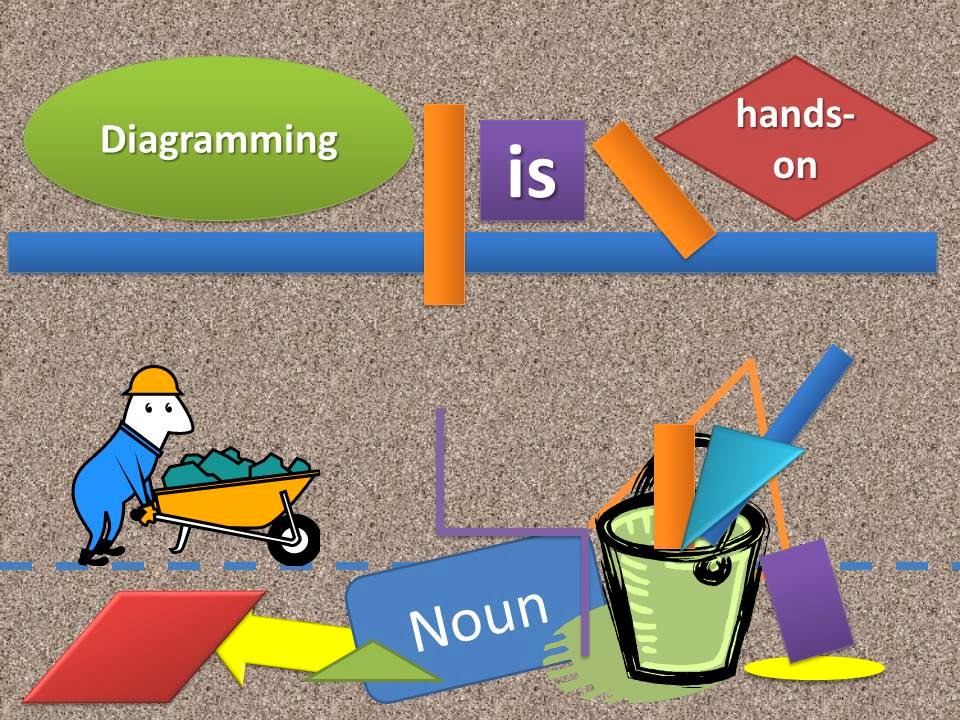
A construction worker wheels new bits and pieces of language and diagrams to the work area.
Constructing a "Hands-on" Lesson
According to The Institute for Learning Styles Research, haptic learning "refers to the sense of touch or grasp."  The Institute also offers examples of the traits of haptic learners, such as "Likes a 'hands-on' approach to learning," "Likes to piece things together," and "Is successful with tasks requiring manipulation."

Mostly, it sounds like this type of learner would love art classes, shop classes, home economics, and science labs.  But wait!  Don't count out English and Language Arts for these learners just yet!

With a little art and crafting, sentence diagramming can be a method of language study that, once shaped into lessons, will be engaging for haptic learners.


Planning a "Hands-on" Lesson

The most important idea to remember when gathering materials for teaching sentence diagramming to haptic learners is to make the learning tactile and to find a way to let the students use their hands.  This is more than writing on the board or completing exercises in a notebook or on a computer; it requires the students to "piece things together." What we can do as teachers, then, is to decide what we want the students to learn, then provide either the pieces, or the pieces to make the pieces.


Creative Sentence Diagramming Options

During short lessons, you can provide pieces of diagrams and vocabulary for students to use to create three dimensional diagrams.  For a longer lesson, students could create their own pieces.

For example, in a small space or setting, you could use "Magnetic Poetry" words and magnetic strips on a magnetic white board to create diagrams.  In that case, you could use a set of "Magnetic Poetry" (in your choice of languages), or you could make your own by purchasing magnets and magnetic materials from a craft store.  If the lesson objective is to teach sentence patterns or the parts of a sentence, create "subject," "predicate," "modifier," "phrase," "clause," "complement," and "object."  If the lesson focuses on the parts of speech, create several of those pieces, instead.

Another way to create your diagramming pieces is to use felt and sandpaper.  Felt will stick to sandpaper, so you can cut your long, rectangular shapes for diagramming, pin or glue a variety of words to rectangular shapes, and have students make or create original or given sentence diagrams.

Other materials could include natural items, like sticks or twigs, or malleable materials, like sand, modeling clay, or pipe cleaners.  No matter what you choose to use, be sure to practice a few times on your own to be sure you don't leave out any important supplies (like having a vacuum cleaner on hand if you decide to use sand).


Assessment

When it comes time to assess student work, the assessment is immediate, as is review and correction when necessary.  Because the work students are completing is in an impermanent state, be prepared to watch the students as they work, checking in with them frequently to get an idea of the success of the lesson.  Assessment results can be documented as the students work, photographed, or more traditional forms of assessment can be used later in the unit.


Want to learn more about diagramming sentences?  
Sentence Diagramming: Diagramming Appositives
Diagramming Sentences for Visual and Kinesthetic Learners
Compound, Complex, and Compound-Complex Sentences


For an in-depth study of sentence diagramming, refer to my text, Diagramming Sentences: A Playful Way to Analyze Everyday Language, or my online course, Sentence Diagramming; From Beginner to Expert in 12 Lessons.  If you want to take my online course, use the coupon code link "Blog" to receive $15.00 off the regular price!


Copyright Amy Lynn Hess.  Please contact the author for permission to republish.

Monday, March 3, 2014

The Benefit of "Play" in the Composition Classroom

A giant hamburger leads sleepwalking students off the edge of a cliff.
That Third Grade Graphic Organizer is Leading Students Astray!

When students stop writing, they stop learning how to write. Students oftentimes stop writing because they are not learning anything new. Make it new!


The most effective way for any student to learn to write is for that student to practice writing. As faculty, we must find ways to inspire and encourage both writing and learning.


The Failure to Learn to Write is the Failure to Write

One reason students fail to learn to write in the college composition classroom is that oftentimes they are not “learning,” in the truest sense, but merely reviewing methods, formulas and structures they have been taught in the past. One ramification of that review process is that students do not become engaged with the assignments or the lecture material, and therefore they either do not complete writing assignments, or they take shortcuts and skip steps in the writing process. They stop writing effectively, writing instead to merely fill in the five-paragraph essay model. Uninspired, they stop thinking about their writing. Eventually, they stop writing.  When they stop writing, they stop learning. They stop writing because they are not learning.

It’s a vicious cycle.


Writing Creatively Addresses the Failure to Write


To address this problem, faculty can present ideas about writing that are new to composition students: writing that goes beyond the basic five paragraph essay. Granted, students must know the rules before they can break them. However, at some point, they should not only be allowed, but encouraged to explore methods outside and beyond the five paragraph essay format they have been taught since grade school.

In order to prevent a stagnation of writing in college composition classes, faculty must open the door for students to play with language and ideas just as students play with these ideas in creative writing workshops.

Franz Andres Morrissey, an English professor at the University of Berne, states in an article published in Teaching English that although creative writing is playful writing, it is also “rigorous work with language” (2002). Yet, as “rigorous” as it may be, the sense of play that accompanies creative writing instills in the student an innate desire to write.


Proven Results when Students Write Creatively


Although the idea of teaching concepts related to creative writing in the composition classroom may send up red flags for those unaccustomed to what creative writing entails, it is an idea that’s been tested and proven effective.


Danita Feinberg studied the effects of using creative writing lessons in one of her composition courses.  She wrote an article detailing the results of her study entitled How Creative Writing and Composition Pedagogical Approaches Can Benefit A Writing Classroom: The Ethnographical Study of an Upper-Level Expository Writing Class. In this report she mentions giving students “room to ‘play’ with their writing” as a way to help the students come to conclusions about their audience’s needs (2006). “I would give them room to 'play' with their writing,” she says, “to take it in different directions without form, before offering different types of genres in which they could decide to ultimately shape their writing, based on what an audience would need and expect” (para. 7).

Allowing the students to play with language while, in Morrissey's words, “rigorously working with language,” paid off. She proudly reports seeing her students smile while working and is even prouder to quote positive reviews of her class by her students.  In short, the students enjoyed the process and were more encouraged to practice writing. . . 

thereby breaking the vicious cycle.


In summary, the most effective way for any student to learn to write is for that student to practice writing. This means, however, that faculty must teach beyond the basic five-paragraph essay. Students must be encouraged to play with language, test the limits of their writing ability, and remain active and engaged in their composition class. The results of such teaching strategies. combining elements of creative writing with composition, have proven effective.


References


  • Feinberg, D. (2006). How creative writing and composition pedagogical approaches can benefit a writing classroom. Writing Macao, 4, Retrieved August 24, 2011, from http://www.writingmacao.site88.net/Fourth_Issue/articles/Danita_Feinberg.htm
  • Morrissey, F. A. (2002, November 25). Write on! Creative writing as language practice. Teaching English, Retrieved August 25, 2011 from http://www.teachingenglish.org.uk/articles/write-creative-writing-language-practice


Want to read more about pedagogy or playful classroom activities?  Try
Sentence Diagramming for Visual and Kinesthetic Learning
Motivate the WIIFM Student with a Learning Audit Assignment
Paranormal Reality Television: A Lesson in Critical Thinking
A Playful Lesson for the Composition Classroom


Copyright Amy Lynn Hess. Contact the author to obtain permission for republication.  Originally published Aug 25, 2011.

Wednesday, February 26, 2014

Strategies to Improve Student Writing: Revision Day

A Revision Worksheet can help guide students to ensure a smooth Revision Day.
Improve Student Papers with a Revision Day Assignment

Oftentimes, faculty members who teach in discipline areas other than English ask me, "What can we do to make our students' papers better?  How can we improve their writing?"  


More times than not, however, it isn't really students' ability to write that prevents quality papers.  More times than not, a writing problem stems from time management problems and a lack of revision: Because students wait until the last day before a paper is due to write it, they skip the revision process all together.

In order to help students recognize the value of revision (and the value in leaving time to revise), my advice to faculty is to have two submission dates for papers: The Revision Day, and The Final Draft.  Everyone can generally guess what The Final Draft submission is all about. Let me explain The Revision Day.


The Revision Day Assignment

The class day before a final draft of a paper is due, offer time for students to come together to revise their papers.  Establish rules and guidelines to help the process run smoothly, and be sure the students know whether you will be grading their work for the day and how they will be earning that grade.  A successful Revision Day helps students see the value in the process.

Every institution's various available resources for students will help faculty determine the best requirements. For example, I have established the following rules based on my students' free access to Grammarly and our institutional adherence to APA style for all papers.

1. Bring a typed outline and complete draft in APA format to class on Revision Day.  Along with the draft, please include a print report for both grammar and plagiarism from Grammarly.
2. Arrive on time and ready to begin when class starts.
3. Trade papers with a partner and complete a Revision Worksheet for each paper.  Work together on one paper at a time.
4. Once you've completed the Revision Worksheet, read the paper aloud to the writer. Stop and correct the paper when either of you hears errors or awkwardness.
5. You will be graded on your full participation in the workshop and the completeness of the outline, draft, and Revision Worksheet.
6. I will check in on you as you work to answer questions, review APA formatting, and check your outline for unity, coherence, and clarity.


Making Time to Revise

The time a professor allows for revision depends on the length of the papers and the level of writing skills the students already demonstrate.  For a three page paper, for example, in a freshman English class, I allow two hours, which is one hour per paper if students are working in pairs.  If students work in threes, which I request in larger classes, I allow three hours. Keep in mind, before panicking about not having enough time during the term to offer revision day, that while students are revising each other's papers the topics and ideas in those papers are being introduced or reinforced - concepts and ideas from your course materials.  Furthermore, your students learn to work as a team,  to communicate or support their original ideas more clearly, and to give and receive constructive criticism.


In Summary

If you are missing quality student papers in your courses, please keep in mind that more times than not, it's the students' writing habits that need remediation.  You have the power to make it better by helping them overcome bad habits and showing them the value of time management and revision.


Want to Read More about Pedagogy?  Try


Motivate the WIIFM Student with a Learning Audit Assignment
Using Anti-Plagiarism Software as an Assignment Requirement
Myths about Writing Essays
"New" Ways to Think about Paragraphs

Try my complete online essay writing course on Udemy Writing for English Composition: College Essays.


Copyright Amy Lynn Hess.  Please contact the author for permission to republish or reproduce.


Monday, February 24, 2014

Before Writing Your Blog

A woman blogs: Image in the style of Pablo Picasso
Woman with Blog after Pablo Picasso
Image by Mike Nicht
Thinking of writing your own blog?  Want to grow the readership of your current blog?  There are a few key ideas to keep in mind that will help you attract and keep your readers.


You Talkin' to Me?  Well, I'm the Only One Here.

When writing a blog post, pick an intended audience and let your readers know right away who that might be.  Use your title, description, or opening lines to define your audience using succinct, specific language.  Readers are drawn to posts that promise, right away, to meet their needs and answer their questions.  Follow through by including information that applies to that chosen audience.  Take a look at this blog post, for example.  Can you tell that my intended audience is "people who are thinking about writing a blog or people who want to grow their current readership?"


Well Said!

When you write a blog post, you want your readers to exclaim, "Well said!"  The key word there is "said."  In order to be a better blogger, study public speaking, and write your blog posts as though you were delivering a speech.  While you'll still be writing well, you will not need to adhere to all of the rules of academic or more formal writing.  For example, it's okay to use contractions in a blog post, and it's okay to address the intended audience or readers using the second person pronoun, "you." Additionally, create headings and leave white space to help your readers see the look of your speech on the screen, and include images related to the topic to add visual interest.


Keep It Short and Sweet

Even though you're allowed to relax the rules for formal and academic writing a bit, your blog posts should still be well organized and concise.  Keep your audience interested by sticking closely to your main point and by providing relevant and informative content (and attribution for that content where necessary).  Write informatively about a narrowed topic instead of having a surface discussion about a broad topic.   Try to stick to 300 - 500 words by writing well-crafted, unified paragraphs that offer strong evidence.  Reduce wordiness by cutting away long transitional phrases, sentences that do not support the topic sentence of the paragraph, or the weakest evidence.


Keep your readers interested, in short, by not only being a good writer, but by being a writer who writes for a specific audience and follows through by delivering concise content with high informative value.


Want to Read More about Writing?  Try


An Overview of the Writing Process
Avoid Unintentional Plagiarism
Myths about Writing Essays


Copyright Amy Lynn Hess.  Please contact the author for permission to reproduce.

Using ChatGPT for Essays in English Composition Classes

The best essays are written by people for people. "Corona Typewriter" image courtesy of the author ChatGPT and other AI language g...