Welcome!

Do you have APA formatting questions? Thesis statements got you down? Need to study grammar? Need some help with critical thinking? Having trouble with literary analysis or research? Want to take a look at some example essays? Well, I probably have a post here somewhere that can help you. Please use "Search This Blog," the "Labels," or my "Blog Archive" to help you find what you need. Have questions about what you find? Please feel free to comment or ask questions. I do moderate comments, and I try to respond to all topical questions and comments in a timely manner.

Friday, August 25, 2017

Sentence Diagramming - Diagramming Determiners

A Reed Kellogg sentence diagram for How much wood could a woodchuck chuck if a woodchuck could chuck wood?
A woodchuck would chuck as much wood as a woodchuck could chuck if a woodchuck could chuck wood.

What is a Determiner?


A determiner is a word or phrase that modifies a noun that cannot be counted.  In this post's first example, the interrogative sentence "How much wood could a woodchuck chuck if a woodchuck could chuck wood," the determiner is "How much," and the noun it modifies is "wood." Although we may be able to count logs, which is another word for wood, we cannot count wood.  We can say "There are 3 logs," but we would not say "There are 3 woods."

How Do I Diagram a Determiner?


Because "How much" modifies "wood" in the first clause of this sentence, it is diagrammed on a diagonal line under the word "wood," which is the first clause's direct object. It's diagrammed like any other modifier.

Would you like another example?

Another uncountable noun is "love." We may be able to count Valentine's Day cards, but we cannot count "love." "Endurance" is uncountable, too, just like "courage" and "fear." Could you diagram the determiner for "fear" in the following sentence?  "She had some fear about her new school, but she showed courage on the first day."


Don't let the length of the sentence throw you off.  Simply pick out the clauses and prepositional phrases, first, then diagram the subjects and predicates.  You can save the modifiers until last, which will include any determiners. In this case, the modifying word for "fear" is "some."

Can you think of any other non-count noun and determiner combinations you'd like to see in diagram form?  Let me know in the comments!

Want to read more about diagramming sentences? Try

Gypsy Daughter's Sentence Diagramming List
Gypsy Daughter's Sentence Diagramming Book


Monday, August 7, 2017

Lyme Disease and Aromatherapy: Rocky Mountain Trail Essential Oil Blend

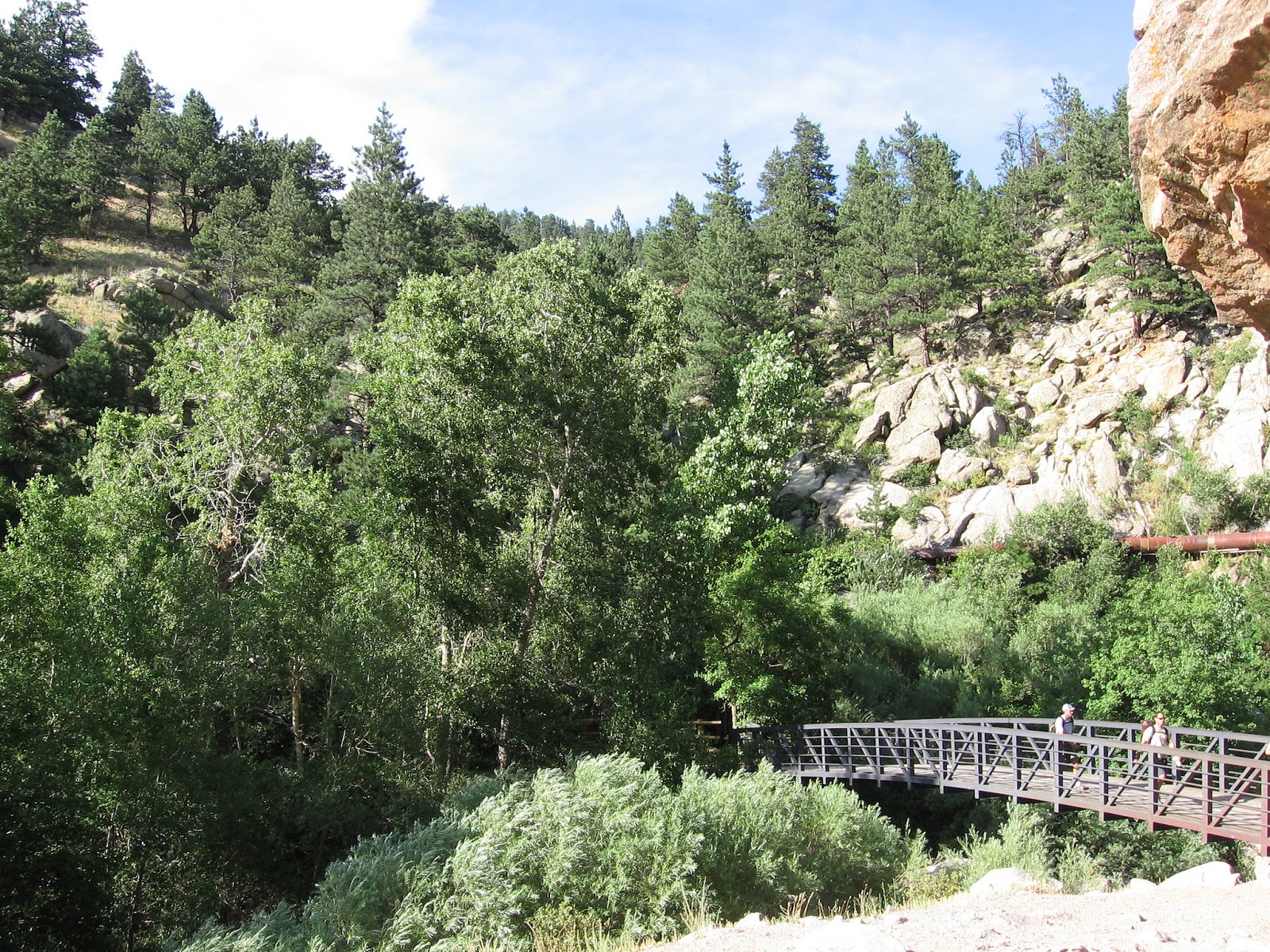
Hiking near Boulder, Colorado

I was recently diagnosed with Lyme Disease.  Part of the effect of the antibiotic treatment includes the release of endotoxins by the microbes as they begin to die: Those microbes and endotoxins, in addition to making me hurt everywhere all the time, cause hormone imbalances that cause severe mood swings.  


Sadness and Frustration 

To be clear, the swings of sadness and frustration I am feeling are probably more to do with my lack of physical energy, which has caused me to be homebound for the last few weeks in a dirty home, as I have not had the time or energy to do much of the cleaning I normally like to do.  The depression, itself, however, goes deeper and causes irrational feelings of hopelessness, anxiety, and worthlessness, or even hours at a time of complete apathy and emotional numbness.  The feelings, or lack of feeling, comes and goes in waves, luckily, so I "snap out of it" as the day goes on and feel like myself in the late afternoon or early evening - before I take another antibiotic, and it starts all over, again.


Fear

Native Cactus near Boulder, Colorado
One thing that is persistent, however, is my fear that I will never again be able to enjoy the outdoors like I once did for fear of being reinfected. Once I take my morning antibiotic, I know that for the next several hours I am going to experience the physical and emotional effects of the microbes and endotoxins, and that my fear is going to grow over the course of the day until my body can catch up on eliminating the toxins causing my reactions. Although there isn't a whole lot more I can do to quickly eradicate the microbes and their toxins, I can combat some of that daily emotional upheaval with aromatherapy via my oil burner. Specifically, I think I have perfected a blend that reminds me of one of my most favorite places in the universe, the wooded mountain trails near Boulder, Colorado.


Aromatherapy Outdoor Blend: Rocky Mountain Trail


I use an oil burner that has been saturated with my own Thieves Blend over the course of several years, which adds a hint of cinnamon and clove to all of my aromatherapy recipes (and helps cleanse the air). If you do not have a Thieves Blend, simply add a one drop each of cinnamon, rosemary, clove, and lemon to this recipe.

5 drops Cedarwood Oil
3 drops Pine Needle
3 drops Eucalyptus
2 drops Jasmine

This particular recipe utilizes all three, top, middle, and base notes for a great balance. Because it is an oil burning recipe only (not meant for skin contact or ingestion), there are few risks for side effects.  It simply helps me relax by reminding me of a place and time that made me happy.

Medical Care 

Boulder, Colorado, 2007
If you are new to aromatherapy, please be sure to research the effects of any oil that's unfamiliar to you - just in case.  Remember to wear gloves, if you aren't using pipettes, to be sure there is no skin contact with any of your aromatherapy oils to prevent irritation.  Of course, you should also talk to your doctor, LLMD, integrated medical practitioner, or herbalsit if you have any questions or concerns about your Lyme treatment symptoms or using aromatherapy, especially if the symptoms seem to be worse than you can handle. Although aromatherapy is a great addition to your care, it is definitely no substitute.


Be well,
Amy


Copyright Amy Lynn Hess.  Please contact the author for permission to republish.

Wednesday, July 26, 2017

How to Pray the Rosary: Quick Guide

The Rosary is a prayerful meditation for peace, and in the words of Pope John Paul II, the goal of praying the Rosary is "the improvement of the living conditions of all."  


In a world where our brothers and sisters struggle daily with poverty, hunger, inequality, hatefulness, disease, and oppression, the Rosary can act as a daily reminder to come together to help one another overcome those conditions - with the help of God.

Instructions for praying the Rosary are followed by a listing of the daily Mysteries and biblical references to each of those Mysteries.  Remember that "a" following a passage's citation is a call to focus on the first part of a passage, and "b" is a call to focus on the end of a passage.

The Prayers of the Rosary


 Begin by making the Sign of the Cross.
 Pray the "Apostle's Creed."
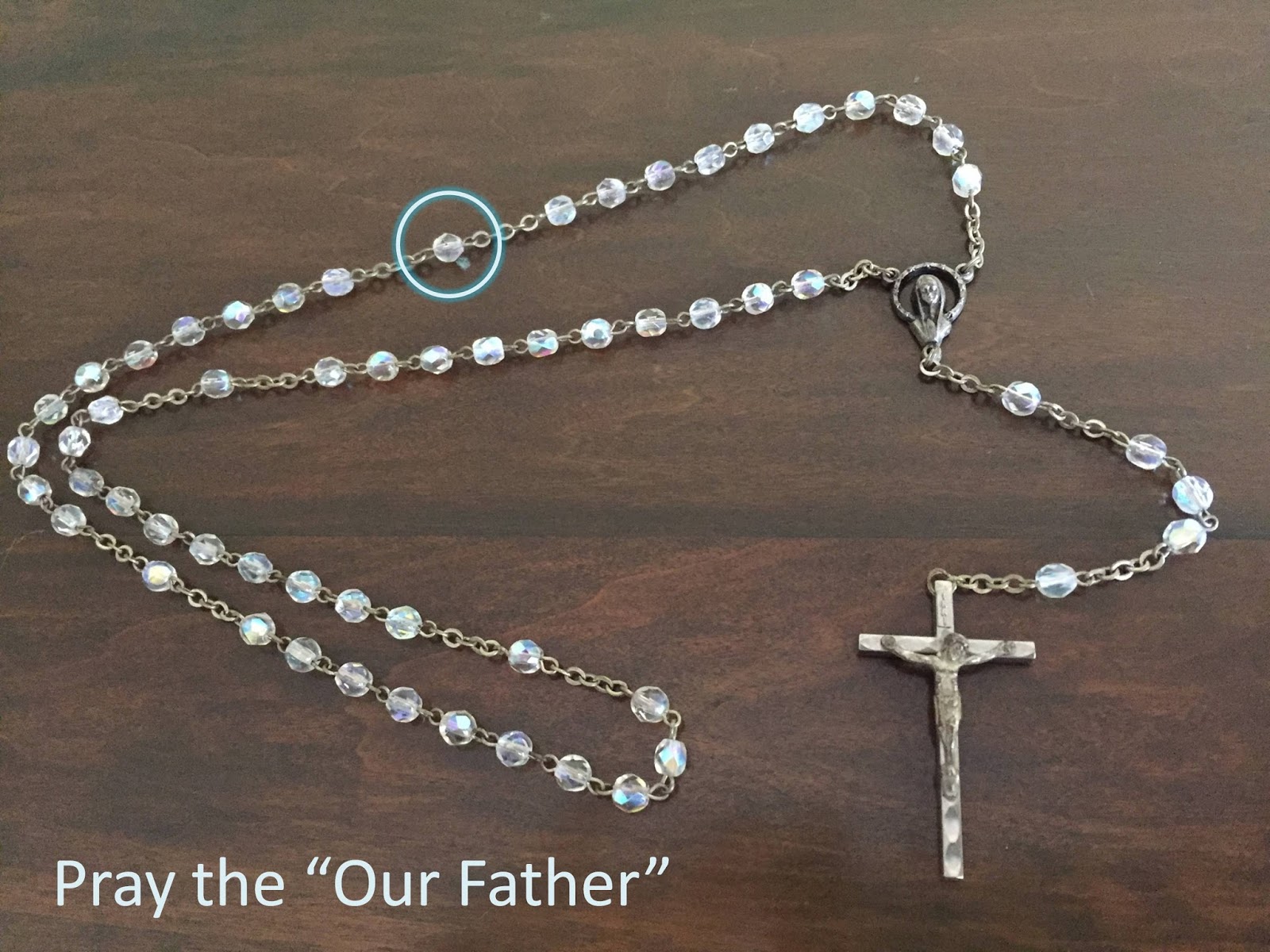
 Pray the "Our Father."
 Pray one "Hail Mary" per each of the three beads.
 Pray the "Glory Be" in the space between the three close beads and the next solitary bead.
Announce the First Mystery.  The types of Mysteries are the Joyful (Sundays during Advent, Mondays and Saturdays), Sorrowful (Sundays during Lent, Tuesdays and Fridays), Glorious (Wednesdays and Sundays), and Luminous (Thursdays). More information appears at the end of this post, and the hyperlinks direct you to follow-along videos.
 Pray the "Our Father" on the next solitary bead.
 While meditating on the First Mystery, pray one "Hail Mary" per the next 10 beads.  This is called a "decade."
 In the space following the decade, pray the "Glory Be" . . .
 and the "Fatima Prayer."

“Oh my Jesus forgive us our sins save us from the fires of hell, lead all souls to heaven especially those most in need of thy mercy.”
 Announce the Second Mystery . . .
 and pray the "Our Father."
 Repeat that pattern through each decade.
End the Rosary by praying the "Hail Holy Queen."


About the Mysteries

If you are unfamiliar with any of the Mysteries, please use the referenced passages to explore their meanings. 


Monday, July 3, 2017

Mizeria: A Dairy Free Cucumber Salad Recipe

Polish Mizeria, Cucumber Salad, Made Gluten and Dairy Free!

Traditionally, mizeria is made with sour cream.  However, it's just as tasty made with the tangy zip of Miracle Whip, now also made as "Gold Standard Recipe" with no high fructose corn syrup! 


That makes my mizeria okay for folks who are gluten free, dairy free, or following a low FODMAP diet!  In other words, thanks to the folks at Kraft who brought back the original Miracle Whip recipe, mizeria is back on my menu!  


Mizeria, or Polish Cucumber Salad


I generally make enough for one or two meals serving one or two people.  That is, I don't make a whole lot at once, otherwise I eat it all at once.  You can double or triple the recipe as you see fit.
  • 1 large or 2 small cucumbers
  • 1 green onion
  • 2 tsp Fresh or dried dill
  • Salt and pepper to taste
  • 2 tbs Miracle Whip Gold Standard Recipe
  • 2 - 3 large radishes

  1. First clean, peel (or don't peel), and thinly slice your cucumber and add it to a mixing bowl.
  2. Clean, peel, and thinly slice your green onion and add it to the cucumber slices.
  3. Add 1 tsp dill, salt and pepper, and Miracle Whip to the mixing bowl.
  4. The fun bit: Wash your hands, then toss your salad until everything is evenly coated with the Miracle Whip. Wash your hands, again.
  5. Serve fresh or chilled with additional dill and radish slices on the side. 

Note: For purists, you can add a bit of vinegar to the recipe, but Miracle Whip already contains a bit of vinegar, so I skip it.

Looking for additional recipes that are easy on the stomach?  Try


Copyright Amy Lynn Hess. Feel free to share, but please contact the author for permission to republish.


Thursday, April 20, 2017

Sample Narrative Essay: Spelling Bees and Fig Leaves

A few weeks ago I came home from work and did not, like I normally do, immediately change my clothes and spend the rest of the afternoon in my pajamas and furry, plaid, bathrobe.  I was still in my work clothes, a pair of leggings and a soft, blue tunic, when my husband got home from work.

"You wore that to work?" he asked.

"Yes.  Do you like it?" I asked in return.

"It's a maternity shirt, I think," he said carefully.

Let it be known that I am not nor ever have been nor plan to be in a state of M-A-T-E-R-N-I-T-Y, but it was soft and blue and only $2.99 at the local Goodwill store.

A few weeks before that incident, a student announced to the me and the rest of the class that she knew I would be in class that day because she saw me walking across campus, and she knew without a doubt it was me walking across campus because of my plaid, corduroy, wide-leg trousers.

"No one else wears pants like that, anymore," she said.

I have heard, too, that I am a very approachable professor because I "don't dress like the other female English professors."  I dress like the professors who teach video game classes, agriculture and animal husbandry, or maybe shop classes. I have a multitude of examples, so suffice it to say, I have a very complicated relationship with my clothes: But this is not a new thing, I realized earlier this week.  The root of my problem taps as deep as a first grade spelling bee. "A-S-S," I spelled out for a student earlier this week who almost used the word "ass" but did not want to swear in class.  "A-S-S," I spelled, and as I did so I was transported immediately back to the St. Clair County Regional Spelling Bee, 1981.

I was in the first grade, and I wanted to be anywhere but at that spelling bee.  It wasn't that I wasn't proud of being the best first grade speller in the entire elementary school, but that my mother had forced me to wear the most dreadful clothing I had ever seen in my life.  It was ugly, outdated, scratchy, and utterly embarrassing.  The dress was pink, faded-flower pink with a smoky yellow tinge coating its pleated overlay; a nicotine tinge.  It had a frayed satin belt U-N-T-I-E-D in what was supposed to be a bow behind my back.  It was something once loved by someone else years and years prior, and it looked to have been worn for a semi-formal occasion.  The tights were white, yet too small, and the crotch sagged, chaffing the insides of my thighs.  The shoes, however, were casual, too big, and they were burgundy with B-O-O-G-E-R-Y, rubber soles. My hair was down, which meant it was snarly and stuck under my armpits.  An unhappier child you have never seen, so to top off the look were streaks running from eyes to chin where the tears had cut through the tomboy dust on my cheeks.

I had to sit on stage like that, in front of people who were going to judge me and my hand-me-down, mismatched clothes. The other kids looked nice . . . until they looked at me and made faces, however.  None of them would talk to me.  They laughed and pointed.  It was mortifying, devastating, and demoralizing.  I sat in the back row and hoped the adjudicators would never call my name. But they did. And the word was "as." Could they have made it any easier?  Did they feel bad for me or something?

"Use that in a sentence, please," I said to buy more time as I considered my options.  I wanted to sink into the stage floor, but that was not an option. I could feel hot, angry, frustrated tears welling up behind my eyes.  My cheeks were steaming, but letting those tears pepper the stage floor was not an option.

"She ran as quickly as a cheetah," the adjudicator read from the card. I wanted to run away as quickly as a cheetah, but that was not an option, either.

I thought of the one option that would allow me to go home early, though. "As," I said. I tried to conjure enough saliva to do what needed to be done next.

"A-S-S," I spelled.

A few people laughed.  I was off the stage before they even had to ask me to leave the stage. We were in the car shortly after that, and no one spoke.

As I recall, that dress and those shoes never saw the light of day, again.  I never competed in a spelling bee, again, either. Was there a better option?  Did I really need to throw the game to save face?  In the moment, I sure as H-E-Double-Hockey-Sticks thought I did.  But would I do it the same today?  Probably not.  I'd probably note the people laughing at the way I dressed and out spell them all, anyway, paying particular attention to enunciate any bad words that appeared within another word while looking at the laughers.

“C-L-A-T-T-E-R-F-A-R-T.”
F-U-K-S-H-E-E-T.”
H-U-M-P-E-N-S-C-R-U-M-P.”
J-E-R-K-I-N-H-E-A-D.”
“P-A-K-A-P-O-O.”

But I'd still feel bad about them laughing at me, and my complicated relationship with my clothes would get ever still more complicated.  It's human nature, I think, and until we all get back to the fig leaf or go naked, it's a complication that will persist.


Want to read more about complicated relationships with my clothes? Try


Project 333 Math: Making my Own Rules
Stitch Fix Review: Styling at 40


Want to read more narrative essay examples? Try


Sample Narrative Essay - Pig
Sample Narrative Essay - Holding Hands


Copyright Amy Lynn Hess.  Please contact the author for permission to republish.


Monday, January 23, 2017

What's a Poster Presentation?

A poster presentation is generally a quick, visual and verbal presentation that uses a poster as a visual aid. While the visual aid, the poster, can usually stand alone to explain the presenter's research using text and images, a short speech will help answer any additional questions a viewer may have.  


What's the Purpose of a Poster Presentation

Poster presentations allow for viewers, generally conference attendees, to gather as much information about current research in their fields as possible in a short amount of time.  This method of "quick introduction" can help spur additional research, partnerships, sponsorships, and scholarship.

How to Plan the Poster Part of a Poster Presentation

A poster should introduce the most pertinent parts of a scholar's research.  Remember, it should be able to stand alone as an explanation of a scholar's current research or project.  The poster should be designed with viewers in mind, viewers who will be standing 4 - 6 feet from the poster. For example, all fonts should be large enough to be easy-to-read, and images should be clearly labelled, crisp, and interesting in color or texture.  The poster should include white space, and information (within the text and as part of images) should be grammatically correct and placed in a logical order. Headings for each section of the poster are also helpful for viewers.


A poster should include, at minimum


  • A Descriptive Title and Contact Information
  • The Research Question, Project's Purpose, or Hypothesis
  • An Explanation of Research Methods, Materials, Approaches, and Process
  • The Informative Results of the Investigation


Additional information might include an overview, summary, abstract, bibliography, a list of partners or assistants, or additional research and project information necessary for a viewer's understanding.

How to Plan the Presentation Part of a Poster Presentation

The speech portion of the poster presentation should be short and to the point.  The time limit for such a speech in a conference setting is generally between one and two minutes.  More time is available when the posters are part of a more limited or specialized event (like a class project). Interested parties, like conference attendees or a professor, may wish to ask additional questions about the scholar's research or project: Anticipating those questions and preparing articulate answers shows professionalism.

A short speech should include an attention-getter, which in this case could be asking a viewer if he or she would like to know more about the research. From there, the scholar can present his or her thesis before transitioning into each main idea presented on the poster, giving examples or pointing out evidence in an appropriate order.  The scholar may wish to reiterate the thesis in the conclusion of the speech or use an additional conclusion technique for impact. Furthermore, the speaker should enunciate and speak with an appropriate volume and tone.

Summary

A poster presentation is both a visual and audible presentation of a scholar's current research or project.  Both the poster and the speech must be prepared with unity, coherence, and clarity, plus appropriate formatting and engaging content. When designing a poster presentation, a scholar must remember to be concise: Poster presentations should be pleasant and interesting for viewers.


Copyright Amy Lynn Hess. Please contact the author for permission to republish.


Friday, November 4, 2016

Playwriting and Screenwriting: Seven Script Starters

An empty chair sits on an otherwise empty stage in an empty theater.
Theater by  Hernán Piñera.
Used with Creative Commons License

When playwrights and screenwriters develop new scripts, they must consider all of the elements of drama: plot, character, setting, dialogue, movement, and theme. New writers, those who are just learning the craft or writing in the genre for the first time, may need assistance pulling all the elements together to create a cohesive script. The following seven exercises can help new writers learn to synthesize their creative ideas.

Knock Knock Script Prompt

One quick prompt for getting started is based on the popular form of the knock-knock joke. This prompt helps writers make decisions by providing two built-in characters, a bit of conflict (one character wants to come in), and an inciting incident. The writers must provide, at minimum, characterization (names, actions, language, and motivations of each character), dialogue based on the characterization, rising action, and a resolution.  In doing this, a clear setting and theme may emerge, or writers can revise their exercises to include elements that are unclear or missing.

Comic Strip Script

The Comic Strip Script exercise, although difficult to enunciate, makes for an excellent exercise in writing stage directions.   The comic provides plot, character, setting, dialogue, movement, and theme. The writer must provide the complete script, sans images, in the appropriate screenwriting or playwriting format.  This requires clearly articulated stage directions to describe the actions, transitional actions, and actions of closure between panels. As an added lesson in Reader-Response Theory, writers in a workshop can compare interpretations of the given comic strip at the end of the exercise to demonstrate how differently people perceive the same work.

Swaperoo Script

This exercise requires some knowledge of famous characters and a bit of  playfulness. Writers will swap one character for another.  For example, a writer could write a scene from Hamlet that answers the question, "What if Xena were swapped for Hamlet?" or  "What if Kermit were swapped for Bob Cratchit?" That has already been done, but there are a multitude of additional options: Bugs Bunny for Mary Poppins, Tony Stark for Oedipus, Dexter for Snow White.   It's a great exercise for helping writers understand how each of the elements of drama must interact with one another to create a whole.  When a character is swapped, everything changes.

Collecting Dialogue

One very popular exercise is eavesdropping on unsuspecting others in order to "borrow" real dialogue. This is a great way to study the way people speak at a particular time and in a particular place.  What makes this ever more interesting, as I learned in a workshop with playwright Mac Wellman at Naropa University in 2006, is writing this dialogue as one long paragraph. The paragraph is then passed to another writer to bifurcate the lines, and passed to a third person to add stage directions.  With groups of four, the fourth writer can add a title, additional character and location descriptions, and format the final script.  By the time the short script makes it back to the original eavesdropper, the words may be unrecognizable, and therefore, eye opening.  

Insight and Theme

Writers can base scripts on real life.  One way to help writers write about their own lives is to ask them to write narrative essays about a time when they learned a valuable life lesson.  Most writers are familiar with how to write an essay, so it's a great way to get them thinking about insightful thesis statements.  Those thesis statements and the narrative sequence of events they tell in the body of their essays become the basis of their plays.  To add a step, ask writers to incorporate a narrative frame or first person narrator, much like in The Glass Menagerie when Tom breaks the fourth wall. In this exercise, theme and the idea of "the trustworthy narrator" are emphasized.

Design and Build

Designing a set helps emphasize
the importance of setting

Many beginning playwrights, especially those within English departments, have never studied theatre as an art form.  To get these new writers thinking specifically about setting, they should design a set for one of their own plays or one of a workshop or classmate's plays. These make for excellent presentations and can be as simple as 2D sketches of theoretical stage spaces, or as complex as 3D models with realistic budget projections on an existing stage or set. The same assignment can be used to emphasize characterization by asking writers to design costumes and make-up, planning for any required backstage changes.  Although these can be fun and enlightening assignments, especially important are justifications for each of their choices. 

Story Cubes

Generating characters and stories for script exercises doesn't have to be stressful. Writers can use Rory's Story Cubes (Amazon affiliate link) or other storytelling dice games to quickly generate a character traits and a story idea that has a beginning, middle, and end. Because it's quick and low stakes, it leaves writers more time to practice other steps in the writing process, like developing a plot that helps tell the story, creating dialogue that matches a character's traits, or revising for consistency in form or function.

When new writers are faced with writer's block or decision paralysis about their scripts, get them moving in the right direction by helping them get started.  These seven script starters can help those writers learn to synthesize and negotiate the elements of drama: plot, character, setting, dialogue, movement, and theme.

Copyright Amy Lynn Hess.  Please contact the author for permission to republish. 

Sunday, October 23, 2016

Using a Tahkli Spindle: Spinning Cotton from the Seed


Tahkli spindle and wooden bowl with three cotton seeds


I grew a bit of cotton in my home garden this year, and I've been creating punis to spin into two-ply cotton yarn. Today, however, before I run out of raw bolls, I decided to test the ease of spinning cotton from seed using my tahkli spindle. At first, I had beginner's luck, and spinning from one seed produced a little over a yard of single ply.  It was definitely beginner's luck, though.  On the second, third, and fourth seeds, I had to spin through a lot of challenges.

USING THE TAKLI TO SPIN FROM SEED 


  • The first step was to loosen the cotton from the seed.  I simply used my fingers to loosen the fibers all around the seed without detaching the fibers.  
  • Next, I used the hook at the end of the spindle and placed it into the loosened cotton to start the process.  I spin clockwise.
  • Just as with any other spinning, I spun the tahkli with my right hand while pinching the loose cotton with my left hand, and released the pinch while pulling my left hand up the fibers to allow the twist to run up the fiber.  
  • The extra step involved with spinning from the seed was rotating the seed so the twist evenly caught all of the fibers from around the seed in order.  


When it worked, this process produced a "fuzzier" single ply than when I used cotton that had been made into punis on my cotton carders.

CHALLENGES SPINNING FROM SEED

Cotton on the plant, unprocessed cotton, and cotton seeds with fiber removed

The first challenge was that this required more twist and a lighter draft than spinning a puni.  With the exception of my first attempt, there were several breaks that had to be reattached as I completed each seed from each boll.  Furthermore, the extra step of rotating the seed as I drafted was exceptionally important: The fibers had to come from the seed in order, around, not from around the other side of the seed.  If I rotated the seed to quickly or too slowly, or at an additional angle, the fibers stopped moving because they became wrapped and twisted around the seed.  Subsequently, tugging the seed to release it broke the work, and paying attention to the seed instead of to my work made me lose focus.  The thread I created is definitely uneven and very thin in some places.  I do worry that this will cause breaks when I ply it.

CONCLUSION: MAKE PUNIS 

My experiment yielded uneven results.  Although I can and did have some success skipping the carding process, it was more difficult to attain quality work without breaks than it is when I diligently comb my cotton into punis.  Perhaps with practice I can find my rhythm and consistently spin from cotton seeds, but in the meantime, I will make punis.


Want to read more about arts and crafts? Try

Which Weaving Loom is Best for Beginners?
Top 10 Crochet Gift Ideas for Grown Ups
Product Review: All-n-One Knitting Loom


Copyright Amy Lynn Hess.  Please contact the author for permission to republish.


Tuesday, October 11, 2016

How to Identify a Sonnet: Italian and English Sonnet Forms

Which type of sonnet do you prefer?
Sonnets have been around since sometime within the 12th Century, which means they've been around for about 1000 years, give or take a few centuries and decades. That's a long, long time.

The most popular sonnets are generally known for their rhyming 14-line forms, each line having been written in iambic pentameter, or the rhythm of a heartbeat in one breath: ta TUM ta TUM ta TUM ta TUM ta TUM.

Although there are several forms of sonnets, as you can imagine of a form that has had a 1000 year lifespan, the most popular sonnets are usually one of two types: Italian, otherwise called Petrarchan, or English, otherwise called Shakespearean.  Understanding the external forms of these poems can help inform readers about the internal forms.

Italian or Petrarchan Sonnet

External Form

The Italian sonnet, named after the writer Petrarch, is divided into an octave (a stanza of 8 lines) and a sestet (a stanza of 6 lines).  The rhyme pattern can vary, but the pattern is often abbaabba and cdecde, cdcdcd, or cdccdc.  Interestingly, however, originals in Italian that are translated to English demonstrate adjustments to the rhyme scheme in order to maintain meaning.  In other words, the meaning of the poem is more important than the rhyme scheme.

Internal Form

The internal form of an Italian sonnet relies on, just like the external form, a division between the octave and the sestet.  The octave often presents a difficult or vexing situation that is resolved in the sestet. There is often a shift in the tone of the poem or the in the attitude of the speaker, as the ideas shift from problem to solution.

Example

This example from Edna St. Vincent Millay (1892 - 1950), a 20th Century American writer from Maine, follows the Italian rhyme scheme and internal form.  Notice the shift in the speaker's attitude in the sestet.

I Will Put Chaos into Fourteen Lines

I will put Chaos into fourteen lines (a)
And keep him there; and let him thence escape (b)
If he be lucky; let him twist, and ape (b)
Flood, fire, and demon — his adroit designs (a)
Will strain to nothing in the strict confines (a)
Of this sweet Order, where, in pious rape, (b)
I hold his essence and amorphous shape, (b)
Till he with Order mingles and combines. (a)
Past are the hours, the years, of our duress, (c)
His arrogance, our awful servitude: (d)
I have him. He is nothing more nor less (c)
Than something simple not yet understood; (d)
I shall not even force him to confess; (c)
Or answer. I will only make him good. (d)


English or Shakespearean Sonnet

External Form

The English sonnet is most often divided into three quatrains (3 stanzas of 4 lines each) followed by a couplet (2 rhyming lines). This rhyme scheme is easier for writers in English to follow than an Italian sonnet simply because English has fewer rhyming words than Italian.

Internal Form

Whereas the shift in attitude or meaning takes place between the octave and the sestet in an Italian sonnet, the shift in an English sonnet often occurs with the break between the final quatrain and the couplet.

Example

This example from "Visions" by Francesco Petrarch (1304 -1374) has been translated into English by the English writer of The Faerie Queene, Edmund Spenser (1552 - 1599).  This translation is written in Spenser's typically archaic style, using Middle English spelling and pronunciation. Although originally written in Italian, in translation it follows the English  rhyme scheme. Readers can look for a shift in meaning within the last two lines of the poem, as the ideas shift from the observations of the speaker to the speaker's insight about the situation.

Being one day at my window all alone, (a)
So manie strange things happened me to see, (b)
As much as it grieveth me to thinke thereon. (a)
At my right hand a hynde appear’d to mee, (b)
So faire as mote the greatest god delite; (c)
Two eager dogs did her pursue in chace. (d)
Of which the one was blacke, the other white: (c)
With deadly force so in their cruell race (d)
They pincht the haunches of that gentle beast, (e)
That at the last, and in short time, I spide, (f)
Under a rocke, where she alas, opprest, (e)
Fell to the ground, and there untimely dide. (f)
Cruell death vanquishing so noble beautie (g)
Oft makes me wayle so hard a desire. (g)


In order to better understand poems, it is necessary to be able to identify forms, both external and internal.  An external form can quickly inform a reader about specific shifts in meaning that he or she can expect to find within the internal structure of the poem.  In this case, when readers know they are reading an Italian sonnet, they can look for shifts in attitude or a solution to the initial problem within the last six lines of the poem.  Likewise, when readers know they are reading English sonnets, those readers can look for shifts in meaning in the last two lines.  The form can always help the reader determine the function.

Want to read more about poetry and literature?  Try

Denotative and Connotative Meaning in the Poetry of Denise Levertov
Diagramming Mina Loy's "Letters of the Unliving" as a Method for Close Reading
The Shoe as Image in the Poetry of Amy Lowell and Charles Simic


Copyright Amy Lynn Hess.  Please contact the author for permission to republish.

Friday, September 2, 2016

How to Organize or Outline an Argumentative Speech or Essay

Creating order helps your reader follow your thoughts.

When writing an argumentative speech or essay, a writer should choose a logical order for the paragraphs and the supporting details within those paragraphs.  Two common ways to arrange the information in argumentative or persuasive speeches and essays are "problem-solution" and "refutation," which is sometimes called "point and counter-point."  The emphasis in this type of speech or paper is for the writer to support his or her reasons in support of the thesis claim or position.


Organizing an Argumentative or Persuasive Speech or Essay


Problem-Solution 

In a problem-solution type speech or paper, the writer argues there is a problem, and the writer follows an explanation of that problem with an explanation of the solution the writer believes is the best solution for that problem. Included within the explanation of the solution are the writer's logical reasons why that solution is better than other solutions.  Those reasons are supported by evidence.  A simplistic outline for this type of paper may look like the following:


  • Introduction with thesis or enthymeme
  • Presentation of the problem
  • Explanation of the currently proposed solutions to the problem
  • Statement of the best solution
  • Reasons and evidence in support of proposed solution 
  • Conclusion

Depending on the scope of the topic (how complicated it may be), each of these main sections of the paper may be one paragraph long, or each section may be several paragraphs long.


Refutation or Point & Counter-Point

Another type of argumentative organizational strategy is by refutation.  In this type of paper the writer investigates multiple perspectives related to an issue (a complicated problem that has no one right answer).  After carefully researching each perspective, the writer then chooses to support one perspective and explains his or her reasons for that decision. The writer briefly presents an opposing view, then emphasizes his or her own view while refuting the opposing view.  In other words, the writer presents a counter-point.  The goal is to present both (or multiple) perspectives while clearly indicating a position that supports one of those perspectives over any other.  Again, this type of paper must include an explanation of the issue, a review of the evidence available, the writer's reasons in support of one perspective, and evidence to support the writer's reasons.


  • Introduction with thesis or enthymeme
  • Explanation of the issue
  • Reasons in support of one perspective over others
  • Evidence in support of each reason
  • Conclusion


Five Additional Hints and Tips for Organizing Argumentative or Persuasive Speeches and Essays


  1. Keep in mind the difference between persuasion and argumentation.  Be sure you are meeting the given assignment's requirements, which may be related to that difference.  
  2. Choose an issue or problem that is of interest to you because you must spend time researching multiple perspectives related to that issue or problem.  You don't want to lose interest before you even begin writing your paper!
  3. Include expert evidence when writing about a problem or issue that is contentious: Expert evidence is more likely than other types of evidence to convince a skeptical audience or readers who hold opposing views.
  4. No matter which organizational structure you choose, you must include all the parts of an argument in your speech or paper: issue, reasons, and evidence.
  5. Use transitional words to indicate your organizational strategy to your audience. It will help them follow your train of thought.


Summary

The most important thing to remember is to choose an organizational pattern for your speech or essay and stick to it while clearly articulating and supporting your own claim or position.  Remember, an essay is the writer's take on a nonfiction topic or idea.  When properly researched and supported with evidence, your reasons for your claim or position should take center stage in this type of speech or essay.


Copyright Amy Lynn Hess.  Please contact the author for permission to republish.

Friday, August 19, 2016

On Teaching the Use of Gender Neutral Pronouns

A Sample of Gendered and Gender Neutral (Ungendered) Pronouns: See More

Opportunities to Introduce Ungendered or Gender Neutral Pronouns

Because  I teach freshman composition, I often do not have the opportunity to teach topics that stretch beyond Standard English as it's used in essays about general topics.  However, every so often the opportunity to "freestyle" does present itself, and in those situations, I like to be prepared to add needed impromptu lessons to my course.

For example, I recently had a student who was struggling with how to divide her short essay into logical paragraphs.  Although I do not generally teach the use of APA headings and subheadings in freshman composition, I introduced the concept to her to help her organize her essay.

In much the same way, I anticipate that I may someday need to introduce students to the proper use of gender neutral pronouns.  I do not generally teach pronouns and antecedents in composition courses, just as I do not generally teach APA headings and subheadings, but if a student is struggling with how to refer to gender, and I believe learning the use of gender neutral pronouns may ease that student's suffering, I want to be prepared to introduce options.

Gender Neutral Pronouns and APA

Gender Diversity Topics

The Publication Manual of the American Psychological Association (APA) reminds us that when writing in the context of gender diversity, it is expected of writers, and respectful to subjects (the antecedents of the pronouns), to use gender neutral pronouns to refer back to individuals who prefer gender neutral pronouns.  When in doubt, they also advise writers avoid the use of pronouns altogether (2010, p. 72-73).  Furthermore, APA advises the use of the singular "they" if necessary and if in the context of gender diversity, regardless of Standard English usage.

On the other hand, writers must also be sure to use gendered pronouns when they refer to subjects who prefer gendered pronouns.  Hillary Clinton and Caster Semenya should both be referred to as "she," for example, and Caitlyn (formerly Bruce) Jenner should be referred to as "she," as well. Using the male or ungendered pronouns to refer to any of those example subjects might be interpreted as aggression or hostility toward those subjects.

General Topics

The APA Style Blog (Lee, 2015) gives the following advice for writing in Standard English about general topics versus topics in the context of gender diversity:

APA recommends several alternatives to the general singular they, including the following:
  • Make the sentence plural: "Participants indicated their preferences."
  • Rewrite the sentence to replace the pronoun with an article (a, an, or the): "The participant indicated a preference."
  • Rewrite the sentence to drop the pronoun: "The participant indicated preferences."
  • Combine both singular pronouns (he or she, she or he, his or her, her or his, etc.): "The participant indicated his or her preferences." (However, avoid overusing this strategy, as it can become cumbersome upon many repetitions.)

These alternatives are also available for you to use when writing in the context of gender diversity if you would prefer them or if you are unsure of the appropriate pronoun to use.

Other alternatives to the singular they are not recommended:
  • Avoid combination constructions like s/he, (s)he, and he/she because they can look awkward and distracting to the reader.
  • Do not use either he or she alone to refer to a generic individual—"use of either pronoun unavoidably suggests that specific gender to the reader" (PM § 3.12).
  • Do not alternate between he and she (e.g., using he in one sentence and she in the next), as this can also become confusing and distracting to the reader.

Practical Examples

As a matter of being prepared, there are several hypothetical assignment scenarios I can anticipate that may require teaching ungendered pronoun use.
  • Acceptance of “ey” in a narrative essay or short story about a real person who prefers “ey.”
  • Acceptance of singular “they” in an essay about restroom policies using singular “they” to refer to individuals who refer to themselves as "they."
  • Acceptance of “xe” to refer to the writer of an article used as source content because the article writer refers to xemself as such. 
  • Acceptance of "she," or likewise "he," to refer to individuals who prefer to be recognized as her or his gender in efforts to avoid being construed as an aggressive or hostile writer.
  • Acceptance of and encouragement to use gender neutral pronouns to refer to classmates and group members who may prefer gender neutral pronouns.
Whether the need to teach ungendered pronouns comes up in my classroom in the next few days, months, or even years, I find it best to stay prepared to introduce students to the ways in which they can maintain their own integrity as writers, and the integrity of others, no matter the rhetorical situation.


References

American Psychological Association. (2010). Publication manual of the American Psychological Association. Washington, DC: American Psychological Association.

Lee, C. (2015). The use of singular "they" in APA style. [Web log post]. Retrieved from http://blog.apastyle.org/apastyle/bias-free-language/


Read more . . .


on the LGBT Resource Center Web site through the University of Wisconsin-Milwaukee.


Copyright Amy Lynn Hess.  Please contact the author for permission to republish.


Using ChatGPT for Essays in English Composition Classes

The best essays are written by people for people. "Corona Typewriter" image courtesy of the author ChatGPT and other AI language g...